Urim and Thummim
Something the high priest carried over his heart to get a yes or no from God — never described, and lost after the exile.
The Urim and Thummim are put into the high priest's breastpiece, and Moses is never told what they are; the text assumes he knows. What they did is clearer than what they were. A leader brings a question to the priest and receives an answer, and the questions recorded are the kind a lot can settle — go up or not, this one or that one. The Greek text of 1 Samuel 14 preserves the fullest example: Saul asks for Urim if the guilt lies with him and Jonathan, Thummim if it lies with the people. They could also stay silent, which is what they do for Saul at the end. After the exile nobody has them. Ezra and Nehemiah both record priests whose descent could not be proved being barred from the holy food until a priest with Urim and Thummim could settle it, and no such priest ever appears.
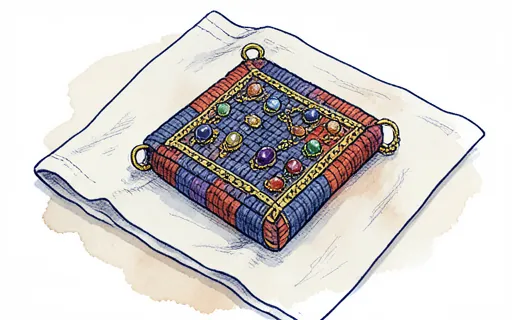
Disputed. Scripture never describes them. The names are usually taken as "lights and perfections", but that is a guess from the Hebrew. Two marked stones drawn as lots is the most common reconstruction, and it rests mainly on how they are used.
Where it appears
See also
- Ephod — The breastpiece that held them was fixed to the ephod
- Casting lots — Both are lots — the priest's kind, and everyone's