1 Corinthians
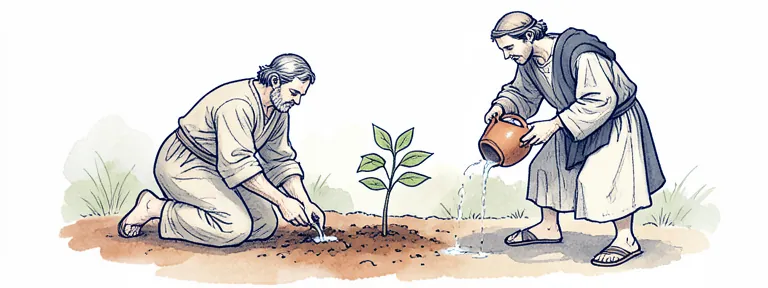
Paul answers a gifted and quarrelsome church’s questions about leaders, sex, food, worship and the resurrection, and measures every answer by the cross and by love.
Overview
Paul founded the church at Corinth and stayed a year and a half (Acts 18). A few years later, while working in Ephesus, he heard from “Chloe’s household” that the believers had split into factions (1:11), some saying “I follow Paul,” others “I follow Apollos” (1:12). He had also received a letter from the church with questions. 1 Corinthians answers both, first the reports and then the letter, point by point.
The issues are practical: a man living with his father’s wife, believers suing one another, whether to marry, whether to eat meat sacrificed to idols, head coverings, disorder at the Lord’s Supper, speaking in tongues and doubts about the resurrection of the dead. Paul answers each from the same centre, “Christ crucified” (1:23), and from love, which chapter 13 sets above every other gift. Chapter 15, with the oldest written list of those who saw the risen Jesus, closes the argument. “If Christ has not been raised, then our preaching is in vain and your faith also is in vain” (15:14).
Author and date
The letter is from Paul and “our brother Sosthenes” (1:1), and Paul adds the final greeting “with my own hand” (16:21). Scholars almost universally accept it as his.
Scholarly consensus
Paul wrote from Ephesus, where he planned to stay “until Pentecost” (16:8), during the long stay described in Acts 19. Stephanas, Fortunatus and Achaicus had just arrived from Corinth (16:17) and may have brought the church’s letter with them.
1 Corinthians was not Paul’s first letter to Corinth; he mentions an earlier one, now lost (5:9). A few scholars think the letter as we have it combines more than one. Some also regard 14:34–35 as a later addition; a group of manuscripts places these verses after 14:40. Most read the letter as a single whole.
Audience and setting
Corinth was a busy trading city on the isthmus joining mainland Greece to the Peloponnese, with a port on each sea. It was also a Roman colony, refounded by Julius Caesar in 44 BC, a century after its destruction. The church was mostly Gentile, with some Jewish members, and it mixed rich and poor. Its divisions ran along social lines as well as loyalties, most visibly at the Lord’s Supper, where “One is hungry, and another is drunken” (11:21).
Genre, and how to read it
The letter follows the order of the church’s concerns. After four chapters on the factions and two on reported scandals, Paul turns to “the things about which you wrote to me” (7:1), and each new topic opens with the same phrase, “Now concerning.” Several times he seems to quote the Corinthians’ own slogans before qualifying them, as in “We know that we all have knowledge” (8:1). Translations mark these differently, and readers do not always agree where a slogan ends and Paul’s reply begins.
- 7:1 the things you wrote
- 7:25 virgins
- 8:1 things sacrificed to idols
- 12:1 spiritual things
- 16:1 the collection
- 16:12 Apollos
Some instructions, on head coverings in chapter 11 and on women speaking in chapter 14, are read very differently: some churches treat them as local and temporary, others as lasting. Chapters 12–14 on spiritual gifts are central for Pentecostal and charismatic Christians. The words over the bread and cup (11:23–26) are the oldest written account of the Last Supper, and many traditions still speak them at communion.
He appeared
Paul passes on a list of those who saw the risen Jesus, that which I also received
(1 Corinthians 15:3), and most date his letter before any of the gospels. It names six, in order. Two of them, the five hundred and James, are told nowhere else, and the appearance to Peter is mentioned in Luke but never narrated. His list names no women, though in Matthew, Mark and John women are the first to see him.
Paul’s list, in his order
-
Cephas (Peter)
he appeared to Cephas
(1 Corinthians 15:5)has appeared to Simon!
(Luke 24:34)
-
The twelve
then to the twelve
(1 Corinthians 15:5)Jesus himself stood among them
(Luke 24:36)Jesus came and stood in the middle
(John 20:19)When they saw him, they bowed down to him
(Matthew 28:17)
-
Over five hundred at once
he appeared to over five hundred brothers at once
(1 Corinthians 15:6) told nowhere else -
James
Then he appeared to James
(1 Corinthians 15:7) told nowhere else -
All the apostles
then to all the apostles
(1 Corinthians 15:7)appearing to them over a period of forty days
(Acts 1:3)
-
Paul himself
he appeared to me also
(1 Corinthians 15:8)I am Jesus, whom you are persecuting
(Acts 9:5)
Told in the gospels, not in Paul’s list
-
Mary Magdalene
saw Jesus standing
(John 20:14)he appeared first to Mary Magdalene
(Mark 16:9)
-
The women from the tomb
Jesus met them
(Matthew 28:9)
-
Two on the road to Emmaus
Jesus himself came near, and went with them
(Luke 24:15)he was revealed in another form to two of them
(Mark 16:12)
-
Thomas with the others
Thomas was with them
(John 20:26)
-
Seven by the Sea of Galilee
revealed himself again to the disciples at the sea of Tiberias
(John 21:1)
Paul’s he appeared
is one Greek form, ōphthē, four times over; Luke uses the same form for Simon. Paul says the twelve
where the gospels, after Judas, say the eleven. The accounts in Mark 16:9–20 are from the longer ending, which the earliest manuscripts lack.
Outline
What Paul has heard (1–6)
- 1:1–1:9 Greeting and thanks — A church rich in speech and knowledge
- 1:10–4:21 Divisions — Factions, the wisdom of the cross, servants of God
- 5:1–6:20 Immorality and lawsuits — A case of incest, believers in court, the body as a temple
What they asked (7–16)
- 7:1–7:40 Marriage and singleness — Husbands and wives, divorce, the unmarried
- 8:1–11:1 Food offered to idols — Knowledge and love, Paul’s rights, a warning from Israel’s history
- 11:2–14:40 Worship — Head coverings, the Lord’s Supper, spiritual gifts, love, order
- 15:1–15:58 The resurrection — Christ raised as the first fruit, the resurrection body
- 16:1–16:24 The collection and farewells — Gifts for Jerusalem, travel plans, greetings
Key themes
- The cross
- “For the word of the cross is foolishness to those who are dying, but to us who are being saved it is the power of God” (1:18). Paul resolved “not to know anything among you except Jesus Christ and him crucified” (2:2).
- One body
- The church is one body with many members (12:12): “Now you are the body of Christ, and members individually” (12:27).
- Love
- Without love, even speaking “with the languages of men and of angels” is noise (13:1). Of faith, hope and love, “The greatest of these is love” (13:13).
- Freedom and conscience
- “Knowledge puffs up, but love builds up” (8:1). Paul insists on his rights and then sets them aside: “I have become all things to all men, that I may by all means save some” (9:22).
- Resurrection
- Paul hands on what he received, “that Christ died for our sins according to the Scriptures” (15:3), and calls the risen Christ “the first fruit of those who are asleep” (15:20).
At a glance
Most mentioned: Jesus Christ, Apollos, Paul, Simon Peter, Stephanas
Main places: Ephesus, Achaia, Asia, Corinth, Galatia
In the Almanac: Unleavened Bread, Firstfruits