1 Kings begins with David old and dying and Solomon securing the throne. Solomon asks God for “an understanding heart” (3:9), becomes famous for wisdom and wealth, and builds the temple in Jerusalem. His prayer at its dedication admits that even “heaven and the heaven of heavens can’t contain you” (8:27). But his many foreign wives turn his heart to other gods (11:4).
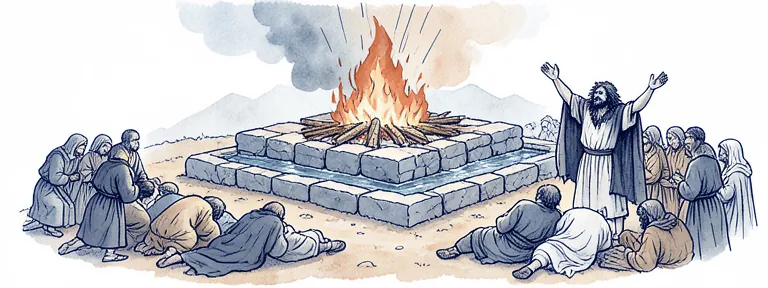
After his death the kingdom splits. Ten northern tribes follow Jeroboam, who sets up golden calves at Bethel and Dan; Judah stays with Solomon’s son Rehoboam. The book then alternates between the two kingdoms, reign by reign. It slows down for the prophet Elijah and his confrontation with King Ahab and Queen Jezebel: drought, the contest on Mount Carmel (18:21) and God’s “still small voice” at Horeb (19:12).
Author and date
1 and 2 Kings are one book in the Hebrew Bible. It does not name its author, but repeatedly refers readers to its sources, such as “the book of the chronicles of the kings of Israel” (14:19).
Traditional view
Jeremiah · 6th century BC
Jewish tradition (the Talmud) credits the prophet Jeremiah, whose book shares language with Kings and ends with the same account of Jerusalem’s fall.
Academic view
Late monarchy, revised in the exile · 7th–6th century BC
Most academic scholars see Kings as the last part of one continuous history running from Deuteronomy. On this view it was first composed under King Josiah and completed during the exile, using court annals, temple records and collections of prophetic stories.
Both views agree the book as we have it was finished after 561 BC, the last date it records (2 Kings 25:27).
Audience and setting
Kings was written for Israel in or after exile, asking why the kingdoms God gave them were lost. Its setting runs from about 970 to 850 BC in 1 Kings: Jerusalem and its temple, Samaria (Omri’s new northern capital), Mount Carmel and Horeb in the south.
Genre, and how to read it
Kings is history with a measuring rod. Each king is introduced with his dates and judged by whether he did “right” or “evil in Yahweh’s sight,” largely by one standard: worship of God alone at the temple. Northern kings are measured against Jeroboam’s calves, southern kings against David.
The reigns of the two kingdoms are interleaved, and each king’s accession is dated by the other kingdom’s reigns, so the timeline is intricate. Scholars reconstruct it with the help of Assyrian and Babylonian records. The Elijah and Elisha stories break the pattern: longer, stranger, full of miracles and focused on prophets rather than kings.
Two kingdoms, side by side
After Solomon the kingdom splits in two (1 Kings 12:16–20), and Kings tells both stories at once, dating each king by the other’s reign. Every reign gets a length and nearly every king a verdict. Laid side by side, the north has nineteen kings in about two hundred and forty years, all but one judged evil, and falls to Assyria. The south has twenty, keeps David’s line, swings between good and evil kings, and lasts about a hundred and thirty years longer.
“right in Yahweh’s eyes”
evil
mixed
no verdict
prophets, by the kings their books name
Kingdom
Kings
Right
Evil
Mixed or none
Years stated
Israel
19
0
17
2
242
Judah
20
8
11
1
394
Nine dynasties against one
Israel’s throne changes family by assassination again and again: Baasha kills Nadab (1 Kings 15:28), Zimri kills Elah and lasts seven days (16:10, 15), and Jehu wipes out Ahab’s house (2 Kings 10). Four of the last six kings are murdered (2 Kings 15:10, 14, 25, 30). Judah keeps David’s line throughout, broken only by Athaliah’s six years (2 Kings 11:3).
The prophets come in the crises
Elijah and Elisha stand against Ahab’s house. Amos, Hosea, Isaiah and Micah all name the same few reigns, from Uzziah and Jeroboam II to Hezekiah, the decades before Samaria falls. Jeremiah begins in Josiah’s thirteenth year and stays to the fall of Jerusalem (Jeremiah 1:2–3).
Two readings: why don’t the sums meet?
Reigns overlapped
Some kings shared the throne with a son, as Jotham did while his father had leprosy (2 Kings 15:5), and the two kingdoms may have counted a king’s first part-year differently. Read that way, the figures fit together and the gap closes.
Figures changed in copying
Numbers are the easiest thing to miscopy, and a few of these synchronisms are hard to fit on any scheme. On this reading some of the figures we have are not the ones first written.
Outline
Solomon (1–11)
1:1–2:46
Solomon succeeds David — A disputed succession and David’s last charge
3:1–4:34
Solomon’s wisdom — The dream at Gibeon and the two mothers
5:1–8:66
The temple — Built with Hiram of Tyre, and dedicated with Solomon’s prayer
9:1–11:43
Splendour and decline — The queen of Sheba, great wealth, a heart turned away
Two kingdoms (12–22)
12:1–14:31
The kingdom splits — Rehoboam’s folly and Jeroboam’s calves
15:1–16:34
Kings of Judah and Israel — Coups in the north, Omri builds Samaria, Ahab comes to the throne
17:1–19:21
Elijah — Drought, Carmel and the still small voice
20:1–22:53
Ahab’s end — Wars with Aram, Naboth’s vineyard, Micaiah’s warning
Key themes
Wisdom and its limits
Solomon’s wisdom is a gift (3:12), but it does not keep his heart from turning (11:4).
The temple
The temple is where God puts his name, yet Solomon’s prayer knows no house can contain him (8:27).
Division
The split of the kingdom is presented as judgement on Solomon’s idolatry (11:11), and Jeroboam’s calves become the north’s defining sin (12:28).
Prophet against king
Elijah calls Israel to stop wavering: “If Yahweh is God, follow him; but if Baal, then follow him” (18:21).