1 Peter
A letter of hope to scattered believers suffering for their faith, reminding them that they are God’s people, foreigners in the world, following a Christ who also suffered.
Overview
The letter is written to “the chosen ones who are living as foreigners in the Dispersion” across five provinces of Asia Minor (1:1). It begins with praise for a God who has given “a living hope through the resurrection of Jesus Christ from the dead” (1:3), and moves to what that hope means for people under pressure: be holy, love one another, grow like newborn babies and remember who you are. Believers are “a chosen race, a royal priesthood, a holy nation, a people for God’s own possession” (2:9), words first spoken to Israel at Sinai.
Much of the letter is about living among neighbours who slander you. It tells citizens, slaves, wives and husbands how to conduct themselves, urges good behaviour so that accusers “may see your good works and glorify God” (2:12), and tells readers to be ready to explain “the hope that is in you” (3:15). Suffering runs through the whole letter, framed by Christ’s example (2:21). It ends with a charge to elders, a warning about the devil prowling “like a roaring lion” (5:8), and greetings from “She who is in Babylon” and from Mark (5:13).
Author and date
The letter opens with “Peter, an apostle of Jesus Christ” (1:1) and says it was written “Through Silvanus” (5:12).
Traditional view
The early church accepted the letter as Peter’s without dispute, and 2 Peter refers back to it (2 Peter 3:1). The writer calls himself “a witness of the sufferings of Christ” (5:1). Silvanus, the Silas of Acts, may have served as secretary, which would account for the letter’s fluent Greek. Babylon is taken as a code name for Rome, where tradition says Peter died under Nero in the mid-60s.
Academic view
Many academic scholars see the letter as written in Peter’s name after his death, perhaps by a circle of his followers in Rome. They point to its polished Greek, its use of the Greek Old Testament and its closeness to Paul’s thought. They also note its use of Babylon as a name for Rome. Jewish writers adopted this name after AD 70, when Rome destroyed the temple as Babylon had done before.
Most on both sides read Babylon in 5:13 as a name for Rome, and connect the letter with the church there.
Audience and setting
The readers live in Pontus, Galatia, Cappadocia, Asia and Bithynia, in what is now northern and western Turkey. They seem to be mostly Gentile converts, who had once spent their time “doing the desire of the Gentiles” (4:3) and had inherited a “useless way of life handed down from your fathers” (1:18). Their suffering comes from social hostility and slander, and perhaps local persecution, which the letter calls a “fiery trial” (4:12).
Genre, and how to read it
Read it as a letter of encouragement shaped by the Old Testament. Its readers are addressed in the language of Israel: chosen, scattered, “foreigners and pilgrims” (2:11), a priesthood and a holy nation. The instructions to slaves, wives and husbands follow a pattern of household rules found also in Paul’s letters, adapted here for people living as a suspect minority.
3:18–22 is one of the most debated passages in the New Testament. It says Christ “went and preached to the spirits in prison” (3:19). Readers have taken it in three ways: as a proclamation of victory to fallen angels; as Christ preaching through Noah to the people of Noah’s day; or as a descent to the dead between his death and resurrection. That last reading is one source of the line in the Apostles’ Creed about his descent into hell.
Wives, husbands, children, slaves
Three letters set out how a Christian household should live, speaking to each member in turn. Ephesians and Colossians address the same six groups in the same order, often in the same words. But Ephesians gives husbands 150 Greek words where Colossians gives 10, and Colossians spends almost half its rules on slaves. 1 Peter speaks only to slaves, wives and husbands, slaves first, and gives them 129 words, more than twice what either of the others does.
Servants, be obedient to those who according to the flesh are your masters
Servants, obey in all things those who are your masters according to the flesh
Lengths are Greek words in the site’s text. Ephesians’ rules hang on the verse before them, subjecting yourselves to one another in the fear of Christ
(Ephesians 5:21): in the Greek its word to wives has no verb of its own and borrows that one. 1 Peter’s slaves may suffer at the hands of harsh masters, and it praises the one who endures pain, suffering unjustly
(1 Peter 2:19); it says nothing to masters at all.
Outline
- 1:1–1:2 Greeting — To the chosen foreigners of Asia Minor
- 1:3–2:10 A living hope and a new people — New birth, holiness, living stones
- 2:11–3:12 Living among the nations — Rulers, slaves, wives and husbands
- 3:13–4:19 Suffering for doing good — Christ’s example, the spirits in prison, the fiery trial
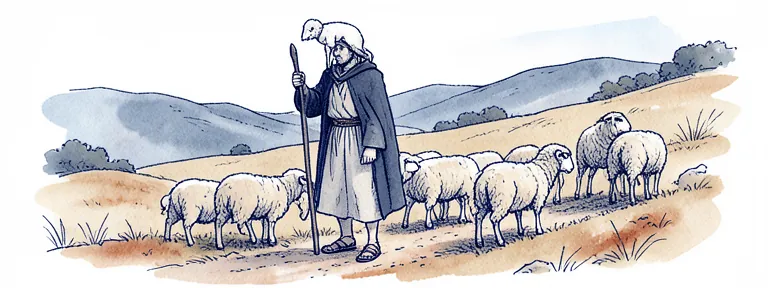
- 5:1–5:14 Elders, humility and greetings — Shepherd the flock, resist the devil, greetings from Babylon
Key themes
- Hope
- The letter opens with “a living hope” (1:3) and asks readers to “set your hope fully on the grace that will be brought to you at the revelation of Jesus Christ” (1:13).
- Suffering and glory
- Christ suffered and was glorified, and his followers share both: “if one of you suffers for being a Christian, let him not be ashamed” (4:16).
- Foreigners and pilgrims
- Believers are at home neither in their old way of life nor in a society that suspects them, and are urged to live “as foreigners and pilgrims” (2:11).
- God’s people
- “In the past, you were not a people, but now are God’s people” (2:10). Titles that belonged to Israel are given to Gentile believers (2:9).
At a glance
Most mentioned: Jesus Christ, Abraham, John Mark, Noah, Sarah
Main places: Asia, Babylon, Bithynia, Cappadocia, Galatia