2 Chronicles
The kings of Judah from Solomon to the exile, measured by their faithfulness to God and his temple, ending with Cyrus’s decree to go home.
Overview
2 Chronicles opens with Solomon, and most of his story is about building and dedicating the temple. Fire comes down from heaven, and God promises that if his people “humble themselves, pray, seek my face, and turn from their wicked ways,” he will hear and heal their land (7:14).
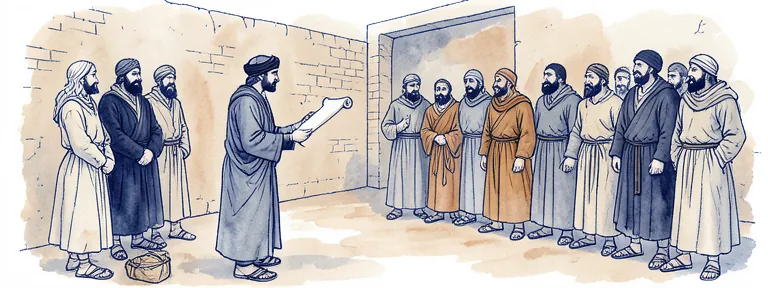
The rest follows the kings of Judah alone, from Rehoboam to Zedekiah. Reforming kings, above all Hezekiah and Josiah, get long and warm treatment; others are judged by whether they sought God. The book ends with the temple burned and the people exiled. Then, in its last two verses, Cyrus of Persia proclaims that God has charged him to rebuild the temple: “let him go up” (36:23). In the Hebrew Bible, where Chronicles comes last, these are the final words.
Author and date
2 Chronicles is the second half of one book with 1 Chronicles, and shares its questions of authorship.
Traditional view
Jewish tradition credits Ezra; the decree of Cyrus that ends 2 Chronicles also opens the book of Ezra (36:22).
Academic view
Most academic scholars attribute it to an unnamed author they call “the Chronicler,” writing in the late Persian or early Greek period, who reshaped Kings for a community centred on the rebuilt temple.
Audience and setting
Like 1 Chronicles, it speaks to the returned community in Judah, and its message is pointed: the exile came through unfaithfulness, and return is always possible for those who seek God.
Genre, and how to read it
Compare it with Kings. Chronicles includes episodes Kings does not, such as Manasseh’s repentance in Babylon (33:12), and stresses the prophets who warned each king. In its pattern, consequences come quickly: faithfulness brings help, pride brings trouble, repentance brings restoration.
Hezekiah’s great Passover (chapter 30), which invites the remnant of the northern tribes, is typical of its hope that all Israel, not only Judah, can return to worship together.
Told twice
Kings tells the story of Judah and of Israel side by side; Chronicles tells only Judah’s. Of the 1,535 verses in 1–2 Kings, 773 belong to Judah’s kings from Solomon on. 2 Chronicles gives them 820 of its 822. Where the two differ is the Chronicler’s choice: Jehoshaphat’s 10 verses become 102, and Abijah, Asa and Uzziah each get about three times as much; the last four kings shrink to a few verses each.
| Kings | King | Chronicles |
|---|---|---|
| 1 Kgs 2:12 | Solomon | 2 Chr 1:1 |
| 1 Kgs 12:1 | Rehoboam | 2 Chr 10:1 |
| 1 Kgs 15:1 | Abijah | 2 Chr 13:1 |
| 1 Kgs 15:9 | Asa | 2 Chr 14:1 |
| 1 Kgs 22:41 | Jehoshaphat | 2 Chr 17:1 |
| 2 Kgs 8:16 | Jehoram | 2 Chr 21:2 |
| 2 Kgs 8:25 | Ahaziah | 2 Chr 22:1 |
| 2 Kgs 11:1 | Athaliah | 2 Chr 22:10 |
| 2 Kgs 11:21 | Joash | 2 Chr 24:1 |
| 2 Kgs 14:1 | Amaziah | 2 Chr 25:1 |
| 2 Kgs 15:1 | Uzziah | 2 Chr 26:1 |
| 2 Kgs 15:32 | Jotham | 2 Chr 27:1 |
| 2 Kgs 16:1 | Ahaz | 2 Chr 28:1 |
| 2 Kgs 18:1 | Hezekiah | 2 Chr 29:1 |
| 2 Kgs 21:1 | Manasseh | 2 Chr 33:1 |
| 2 Kgs 21:19 | Amon | 2 Chr 33:21 |
| 2 Kgs 22:1 | Josiah | 2 Chr 34:1 |
| 2 Kgs 23:31 | Jehoahaz | 2 Chr 36:1 |
| 2 Kgs 23:34 | Jehoiakim | 2 Chr 36:4 |
| 2 Kgs 24:8 | Jehoiachin | 2 Chr 36:9 |
| 2 Kgs 24:18 | Zedekiah | 2 Chr 36:11 |
Each reign is counted from the king’s coming to the throne to his burial, in the WEB. Bold names have at least twice as many verses in Chronicles, faded ones fewer. Kings tells Rehoboam and Ahaziah in two pieces around Israel’s story, and both are counted; Jehoshaphat also rides out with Ahab (1 Kings 22) and with Joram (2 Kings 3), passages counted here as Israel’s. David’s reign, which Chronicles tells in 1 Chronicles 11–29, is left out.
Outline
- 1:1–9:31 Solomon and the temple — Wisdom, the temple built, fire from heaven, the queen of Sheba
- 10:1–20:37 Rehoboam to Jehoshaphat — The split, early kings, Jehoshaphat’s faith in battle
- 21:1–28:27 Jehoram to Ahaz — Decline, a boy king, Uzziah’s pride
- 29:1–32:33 Hezekiah — The temple cleansed, a great Passover, the Assyrian siege
- 33:1–35:27 Manasseh to Josiah — A king’s repentance, and the law rediscovered
- 36:1–36:23 Exile, and the decree of Cyrus — Jerusalem falls; “let him go up”
Key themes
- Seeking God
- The key verb is “seek”: kings and people who seek God find help (15:2), and even a king as bad as Manasseh is restored when he humbles himself (33:12).
- Humility and healing
- God’s answer to Solomon (7:14) sets the pattern for the whole book.
- Trust
- Jehoshaphat’s charge, “Believe in Yahweh your God, so you will be established” (20:20), sums up the book’s view of faith in crisis.
- Return
- The book ends not with ruin but with an invitation to go back and rebuild (36:23).
At a glance
Most mentioned: Solomon, David, Hezekiah, Jehoshaphat, Asa
Main places: Jerusalem, Egypt, Assyria, Ramoth-gilead, Samaria
In the Almanac: Sabbatical year, Solomon's temple