2 Thessalonians
A short letter to a persecuted church unsettled by claims that the day of the Lord had already come: it has not, so stand firm and keep working.
Overview
The Thessalonian believers were still suffering persecution (1:4), and the letter opens by assuring them that God will set things right “when the Lord Jesus is revealed from heaven with his mighty angels in flaming fire” (1:7). The central chapter deals with a claim, spread “by spirit or by word or by letter as if from us,” that “the day of Christ has already come” (2:2).
The reply is that certain things must happen first: “the rebellion” and the revealing of “the man of sin” (2:3). This figure will set himself up in the temple of God (2:4), but for now he is held back by something the readers already know about (2:6). The last chapter turns to members who had stopped working and were living off others as “busybodies” (3:11), and repeats a rule Paul gave when he was with them: “If anyone is not willing to work, don’t let him eat” (3:10). The letter closes with a signature “which is the sign in every letter” (3:17).
Author and date
Like 1 Thessalonians, the letter is from “Paul, Silvanus, and Timothy” (1:1). Whether Paul wrote it is debated, and scholars are divided.
Traditional view
Paul wrote a few months after 1 Thessalonians, when he heard that his teaching about the Lord’s coming had been misunderstood, perhaps by readers who took the earlier letter to mean the day had arrived. On this view, the similarities between the two letters come from one writer addressing the same church soon afterwards. The closing signature guards against letters falsely claiming to be Paul’s, the kind “as if from us” mentioned in 2:2.
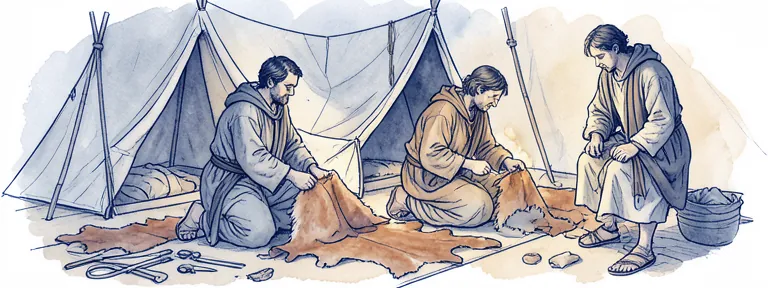
Academic view
Many academic scholars think a follower wrote the letter after Paul’s death, closely modelled on 1 Thessalonians. They point to wording borrowed from the earlier letter alongside a different outlook. In 1 Thessalonians the day comes “like a thief in the night,” but here it is preceded by clear signs. They also read the stress on Paul’s signature (3:17) as a way of establishing the letter’s own authority.
Both views agree that the letter answers real confusion about the timing of the day of the Lord, and that the identity of “the man of sin,” and of what restrains him, is uncertain. Proposals over the centuries have included a Roman emperor, the Roman state, the preaching of the gospel and a figure still to come.
Audience and setting
The letter addresses the church in Thessalonica (see 1 Thessalonians), or, on the critical view, believers who knew Paul’s letter to that church. The readers are under persecution, alarmed by talk that the end has arrived, and dealing with members who have stopped working, perhaps because they believed the end was near.
Genre, and how to read it
The letter is short and follows a clear pattern: thanksgiving and encouragement (chapter 1), correction (chapter 2) and instruction (chapter 3). Chapter 2 is among the hardest passages in Paul’s letters, because Paul refers to what he told the church in person (2:5) and leaves out what his first readers already knew.
Readers in different traditions take “the man of sin” in 2:3–12 as a future Antichrist, as a pattern of opposition to God repeated in every age, or as a figure of Paul’s own time. The rule about work (3:10) has been quoted far beyond the church, including in the Soviet constitution of 1936. In the letter it concerns members of the church living at others’ expense.
The coming
The Greek word the church took for Christ’s return is parousia, a coming or a presence: in everyday Greek it could mean a ruler’s visit to a city. It is used 24 times in the New Testament, 16 of them for Christ’s coming, and 6 of those are in the two letters to Thessalonica, more than anywhere else. The gospels use it only in Matthew 24. Paul also uses it of ordinary arrivals, his friends’ and his own.
- Matthew 4
- 1 Corinthians 2
- 2 Corinthians 3
- Philippians 2
- 1 Thessalonians 4
- 2 Thessalonians 3
- James 2
- 2 Peter 3
-
1 John 1
- 2:28
not be ashamed before him at his coming
- 2:28
Counted in the site’s Greek, every use of parousia. In 2 Thessalonians 2 the same word names both arrivals, the Lord’s and the lawless one’s, two verses apart. Paul also calls it the day of the Lord, which comes like a thief
(1 Thessalonians 5:2), the New Testament’s echo of the prophets’ day of Yahweh.
Outline
- 1:1–1:12 Thanks and encouragement — Persecution, and God’s justice when Christ is revealed
- 2:1–2:12 The day of the Lord — Not yet: the rebellion and the man of sin
- 2:13–2:17 Chosen and called — Stand firm and hold the traditions
- 3:1–3:5 A request for prayer — That the word may spread
- 3:6–3:15 Against idleness — Paul’s example, and a rule about work
- 3:16–3:18 Peace, and Paul’s signature — The sign in every letter
Key themes
- Justice for the persecuted
- The church’s “perseverance and faith in all your persecutions” (1:4) will be answered with relief when Christ is revealed (1:7).
- Not yet
- “Let no one deceive you in any way” (2:3). The day of the Lord has not come, and the readers are “not to be quickly shaken” (2:2).
- Chosen
- “God chose you from the beginning for salvation through sanctification of the Spirit and belief in the truth” (2:13).
- Tradition
- The readers are to “stand firm and hold the traditions which you were taught by us, whether by word or by letter” (2:15). Catholic and Orthodox writers cite this verse for the authority of tradition alongside Scripture.
- Faithful work
- Paul worked to support himself as an example (3:6–9), and urges, “don’t be weary in doing what is right” (3:13).
At a glance
Most mentioned: Jesus Christ, Paul, Satan, Silas, Timotheus