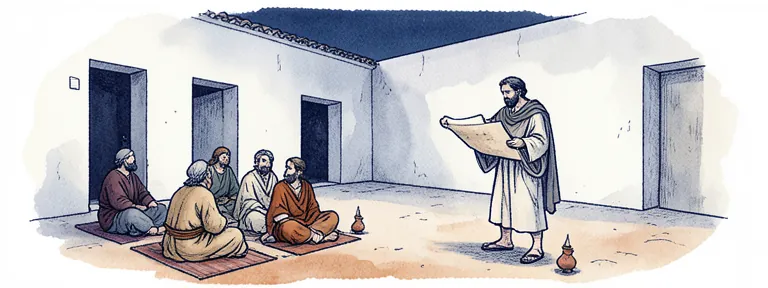
Colossians
Christ is supreme over all creation and every power, so believers need no further teaching, ritual or spiritual power to be complete.
Overview
Colossians is written to a church Paul had never visited (2:1), founded by his co-worker Epaphras (1:7). News had come of a teaching that threatened it, and the letter answers with a portrait of Christ. In a passage often thought to be an early hymn (1:15–20), Christ is “the image of the invisible God, the firstborn of all creation” (1:15). All things were created through him, and in him “all things are held together” (1:17). He reconciles all things “through the blood of his cross” (1:20).
Since “in him all the fullness of the Deity dwells bodily” (2:9), Paul warns against “philosophy and vain deceit” (2:8), rules about food and festivals (2:16) and the “worshiping of the angels” (2:18). The second half describes the new life: “seek the things that are above” (3:1), put off the old self and put on compassion and love. Instructions for households and a long list of greetings follow. Tychicus carries the letter, with Onesimus, “who is one of you” (4:9).
Author and date
The letter names Paul and Timothy as its senders (1:1) and ends with Paul’s own signature (4:18). Scholars are divided on whether Paul wrote it; the split is more even than for Ephesians.
Traditional view
The church received Colossians as Paul’s, and many scholars still hold it to be his. It shares most of its names with Philemon, among them Onesimus, Epaphras, Archippus, Mark, Luke and Demas (4:9–17), which fits the two being sent together. Some prefer an earlier imprisonment in Ephesus, around AD 54–55. Its differences of style from Paul’s other letters are put down to the subject, or to Timothy’s share in the writing.
Academic view
Many academic scholars think a disciple wrote Colossians after Paul’s death, taking its names from Philemon. They point to its long sentences and distinctive vocabulary, and to a more developed picture of Christ as head of a universal church. They also note that believers are already “raised together with Christ” (3:1), whereas the undisputed letters (the seven that nearly all scholars accept as Paul’s) look ahead to resurrection.
Both views see a close relationship with Ephesians, which repeats much of Colossians’ wording, and both accept that the teaching the letter opposes cannot be identified with certainty. Suggestions range from Jewish mysticism and local folk religion to early forms of Gnosticism, which taught salvation through secret knowledge.
Audience and setting
Colossae was a small town in the Lycus valley of Phrygia, in the Roman province of Asia, near the larger cities of Laodicea and Hierapolis (4:13). Its believers were mostly Gentile, taught by Epaphras, a native of the town (4:12). Paul asks for this letter to be read in Laodicea and for “the letter from Laodicea” to be read in Colossae (4:16). No letter under that name survives from Paul, and some identify it with Ephesians.
Genre, and how to read it
Colossians moves from belief to life in the same way as Ephesians, with chapters 1–2 on Christ and chapters 3–4 on conduct. Its vocabulary of fullness, mystery and powers may have been taken from the teaching it opposes and applied to Christ; the mystery, Paul says, is “Christ in you, the hope of glory” (1:27).
The hymn in chapter 1 was central to early Christian thinking about Christ’s divinity and his part in creation, and it is still read that way across traditions. Some modern readers also draw from it a concern for the whole creation, since Christ reconciles “things on the earth or things in the heavens” (1:20). The instructions for households (3:18–4:1) raise the same questions as those in Ephesians. Beside them stands the vision of a people in which “Christ is all, and in all” (3:11).
Wives, husbands, children, slaves
Three letters set out how a Christian household should live, speaking to each member in turn. Ephesians and Colossians address the same six groups in the same order, often in the same words. But Ephesians gives husbands 150 Greek words where Colossians gives 10, and Colossians spends almost half its rules on slaves. 1 Peter speaks only to slaves, wives and husbands, slaves first, and gives them 129 words, more than twice what either of the others does.
Servants, be obedient to those who according to the flesh are your masters
Servants, obey in all things those who are your masters according to the flesh
Lengths are Greek words in the site’s text. Ephesians’ rules hang on the verse before them, subjecting yourselves to one another in the fear of Christ
(Ephesians 5:21): in the Greek its word to wives has no verb of its own and borrows that one. 1 Peter’s slaves may suffer at the hands of harsh masters, and it praises the one who endures pain, suffering unjustly
(1 Peter 2:19); it says nothing to masters at all.
Outline
- 1:1–1:14 Greeting, thanks and prayer — Rescued into the Kingdom of the Son
- 1:15–1:23 The supremacy of Christ — The hymn, and reconciliation through the cross
- 1:24–2:5 Paul’s labour — The mystery: Christ in you
- 2:6–2:23 Warnings — Empty philosophy, rules, angel worship; fullness in Christ
- 3:1–3:17 The new life — Things above, the old self and the new
- 3:18–4:1 The household — Wives and husbands, children and parents, slaves and masters
- 4:2–4:18 Prayer and greetings — Tychicus, Onesimus, Epaphras, the letter from Laodicea
Key themes
- Christ over all
- “He is before all things, and in him all things are held together” (1:17). “He is the head of the body, the assembly” (1:18).
- Fullness
- Because “all the fullness was pleased to dwell in him” (1:19), believers have nothing to add to Christ.
- Freedom from rules
- “Let no one therefore judge you in eating or drinking, or with respect to a feast day or a new moon or a Sabbath day” (2:16), since the record against believers was nailed to the cross (2:14).
- Raised with Christ
- “Set your mind on the things that are above, not on the things that are on the earth” (3:2).
- The new humanity
- In the new self “there can’t be Greek and Jew, circumcision and uncircumcision, barbarian, Scythian, bondservant, or free person” (3:11), and love is “the bond of perfection” (3:14).
At a glance
Most mentioned: Jesus Christ, Paul, Epaphras, Archippus, Aristarchus
Main places: Laodicea, Colossae, Hierapolis