Daniel
Faithful Jews at the court of foreign kings, and visions of empires rising and falling until God gives the kingdom to his holy people.
Overview
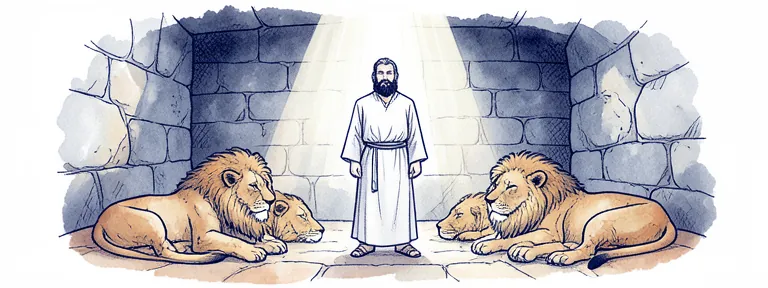
Daniel falls into two halves. Chapters 1–6 are stories about Daniel and his three friends, Shadrach, Meshach and Abed-nego, young Judeans taken to Babylon and trained for the king’s service. They refuse the king’s food (1:8), and Daniel interprets Nebuchadnezzar’s dreams. The friends refuse to worship a golden statue and are thrown into a furnace (“But if not … we will not serve your gods,” 3:18). Nebuchadnezzar is humbled, Belshazzar sees the writing on the wall, and Daniel keeps praying toward Jerusalem and is thrown to the lions (6:10).
Chapters 7–12 are Daniel’s own visions: four beasts from the sea, “one like a son of man” coming with the clouds to the Ancient of Days (7:13), a ram and a goat, a prophecy of seventy weeks, and a long revelation of wars between kings of the north and south. The book ends with the Old Testament’s clearest promise of resurrection: “many of those who sleep in the dust of the earth will awake” (12:2).
Author and date
The stories in chapters 1–6 speak of Daniel in the third person; the visions in chapters 7–12 are mostly in his own voice (8:1). The date of the book is one of the sharpest divides in biblical scholarship.
Traditional view
Jewish and Christian tradition hold that Daniel, taken to Babylon in 605 BC, recorded these events and visions, which reach into the reign of Cyrus of Persia (10:1). Holders of this view read the visions as prediction of events centuries ahead, and note that Jesus speaks of “Daniel the prophet” (Matthew 24:15).
Academic view
Most academic scholars date the book in its final form to the persecution of the Jews by the Seleucid (Greek-Syrian) king Antiochus IV Epiphanes, who desecrated the temple in 167 BC. They note that chapter 11 traces the wars between the Seleucid kings of Syria and the Ptolemaic kings of Egypt in close detail up to his reign. Its last verses, however, do not match other accounts of his death. The court stories are often seen as older traditions.
Both views identify the “little horn” of chapter 8 (8:9) and much of chapter 11 with Antiochus IV. They differ on whether the book foresaw his persecution or was written during it.
Audience and setting
Daniel is set in Babylon from Nebuchadnezzar’s first attack on Jerusalem (1:1) into the Persian period, and its stories speak to Jews living faithfully under foreign rule. Its visions speak to people facing persecution, promising that God rules “in the kingdom of men” (4:17) and will bring the empires to an end.
The book is written in two languages: Hebrew from 1:1 to the middle of 2:4, Aramaic from there to the end of chapter 7, and Hebrew again in chapters 8–12.
Genre, and how to read it
The second half of Daniel is apocalyptic: a type of writing that shows the heavenly realities behind earthly events, through symbolic beasts, horns and numbers, and angels who explain the visions. The angels Gabriel and Michael are named here for the first time in the Bible. Readers identify the four kingdoms of chapters 2 and 7 differently: many as Babylon, Media-Persia, Greece and Rome, and many others as Babylon, Media, Persia and Greece.
In the Hebrew Bible Daniel stands among the Writings, the third section after the Law and the Prophets; Christian Bibles place it among the prophets. Catholic and Orthodox Bibles also include Greek additions: the Prayer of Azariah and the Song of the Three Young Men in chapter 3, and the stories of Susanna and of Bel and the Dragon.
Daniel in time order
Daniel dates most of its chapters by a king’s reign, but it does not tell them in that order. Belshazzar dies at the end of chapter 5 (In that night Belshazzar the Chaldean King was slain
5:30), yet chapters 7 and 8 are dated to his first and third years (7:1, 8:1). Each line joins a chapter to the reign the text gives it; where lines cross, the book has stepped back in time.
| Chapter | King | When | Verse |
|---|---|---|---|
| 1 | Jehoiakim | 3rd year | 1:1 |
| 2 | Nebuchadnezzar | 2nd year | 2:1 |
| 3 | Nebuchadnezzar | no year given | 3:1 |
| 4 | Nebuchadnezzar | no year given | 4:1 |
| 7 | Belshazzar | 1st year | 7:1 |
| 8 | Belshazzar | 3rd year | 8:1 |
| 5 | Belshazzar | the night he died | 5:30 |
| 9 | Darius the Mede | 1st year | 9:1 |
| 6 | Darius the Mede | no year given | 6:1 |
| 10–12 | Cyrus | 3rd year | 10:1 |
Chapter 1 runs from the third year of the reign of Jehoiakim
(1:1) to the first year of King Cyrus
(1:21), so it frames the whole book. Chapters 3, 4 and 6 give no year; they are placed by the king they name. Chapters 10–12 are one vision, dated In the third year of Cyrus
(10:1). Darius the Mede is named only in Daniel, and who he was is debated.
From in the Syrian language
(2:4) to the end of chapter 7, Daniel is written in Aramaic rather than Hebrew; English does not show where it switches back. Inside that Aramaic section, chapters 2 and 7 both describe four kingdoms (2:39–40; 7:17), 3 and 6 a rescue from death, and 4 and 5 a king judged; many read the six as a matched set.
Outline
Stories at court (1–6)
- 1:1–1:21 Faithful in Babylon — Daniel and his friends refuse the king’s food
- 2:1–2:49 The statue dream — Four kingdoms, and a stone that becomes a mountain
- 3:1–3:30 The fiery furnace — Shadrach, Meshach and Abed-nego refuse to bow
- 4:1–4:37 Nebuchadnezzar humbled — A great tree cut down, and a king who learns who rules
- 5:1–5:31 The writing on the wall — Belshazzar’s feast and the fall of Babylon
- 6:1–6:28 The lions’ den — Daniel keeps praying, and is delivered
Visions (7–12)
- 7:1–7:28 Four beasts — The Ancient of Days and one like a son of man
- 8:1–8:27 The ram and the goat — Media and Persia, Greece, and a little horn
- 9:1–9:27 Seventy weeks — Daniel’s prayer, and Gabriel’s answer
- 10:1–12:13 The final vision — Kings of the north and south, the time of the end, resurrection
Key themes
- God rules the nations
- The stories repeat that “the Most High rules in the kingdom of men, and gives it to whomever he will” (4:17), and even Nebuchadnezzar confesses it (4:34).
- Faithfulness under pressure
- Daniel and his friends serve foreign kings loyally but will not compromise their worship, whatever it costs: “our God whom we serve is able to deliver us” (3:17).
- The kingdom of God
- The God of heaven will set up “a kingdom which will never be destroyed” (2:44), given to one like a son of man (7:14). Jesus’ most frequent title for himself, “the Son of Man,” draws on this vision.
- Resurrection
- The book closes with the dead raised “some to everlasting life, and some to shame and everlasting contempt” (12:2).
At a glance
Most mentioned: Daniel, Nebuchadnezzar, Meshach, Shadrach, Belshazzar