Ephesians
A letter in praise of God’s plan to unite all things in Christ, and a call for Jew and Gentile to live as one new people.
Overview
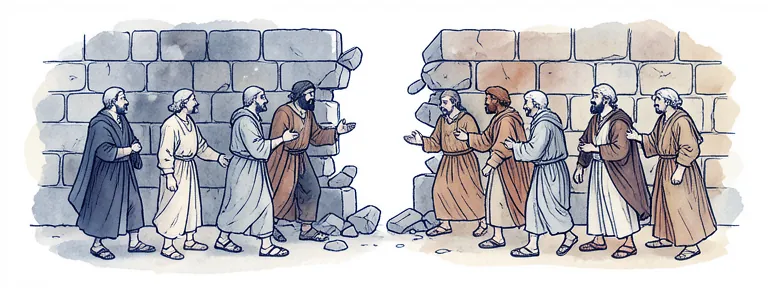
Ephesians opens with a long outpouring of praise for a plan God made “to sum up all things in Christ” (1:10). In the Greek, the whole passage (1:3–14) is a single sentence. The first half describes what God has done. He has raised the readers from death in sin, for “by grace you have been saved through faith” (2:8). In Christ he has also broken down “the middle wall of separation” (2:14) between Jew and Gentile, making one people and one household. The church is Christ’s body, “the fullness of him who fills all in all” (1:23).
The second half turns this into conduct, beginning with an appeal “to walk worthily of the calling with which you were called” (4:1). Unity comes first, “one Lord, one faith, one baptism” (4:5), with gifts given to build up the church. Then come the contrast between the old life and the new, instructions for households, and the closing picture of the believer putting on “the whole armor of God” (6:11).
Author and date
The letter names Paul, writing as a prisoner (3:1). Whether he wrote it is one of the more debated questions about his letters.
Traditional view
The church accepted Ephesians as Paul’s from the second century, and many scholars still hold that view. They place it in Paul’s imprisonment in Rome, sent with Tychicus (6:21) at the same time as Colossians and Philemon. They explain its style by its purpose: it is closer to prayer and sermon than to a letter answering particular problems.
Academic view
Many academic scholars think a disciple of Paul wrote Ephesians after his death, in his name. They point to its long, prayer-like sentences and to vocabulary unlike that of the undisputed letters (the seven that nearly all scholars accept as Paul’s). They also note its view of the church as universal, its close dependence on Colossians, whose wording it often shares, and that it reads as if writer and readers had not met (1:15, 3:2), though Paul spent years in Ephesus.
Both views note that the words “at Ephesus” in 1:1 are missing from some of the earliest manuscripts, and many on both sides think the letter was meant to circulate among several churches in the province of Asia.
Audience and setting
Ephesus was the chief city of the Roman province of Asia, a port on the Aegean with a famous temple of Artemis. Paul worked there for two to three years (Acts 19), and Acts 20 records his farewell to its elders. The letter addresses Gentile believers (2:11) who were once “strangers and foreigners” and are now “fellow citizens with the saints” (2:19). It names no single crisis, and dwells instead on who the readers are in Christ and how that shows in daily life.
Genre, and how to read it
Ephesians is written in long, flowing sentences full of prayer and praise. Its first three chapters are almost entirely thanksgiving, prayer and description, closing with a doxology, a short burst of praise to God (3:20–21). The “therefore” of 4:1 turns from belief to practice, as Romans does at chapter 12.
The household instructions (5:21–6:9) are read differently across traditions. Some stress the call to mutual submission in 5:21 and read the rest in its light; others take the roles of husband and wife as a lasting pattern grounded in Christ and the church (5:32). The instructions to slaves and masters raise the same questions about what is cultural and what is binding. Catholic, Orthodox and Protestant readers alike draw on the letter’s picture of one body under one Lord (4:4–6).
Wives, husbands, children, slaves
Three letters set out how a Christian household should live, speaking to each member in turn. Ephesians and Colossians address the same six groups in the same order, often in the same words. But Ephesians gives husbands 150 Greek words where Colossians gives 10, and Colossians spends almost half its rules on slaves. 1 Peter speaks only to slaves, wives and husbands, slaves first, and gives them 129 words, more than twice what either of the others does.
Servants, be obedient to those who according to the flesh are your masters
Servants, obey in all things those who are your masters according to the flesh
Lengths are Greek words in the site’s text. Ephesians’ rules hang on the verse before them, subjecting yourselves to one another in the fear of Christ
(Ephesians 5:21): in the Greek its word to wives has no verb of its own and borrows that one. 1 Peter’s slaves may suffer at the hands of harsh masters, and it praises the one who endures pain, suffering unjustly
(1 Peter 2:19); it says nothing to masters at all.
Outline
God’s plan in Christ (1–3)
- 1:1–1:14 Greeting and blessing — Chosen, redeemed, sealed with the Spirit
- 1:15–1:23 A prayer for understanding — Christ raised and made head over all things
- 2:1–2:10 Saved by grace — From death to life
- 2:11–2:22 One new people — Jew and Gentile in one household
- 3:1–3:21 The mystery revealed — Paul’s calling, and a prayer to know Christ’s love
Walking worthily (4–6)
- 4:1–4:16 Unity and gifts — One body, and gifts to build it up
- 4:17–5:20 The old life and the new — Truth, kindness, children of light
- 5:21–6:9 The household — Wives and husbands, children and parents, slaves and masters
- 6:10–6:24 The armour of God — Standing firm, and farewell
Key themes
- Grace
- Salvation is “the gift of God” (2:8), “not of works, that no one would boast” (2:9), yet it is for “good works, which God prepared before that we would walk in them” (2:10).
- All things in Christ
- God’s purpose is “to sum up all things in Christ” (1:10), and he has made Christ “head over all things for the assembly” (1:22).
- Jew and Gentile together
- Christ “made both one” (2:14), so that Gentiles are “fellow heirs and fellow members of the body” (3:6).
- Unity
- “There is one body and one Spirit” (4:4), and believers are to keep “the unity of the Spirit in the bond of peace” (4:3).
- Spiritual conflict
- Paul writes that “our wrestling is not against flesh and blood” (6:12), and the believer stands in the armour God provides (6:10–11).
At a glance
Most mentioned: Jesus Christ, Paul, Tychicus
Main places: Ephesus