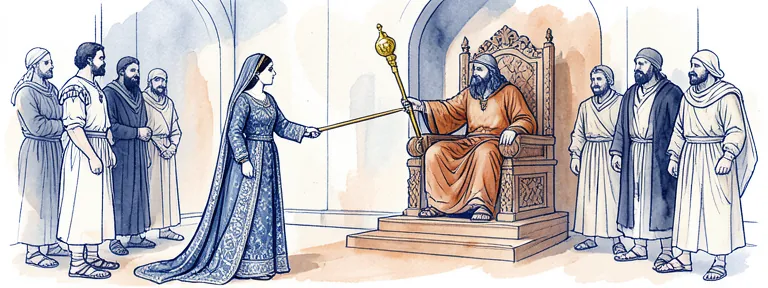
Esther
A Jewish queen in Persia risks her life to save her people from a plot to destroy them, and the festival of Purim is born.
Overview
Esther is set in Susa during the reign of Ahasuerus, usually identified with Xerxes I (1:1). After the king deposes Queen Vashti, he chooses Esther, a Jewish orphan raised by her cousin Mordecai, to replace her. She keeps her Jewish identity hidden. The king’s chief minister Haman, enraged that Mordecai will not bow to him, casts lots (pur) to choose a day to destroy all the Jews of the empire (3:7). Mordecai urges Esther to act: “Who knows if you haven’t come to the kingdom for such a time as this?” (4:14).
Esther fasts and approaches the king uninvited, at the risk of her life (“if I perish, I perish,” 4:16). Through two banquets she exposes Haman, who is hanged on the gallows he built for Mordecai. The Jews are allowed to defend themselves, and the days of danger become the feast of Purim, days of “feasting and gladness” (9:22).
Author and date
Esther does not name its author, and God is never mentioned in its Hebrew text.
Traditional view
Jewish tradition credits the “men of the Great Assembly,” the leaders after the return; some point to Mordecai, who is said to have recorded these events (9:20).
Academic view
Many scholars date the book to the late Persian or early Greek period and read it as a court story with historical colour. They note that Greek historians name Xerxes’ queen as Amestris, not Esther or Vashti. Others defend its accuracy, pointing to its close knowledge of Persian court life.
Catholic and Orthodox Bibles include six Greek additions to Esther, with prayers and explicit references to God. The Hebrew book, used in Protestant Bibles and in Jewish worship, has none.
Audience and setting
Esther was written for Jews living in the diaspora, scattered across an empire under foreign rule, and explains the origin of Purim, which they were to keep every year. The setting is Susa, the Persian winter capital, in the early 5th century BC.
Genre, and how to read it
Esther is a story of reversals, told with irony and a sense of comedy: Haman plans honour for himself and ends up giving it to Mordecai; he builds a gallows and hangs on it; a day marked for destruction becomes a holiday. Banquets structure the whole book, from the king’s opening feast to the feasts of Purim.
God’s absence from the text is deliberate or at least meaningful. Many readers see his hand in the coincidences (a sleepless king and a well-timed reading of the royal records, 6:1) and in Mordecai’s confidence that deliverance will come “from another place.”
Ten feasts and a fast
Esther is a story told in feasts. Its word for one, mishteh, a drinking, comes 20 times in its ten chapters, out of 46 in the whole Old Testament. The king’s feasts open the book, the Jews’ close it, and between them come Esther’s two banquets, where Haman falls. At the centre, instead of a feast, a fast.
-
1:3–4
For the princes given by the king
even one hundred eighty days
-
1:5–12
For all Susa, seven days given by the king
the queen Vashti refused to come
-
1:9
Vashti’s, for the women given by Vashti
Vashti the queen made a feast for the women
-
2:18
Esther made queen given by the king
even Esther’s feast
-
3:15
After the decree given by the king
The king and Haman sat down to drink
-
5:4–8
Esther’s first banquet given by Esther
the banquet that I have prepared for him
-
7:1–10
Esther’s second banquet given by Esther
on the second day at the banquet of wine
-
8:17
After the second decree given by the Jews
a feast and a holiday
-
9:17
Purim, the fourteenth given by the Jews
made it a day of feasting and gladness
-
9:18
Purim in Susa, the fifteenth given by the Jews
on the fifteenth day of that month
The ten feasts are the usual count. The seven-day feast is where Vashti refuses the king; the second banquet is where Esther names Haman. Two pair across the book: after Haman’s decree The king and Haman sat down to drink
(3:15), and after Mordecai’s the Jews have a feast and a holiday
(8:17). The fasts, from fast for me
(4:16) to the rules for Purim (9:31), are counted in the site’s Hebrew.
Outline
- 1:1–2:23 Esther becomes queen — Vashti deposed, Esther chosen, Mordecai uncovers a plot
- 3:1–4:17 Haman’s plot — The lot cast, the decree, “for such a time as this”
- 5:1–7:10 Esther’s banquets — A sleepless king, Mordecai honoured, Haman exposed
- 8:1–10:3 Reversal, and Purim — A counter-decree, the Jews defend themselves, a feast is founded
Key themes
- Hidden providence
- God is never named, yet the story is built so that “relief and deliverance” arrive at exactly the right moment (4:14).
- Courage
- Esther’s decision to risk her life, “if I perish, I perish” (4:16), is the turning point.
- Reversal
- The month that was to bring destruction is “turned to them from sorrow to gladness” (9:22).
- Purim
- The feast takes its name from the lot Haman cast (9:26). See Pur and Purim in the Almanac.
At a glance
Most mentioned: Mordecai, Esther, Haman, Ahasuerus, Vashti