Habakkuk
A prophet questions God about injustice, waits for an answer, and ends in trust, because “the righteous will live by his faith.”
Overview
Habakkuk opens with the prophet speaking to God on the people’s behalf: “Yahweh, how long will I cry, and you will not hear?” (1:2). Judah is full of violence and the law is powerless. God’s reply is more troubling than the question. He is raising up the Chaldeans (the Babylonians), “that bitter and hasty nation” (1:6), to punish Judah. Habakkuk protests again. How can a God with “purer eyes than to see evil” (1:13) use the wicked to swallow up those more righteous than they?
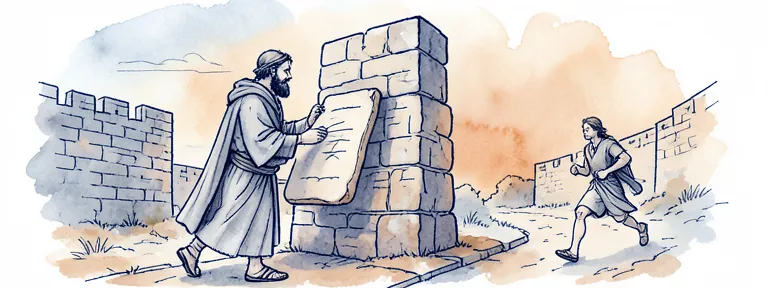
Habakkuk takes his stand on the ramparts to wait (2:1). The answer comes as a vision to be written plainly on tablets (2:2): the proud will not last, “but the righteous will live by his faith” (2:4). Five woes follow, each a saying against the oppressor that begins “Woe to him” (2:6). The chapter closes, “Yahweh is in his holy temple. Let all the earth be silent before him!” (2:20). The book ends with a prayer. Habakkuk recalls God’s mighty acts and resolves to rejoice in him, even if the fig tree fails and the fields yield no food (3:17–18).
Author and date
The book names “Habakkuk the prophet” twice (1:1, 3:1) but tells us nothing of his family or home.
Traditional view
Habakkuk wrote the whole book as the Babylonians rose to power, before they invaded Judah, probably in the years around 609–598 BC. A later legend in the Greek additions to Daniel has him carry a meal to Daniel in the lions’ den.
Academic view
Most academic scholars agree on a date near the rise of Babylon for chapters 1–2, though some think the oppressor was first Assyria and later identified with Babylon. The psalm of chapter 3 has its own heading and musical notes and may once have stood alone. The commentary on Habakkuk found among the Dead Sea Scrolls covers only chapters 1–2.
Both views place the book in the late 7th or early 6th century BC, as the Babylonians became the power in the region.
Audience and setting
Habakkuk wrote for Judah in its last decades, before the Babylonian conquests of 597 and 586 BC. His readers knew injustice at home and faced an empire abroad that was more ruthless still. The book asks their question aloud: how can God use a wicked nation to judge a less wicked one?
Genre, and how to read it
Habakkuk is built as a conversation: two complaints from the prophet, each followed by God’s reply (1:2–11, 1:12–2:5), then five woes against the oppressor (2:6–20), and a psalm with notes for singing, including the word “Selah” (3:3). It moves from protest, to waiting, to worship. Habakkuk is eighth in the Twelve, the shorter prophets gathered on one scroll in the Hebrew Bible.
Its central verse has a long history. Paul quotes 2:4 in Romans 1:17 and Galatians 3:11, and Hebrews 10:38 cites it too. The Hebrew word behind “faith,” emunah, means faithfulness as well as faith, and readers discuss which sense Habakkuk intended. The verse later became central to Martin Luther’s teaching that people are put right with God through faith.
Outline
Habakkuk’s questions (1–2)
- 1:1–1:4 How long? — Violence in Judah, and a God who seems silent
- 1:5–1:11 God’s first answer — The Chaldeans are coming
- 1:12–2:1 A second complaint — Why use the wicked against the more righteous?
- 2:2–2:5 God’s second answer — Write the vision: the righteous will live by faith
- 2:6–2:20 Five woes — Extortion, unjust gain, bloodshed, drunkenness and idols
Habakkuk’s prayer (3)
- 3:1–3:19 A psalm of trust — God comes in power, and the prophet rejoices though the harvest fails
Key themes
- Honest complaint
- The book begins with “how long?” (1:2), and God answers the prophet’s questions without rebuking him for asking.
- Faith and faithfulness
- “The righteous will live by his faith” (2:4), set against the proud whose soul “is puffed up.”
- Waiting
- “Though it takes time, wait for it, because it will surely come” (2:3).
- God’s glory
- Against empires that fill the earth with plunder, “the earth will be filled with the knowledge of Yahweh’s glory, as the waters cover the sea” (2:14).
- Joy in loss
- With no fruit, no flocks and no harvest, “yet I will rejoice in Yahweh. I will be joyful in the God of my salvation!” (3:18).
At a glance
Most mentioned: Habakkuk, Midian
Main places: Cushan, Lebanon, Midian, Mount Paran, Teman