James
A practical letter on living out faith: endure trials, guard your tongue, care for the poor and show your faith by what you do.
Overview
James is addressed “to the twelve tribes which are in the Dispersion” (1:1) and reads more like a collection of wisdom teaching than a letter to one church. It moves quickly between subjects: joy in trials, asking God for wisdom, favouritism toward the rich, the power of the tongue, quarrels, boasting about tomorrow, patience and prayer for the sick. Its tone is direct, with more than fifty commands in 108 verses.
Its most discussed passage is on faith and works. “Even so faith, if it has no works, is dead in itself” (2:17), James writes, and “by works a man is justified, and not only by faith” (2:24). The letter also echoes the teaching of Jesus more than any other New Testament letter, especially the Sermon on the Mount: blessing on the poor, a warning against oaths (5:12), and the call to be “doers of the word, and not only hearers” (1:22).
Author and date
The writer calls himself “James, a servant of God and of the Lord Jesus Christ” (1:1), without saying which James he is.
Traditional view
Tradition identifies the author as James the brother of Jesus, who led the church in Jerusalem (Acts 15, Galatians 1:19) and was killed around AD 62. On this view the letter’s Jewish character, its simple picture of church life and its closeness to Jesus’ sayings point to an early date, possibly making it one of the first New Testament books written.
Academic view
Many academic scholars read the letter as written in James’ name by a later admirer, noting its polished Greek and what looks like a response to a distorted form of Paul’s teaching on faith. The letter was slow to be accepted in some parts of the early church, and Eusebius, a 4th-century church historian, lists it among the books whose place in Scripture was disputed.
Both views see a Jewish-Christian writer rooted in the Old Testament wisdom tradition, and both read 2:14–26 as engaging with the kind of language Paul uses about faith and works.
Audience and setting
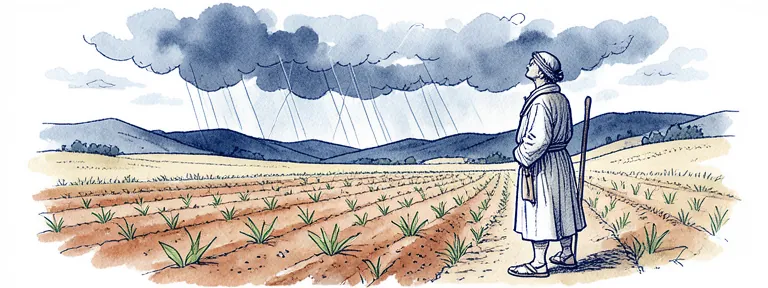
The address “to the twelve tribes which are in the Dispersion” (1:1) may mean Jewish Christians scattered outside Judea, or the church pictured as the new Israel. The readers seem to be mostly poor, facing wealthy landowners who hold back wages (5:4), and tempted to flatter the rich in their gatherings (2:1). The letter mentions “the early and late rain” (5:7) of the eastern Mediterranean, but nothing else fixes its place.
Genre, and how to read it
James belongs with the wisdom books, Proverbs above all, and with the sayings of Jesus. Topics are linked more by repeated words than by a developing argument, so it reads best a paragraph at a time. Vivid images carry the teaching: a wave of the sea, a mirror, a horse’s bit, a ship’s rudder, a forest fire, a vapour that vanishes (4:14).
Readers have long debated how James relates to Paul, who writes that a person is justified by faith apart from the works of the law (Romans 3:28). Martin Luther, in the preface to his 1522 New Testament, set James below Paul’s letters and called it a letter of straw. Many interpreters today note that the two writers use “faith,” “works” and “justified” in different senses, and that both appeal to Abraham (2:21). Others see a real disagreement between them.
Do this
James gives orders faster than any other letter in the New Testament: 61 commands in 1,739 Greek words, about one every 29 words. The first comes in its second verse, Count it all joy
(1:2), and they never let up; the book’s own summary of itself might be be doers of the word, and not only hearers
(1:22).
- James 35.1
- 1 Timothy 27.1
- 2 Timothy 26.7
- 1 Peter 21.5
- Titus 21.3
- Colossians 18.4
- Ephesians 16.9
- Philippians 15.3
- 1 Corinthians 14.5
- 1 Thessalonians 13.6
- Jude 13.1
- 2 John 12.2
- Philemon 11.9
- Galatians 9.9
- 3 John 9.1
- Romans 8.9
- 2 Thessalonians 8.5
- Hebrews 6.5
- 2 Peter 6.4
- 2 Corinthians 6.3
- 1 John 4.2
- 1 12 in 27 verses
- 2 11 in 26 verses
- 3 6 in 18 verses
- 4 12 in 17 verses
- 5 20 in 20 verses
Counted in the site’s Greek, where a verb in the imperative mood is a command. The thickest run is chapter 4, where 10 come in four verses, from Be subject therefore to God.
(4:7) to Humble yourselves in the sight of the Lord
(4:10); chapter 5, on patience and prayer, has the most. The letters to Timothy come nearest; at the other end, 1 John gives one every 237 words.
Outline
- 1:1–1:18 Trials and wisdom — Joy in testing, asking in faith, every good gift from above
- 1:19–1:27 Doers of the word — Hearing, doing, and pure religion
- 2:1–2:13 No favouritism — Rich and poor in the assembly, and the royal law of love
- 2:14–2:26 Faith and works — Faith without works is dead
- 3:1–3:12 The tongue — A small fire and a restless evil
- 3:13–4:12 Two kinds of wisdom — Peace, quarrels, drawing near to God
- 4:13–5:6 Warnings to the proud and the rich — Boasting about tomorrow, wages held back
- 5:7–5:20 Patience and prayer — The farmer, Job, Elijah and bringing back the wanderer
Key themes
- Faith that works
- “For as the body apart from the spirit is dead, even so faith apart from works is dead” (2:26).
- Doing the word
- Hearing without doing is self-deception (1:22). “Pure religion and undefiled” is to care for “the fatherless and widows in their affliction” and stay unstained by the world (1:27).
- Rich and poor
- James is severe on the rich who oppress (5:1–6) and on believers who honour the rich over the poor in the assembly (2:1–7).
- The tongue
- A small part of the body that sets great things alight, the tongue is the hardest thing to master, and “nobody can tame the tongue” (3:8).
- Wisdom from God
- Anyone who lacks wisdom is told to “ask of God, who gives to all liberally and without reproach, and it will be given to him” (1:5).
At a glance
Most mentioned: Jesus Christ, Abraham, Elijah, Isaac, James (Brother of Jesus)