Job
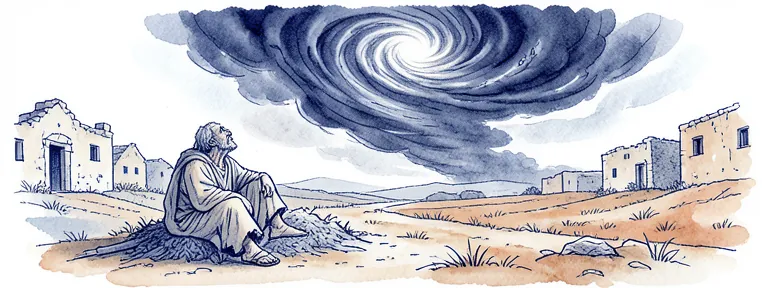
A blameless man loses everything, argues with his friends and with God over why, and is answered out of the whirlwind.
Overview
Job opens in the land of Uz with a man who is “blameless and upright” (1:1). In a scene in heaven, the accuser (“the satan” in Hebrew) asks, “Does Job fear God for nothing?” (1:9). God allows Job to be tested. Job loses his herds, his servants, his children and his health, yet says, “Yahweh gave, and Yahweh has taken away. Blessed be Yahweh’s name” (1:21). Three friends come and sit with him in silence for seven days.
Then Job speaks, cursing the day he was born (3:3), and the book becomes a long argument in poetry. The friends insist that suffering must be punishment for sin; Job insists he is innocent and demands a hearing with God. A younger man, Elihu, adds four speeches of his own. At last Yahweh answers “out of the whirlwind” (38:1) with questions about creation that Job cannot answer: “Where were you when I laid the foundations of the earth?” (38:4). Job submits, God rebukes the friends, and Job’s fortunes are restored twice over.
Author and date
Job does not name its author, and its date is among the most uncertain in the Old Testament.
Traditional view
The Talmud records a tradition that Moses wrote Job, and many readers place the story in the age of Abraham: Job’s wealth is counted in livestock, he offers sacrifices for his family himself, and he lives 140 years after his trials (42:16). The same Talmud passage records one rabbi’s opinion that Job never existed and the book is a parable.
Academic view
Most academic scholars date the poem between the 6th and 4th centuries BC. They base this on its language and on its questions about innocent suffering, which many connect with the crisis of the exile. Many see the prose story that frames the poem as an older folk tale, and the Elihu speeches (chapters 32–37) as a later addition, since Elihu appears in neither the prologue nor the epilogue.
Both views note that the story is set outside Israel, in the land of Uz, and that Job and his friends are presented as non-Israelites.
Audience and setting
Job was written for Israel, though its hero is a foreigner and its questions belong to anyone who suffers. The location of Uz is uncertain; it is most often placed in Edom or northern Arabia, and the friends come from Teman, Shuah and Naamah. Through most of the poem Job sits “among the ashes” (2:8).
Genre, and how to read it
Job is a poem set inside a story. The prose prologue (chapters 1–2) and epilogue (42:7–17) frame some of the most difficult Hebrew poetry in the Bible. Translations differ widely on individual lines. The debate runs in three rounds of speeches, with Job replying to each friend in turn. In the third round, Bildad’s speech is very short and Zophar does not speak at all.
Read the friends carefully. Much of what they say sounds like Proverbs, yet God’s verdict at the end is that they “have not spoken of me the thing that is right, as my servant Job has” (42:7). The book never tells Job about the scene in heaven. Yahweh’s speeches answer him with the wonders of creation, including behemoth and Leviathan, and readers still debate what Job understood when he said, “now my eye sees you” (42:5).
Who speaks, and for how long
Every speech in Job is introduced by name (Then Bildad the Shuhite answered
8:1), so its length can be counted. Each bar is one speech, in verses of the WEB, all on one scale. The friends run short as the rounds go on and Job’s answers grow, until these three men ceased to answer Job
(32:1).
- 501 Job, to his friends
- 203 the three friends
- 157 Elihu
- 123 Yahweh
- 7 Job, to Yahweh
Job opens before the first round with 24 verses cursing his birth (3). His last answer runs from 26 to 31, twice resumed with Job again took up his parable
(27:1; 29:1), and ends The words of Job are ended
(31:40).
After the friends
A younger man, angry with Job and with the friends, speaks four times, and no one answers him (32:2–5).
Yahweh speaks out of the whirlwind
(38:1); Job answers twice, in two verses and in five.
Job’s two answers: I lay my hand on my mouth
(40:4) and now my eye sees you
(42:5). Then Yahweh tells Eliphaz, you have not spoken of me the thing that is right, as my servant Job has
(42:7). Each speech is counted from the verse after its introduction; 32:6 both introduces Elihu and begins his speech, so it counts.
Outline
The test (1–2)
- 1:1–2:13 Prologue — The scene in heaven, Job’s losses, the three friends
The debate (3–31)
- 3:1–3:26 Job’s lament — He curses the day he was born
- 4:1–14:22 The first round — Eliphaz, Bildad and Zophar, and Job’s replies
- 15:1–21:34 The second round — The fate of the wicked, and “my Redeemer lives”
- 22:1–27:23 The third round — The friends run out of words
- 28:1–28:28 Where wisdom is found — A poem on wisdom hidden from all but God
- 29:1–31:40 Job’s final defence — His past honour, his present misery, an oath of innocence
The answers (32–42)
- 32:1–37:24 Elihu — A younger man rebukes Job and the friends
- 38:1–42:6 Yahweh speaks — Creation, behemoth and Leviathan, and Job’s reply
- 42:7–42:17 Epilogue — The friends rebuked, Job restored
Key themes
- Innocent suffering
- The book sets aside the easy answer that suffering is always deserved: the reader knows from the first verse that Job is blameless (1:1).
- Faith for nothing
- The accuser’s question, “Does Job fear God for nothing?” (1:9), sets the test for the whole book: does anyone serve God apart from reward?
- Honest protest
- Job complains, accuses and demands a hearing, and is still called God’s servant who spoke what is right (42:7). In the middle of his anguish he says, “I know that my Redeemer lives” (19:25).
- Wisdom beyond reach
- The poem of chapter 28 concludes that “the fear of the Lord, that is wisdom” (28:28), and God’s speeches show a creation far larger than any human account of it. See Leviathan and behemoth in the Almanac.
At a glance
Most mentioned: Job, Satan, Elihu, Eliphaz, Bildad
Main places: Ophir, Ethiopia, Jordan, Sheba, Tema
In the Almanac: Leviathan, Behemoth, Rahab (the sea monster)