Joel
A plague of locusts becomes a warning of the day of Yahweh, a call to return to God, and a promise that he will pour out his Spirit on all flesh.
Overview
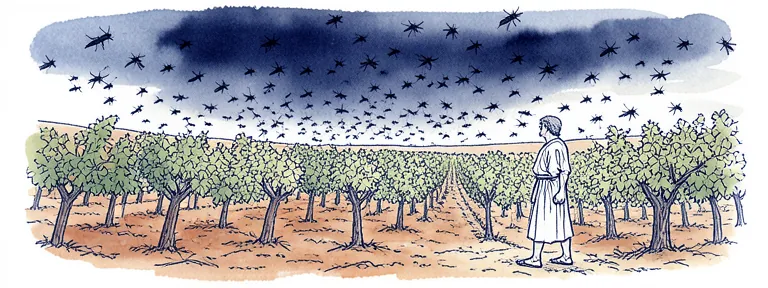
Joel begins with a disaster. Wave after wave of locusts has stripped the land (1:4) and left the vines and fig trees bare. Drought follows, and there is no grain or wine left to offer in the temple. Joel calls everyone, from elders to drunkards to priests, to mourn and gather for a fast. The disaster points beyond itself: “the day of Yahweh is at hand” (1:15), the day when God comes to judge. In chapter 2 an army sweeps over the land like fire, and the sun and moon go dark.
At the centre of the book stands the call “turn to me with all your heart” (2:12), with a reason to hope: God “is gracious and merciful, slow to anger” (2:13). From there the book turns. God promises to restore “the years that the swarming locust has eaten” (2:25) and to pour out his Spirit “on all flesh” (2:28). The last chapter gathers the nations for judgement in the valley of Jehoshaphat (3:2) and ends with Judah secure and a fountain flowing from the temple (3:18).
Author and date
The book names Joel son of Pethuel (1:1) and tells us nothing else about him. It names no king and gives no date, and its date is the main question.
Traditional view
The book’s place between Hosea and Amos suggested to early readers that Joel was an early prophet. Some date him to the boyhood of King Joash (c. 835 BC), when priests and elders led Judah. They note that the enemies named are Philistia, Tyre and Sidon, Egypt and Edom, not Assyria or Babylon. Others place him late in the monarchy.
Academic view
Most academic scholars, and a number of conservative ones, date the book after the return from exile. They point to several clues: no king is mentioned, the temple and city wall are standing, Judah’s scattering among the nations seems to lie in the past (3:1–2), there is trade with “the sons of the Greeks” (3:6) and Joel shares many phrases with other prophets.
Both views note how much language Joel shares with other prophets. Joel’s line “Yahweh will roar from Zion” (3:16) also opens Amos’s prophecies (Amos 1:2). That may be why the two books stand side by side in the Twelve, the shorter prophets gathered on one scroll in the Hebrew Bible.
Audience and setting
Joel speaks to Judah and Jerusalem: to farmers who have lost their harvest, and to priests who can no longer bring the meal offering and the drink offering (1:9). Its world centres on the temple on Mount Zion, where the trumpet is blown, the fast is called and the priests weep “between the porch and the altar” (2:17).
Genre, and how to read it
Joel is poetry, and its images move between the literal and the symbolic. Readers disagree over whether the army of chapter 2 is the locust swarm pictured as an invading force, a human invader pictured as locusts, or an army of the last days. The book falls into two halves: lament and the call to repentance up to 2:17, and God’s answer from 2:18, when “Yahweh was jealous for his land, and had pity on his people.”
English Bibles number Joel differently from Hebrew ones. What the World English Bible calls 2:28–32 is chapter 3 in Hebrew Bibles, and its chapter 3 is the Hebrew chapter 4. In the New Testament, Peter quotes the promise of the Spirit at Pentecost (Acts 2:16–21), and Paul cites the promise that “whoever will call on Yahweh’s name shall be saved” (2:32) in Romans 10:13.
The day of Yahweh
“The day of Yahweh”, the day God comes in judgement, is named 16 times in the Old Testament, every one of them in the prophets, and 5 of them in Joel. Again and again it is near
or at hand
. Amos turns the hope on its head, telling those who long for it that it is darkness, and not light
.
- Isaiah 2
- Ezekiel 1
- Joel 5
- Amos 3
-
Obadiah 1
- 1:15
the day of Yahweh is near all the nations
- 1:15
- Zephaniah 3
-
Malachi 1
- 4:5
the great and terrible day of Yahweh
- 4:5
Counted in the site’s Hebrew as yom followed by the divine name. The hollow marks are the Hebrew’s a day for Yahweh, a different turn of phrase that the WEB also renders as Yahweh’s day. Malachi’s is the last in the Old Testament, with Elijah sent before it; at Pentecost Peter quotes Joel’s, before the great and glorious day of the Lord comes
(Acts 2:20).
Outline
The locusts and the call to return (1–2)
- 1:1–1:20 The locust plague — Ruined crops, an empty temple, and a call to lament
- 2:1–2:11 The day of Yahweh — An army like fire, and a darkened sky
- 2:12–2:17 Return to me — “Tear your heart and not your garments”
God’s answer (2–3)
- 2:18–2:27 The land restored — Grain, wine and oil, and the lost years repaid
- 2:28–2:32 The Spirit poured out — Sons and daughters prophesy, and whoever calls is saved
- 3:1–3:16 The nations judged — The valley of Jehoshaphat, and plowshares beaten into swords
- 3:17–3:21 Zion secure — Sweet wine, flowing brooks and a fountain from the temple
Key themes
- The day of Yahweh
- The phrase runs through the book. The locusts are a foretaste of a day that is “great and very awesome” (2:11), and the question hangs over it: “who can endure it?”
- Repentance
- God asks for inward change: “Tear your heart and not your garments” (2:13). The verse echoes God’s description of himself in Exodus 34:6, as Jonah 4:2 also does.
- Restoration
- God promises to give back what was lost: “I will restore to you the years that the swarming locust has eaten” (2:25).
- The Spirit for all
- A gift once given to a few prophets is promised to sons and daughters, old and young, and even “on the servants and on the handmaids” (2:28–29).
- The nations
- Joel reverses Isaiah’s and Micah’s hope that swords will become plowshares: “Beat your plowshares into swords” (3:10) summons the nations to the judgement that comes before peace.
At a glance
Most mentioned: Jehoshaphat, Esau (Edom), Jacob (Israel), Joel, Pethuel
Main places: Jerusalem, Valley of Jehoshaphat, Eden, Edom, Egypt