Jonah
A prophet runs from God rather than preach to Israel’s enemies in Nineveh, and is angry when God spares them.
Overview
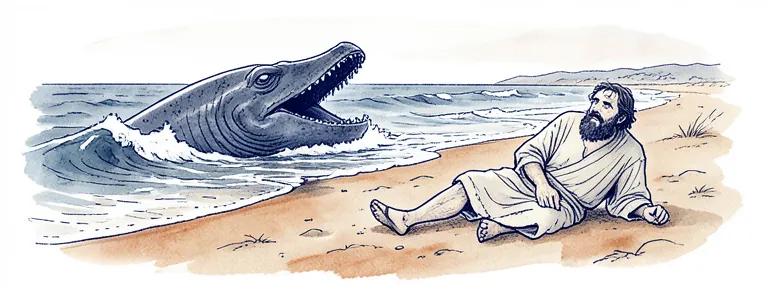
Jonah is a story about a prophet, with hardly any prophecy in it. God sends Jonah to Nineveh, the great city of Assyria, but he “rose up to flee to Tarshish” (1:3), as far the other way as a ship could take him. A storm, a crew of pagan sailors more devout than he is, and a huge fish that swallows him (1:17) bring him back. From inside the fish he prays a psalm of thanksgiving that ends, “Salvation belongs to Yahweh” (2:9).
Sent a second time, Jonah preaches a message of just five words in Hebrew: “In forty days, Nineveh will be overthrown!” (3:4). The whole city repents, from the king to the cattle. God relents (3:10), and Jonah is furious, because he knew God to be “a gracious God and merciful, slow to anger” (4:2). God makes a vine grow to shade him, then withers it, and ends the book with a question that Jonah never answers (4:11).
Author and date
The book tells its story in the third person and does not name its author. Jonah son of Amittai also appears in 2 Kings 14:25, prophesying in the reign of Jeroboam II.
Traditional view
Jewish and Christian tradition have read the book as an account of real events in the life of the 8th-century prophet, perhaps written by Jonah himself or someone close to him. Jesus speaks of Jonah in the fish and of the repentance of Nineveh (Matthew 12:39–41), which many take as confirming the history.
Academic view
Many scholars read Jonah as a story with a teaching purpose, like a parable or satire, written after the exile around a prophet known from Kings. They point to its Hebrew, which is typical of a later period; its “king of Nineveh” (3:6), a title Assyrian kings did not use; a city “three days’ journey across” (3:3); and the absence of any Assyrian record of the city’s repentance.
Both views read the book as a challenge to its hearers, pressed home by God’s closing question, and many who take it as history also see a carefully shaped story.
Audience and setting
Jonah was written for Israel. Its hearers knew Assyria as the empire that destroyed the northern kingdom in 722 BC, and the book of Nahum celebrates the fall of its capital, Nineveh. The story runs from Joppa on the coast of Israel toward Tarshish, usually placed in the far west of the Mediterranean, and then east to Nineveh on the Tigris, across the river from modern Mosul.
Genre, and how to read it
Jonah is a short story in four scenes, built on repetition and irony. The Hebrew word for “great” recurs: the great city, the great wind, the great fish, the sailors’ great fear. Everyone in the story responds to God except the prophet. The sailors pray and sacrifice, and the Ninevites fast in sackcloth, “both man and animal” (3:8), while Jonah flees, sleeps and sulks.
Its place among the prophets surprises some readers, since it tells a prophet’s story and records only one line of his preaching. It is fifth in the Twelve, the shorter prophets gathered on one scroll in the Hebrew Bible, and synagogues read it on the afternoon of Yom Kippur, the Day of Atonement, as a lesson in repentance. Jesus speaks of the sign of Jonah when asked for a sign (Matthew 12:39–41).
Great, evil, down, prepared
Jonah is told with a handful of Hebrew words used over and over, and English hides most of them by translating each one several ways. The same word is the great
city, the storm, the sailors’ fear and Jonah’s anger. Jonah goes down: to Joppa, into the ship, into its hold, and in his prayer to the bottoms of the mountains
. And God prepared
four things: a fish to save Jonah, then a vine, a worm and a wind to teach him.
gadol great 14
- 1:2 that great city
- 1:4 a great wind
- 1:4 a mighty storm
- 1:10 exceedingly afraid
- 1:12 this great storm
- 1:16 feared Yahweh exceedingly
- 1:17 a huge fish
- 3:2 that great city
- 3:3 an exceedingly great city
- 3:5 their greatest
- 3:7 his nobles
- 4:1 displeased Jonah exceedingly
- 4:6 exceedingly glad
- 4:11 that great city
ra‘ah evil 9
- 1:2 their wickedness
- 1:7 this evil
- 1:8 this evil
- 3:8 his evil way
- 3:10 their evil way
- 3:10 the disaster
- 4:1 it displeased Jonah
- 4:2 doing harm
- 4:6 his discomfort
yarad go down 4
manah appoint 4
- 1:17 prepared a huge fish
- 4:6 prepared a vine
- 4:7 prepared a worm
- 4:8 prepared a sultry east wind
Counted in the site’s Hebrew. The sharpest play is on ra‘ah: Nineveh turns from its evil way
, so God relents of the disaster
(3:10), and that is ra‘ah to Jonah, in Hebrew it was evil to Jonah, a great evil (4:1). Then the vine delivers him from his discomfort
, the same word again (4:6).
Slow to anger
On Sinai Yahweh proclaims his own name: merciful, gracious, slow to anger, abundant in loving kindness, forgiving, and yet by no means clearing the guilty (Exodus 34:6–7). Later writers quote it over and over, and each keeps the part they need. Jonah throws it back at God as a complaint, because it meant Nineveh would be spared. Nahum, preaching against the same Nineveh, keeps only slow to anger
, puts great in power
where the creed has loving kindness, and ends on the guilty.
| Passage | merciful | gracious | slow to anger | abundant in loving kindness | forgiving iniquity | relents from harm | by no means clear the guilty |
|---|---|---|---|---|---|---|---|
Exodus 34:6–7a merciful and gracious God, slow to anger, and abundant in loving kindness and truth |
yes | yes | yes | yes | yes | no | yes |
Numbers 14:18slow to anger, and abundant in loving kindness, forgiving iniquity and disobedience |
no | no | yes | yes | yes | no | yes |
Nehemiah 9:17gracious and merciful, slow to anger, and abundant in loving kindness |
yes | yes | yes | yes | no | no | no |
Psalm 86:15a merciful and gracious God, slow to anger |
yes | yes | yes | yes | no | no | no |
Psalm 103:8Yahweh is merciful and gracious, slow to anger |
yes | yes | yes | yes | no | no | no |
Psalm 145:8Yahweh is gracious, merciful, slow to anger, and of great loving kindness |
yes | yes | yes | yes | no | no | no |
Joel 2:13gracious and merciful, slow to anger, and abundant in loving kindness, and relents from sending calamity |
yes | yes | yes | yes | no | yes | no |
Jonah 4:2you are a gracious God and merciful, slow to anger, and abundant in loving kindness, and you relent of doing harm |
yes | yes | yes | yes | no | yes | no |
Nahum 1:3Yahweh is slow to anger, and great in power, and will by no means leave the guilty unpunished |
no | no | yes | power | no | no | yes |
Matched in the site’s Hebrew, phrase by phrase. Joel and Jonah add that God relents
from the harm he threatens, the very thing Jonah resents. Numbers 14:18 is Moses quoting the creed back to God to plead for Israel; Nehemiah and the Psalms keep only its mercy. Shorter echoes, gracious and merciful
alone, come in 2 Chronicles 30:9, Nehemiah 9:31 and Psalms 111:4 and 112:4.
Outline
- 1:1–1:17 Running from God — The flight to Tarshish, the storm, the sailors and the fish
- 2:1–2:10 Jonah’s prayer — A psalm from the belly of the fish
- 3:1–3:10 Nineveh repents — Forty days, sackcloth, and God relents
- 4:1–4:11 Jonah’s anger — The vine, the worm, and God’s question
Key themes
- God’s compassion
- God’s closing question sets his concern for Nineveh, with its “more than one hundred twenty thousand persons” and “also many animals,” against Jonah’s concern for a vine (4:11).
- Repentance
- “God saw their works, that they turned from their evil way” (3:10). The threat of judgement was an invitation to turn.
- The reluctant prophet
- Jonah confesses faith in the God “who has made the sea and the dry land” (1:9) while trying to escape him by sea, and knows God’s mercy well enough to resent it (4:2).
- The outsiders
- Pagan sailors and the people of an enemy city turn to God more readily than Israel’s prophet does (3:5).
- Salvation
- “Salvation belongs to Yahweh” (2:9), for a disobedient prophet and for Nineveh alike.
At a glance
Most mentioned: Jonah, Amittai
Main places: Nineveh, Tarshish, Joppa
In the Almanac: Casting lots