Nahum
A poem announcing the fall of Nineveh, capital of the Assyrian empire that had terrorised the Near East for more than a century.
Overview
Nahum is about one thing, the fall of Nineveh (1:1). It opens with a hymn to God as warrior and judge: “Yahweh is slow to anger, and great in power, and will by no means leave the guilty unpunished” (1:3). He comes in whirlwind and storm against his enemies, and he is “a stronghold in the day of trouble” for those who trust him (1:7). For Judah, long under Assyria’s power, Nineveh’s end is good news: “on the mountains the feet of him who brings good news, who publishes peace!” (1:15).
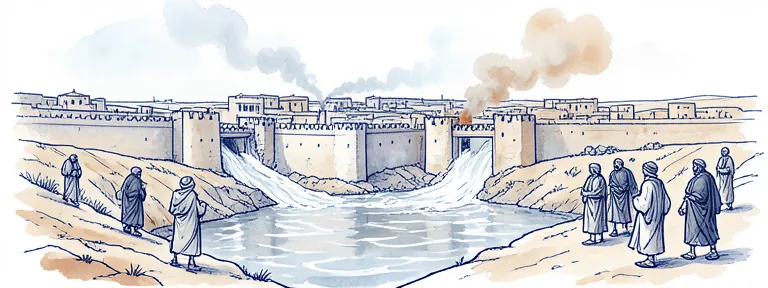
Chapters 2 and 3 picture the attack with fierce immediacy: red shields, chariots racing through the streets, river gates opened, “the palace is dissolved” (2:6), and the plunder carried away. Nineveh is “the bloody city” (3:1), and it will fall as surely as Thebes in Egypt, which the book calls No-Amon, fell to Assyria (3:8). The book ends with a question to the king of Assyria: “who hasn’t felt your endless cruelty?” (3:19).
Author and date
Its heading reads “The book of the vision of Nahum the Elkoshite” (1:1). Nothing else is known of him, and no one knows for certain where Elkosh was.
Traditional view
Nahum wrote before Nineveh fell, foretelling its destruction. He speaks of the fall of Thebes, which Assyria sacked in 663 BC, as past (3:8), and of Nineveh as still standing. Some date him soon after 663 BC, others close to 612 BC, when the city fell to the Babylonians and Medes.
Academic view
Most academic scholars also place Nahum’s poems between 663 and 612 BC. Some think the book took its final shape after Nineveh fell, perhaps for use in worship. They see the opening hymn as added or adapted to frame the poems. It is a partial acrostic: its lines begin with successive letters of the Hebrew alphabet.
Both views date the core of the book to the decades of Assyria’s decline, between the fall of Thebes and the fall of Nineveh.
Audience and setting
Nahum wrote for Judah, a small kingdom that had paid tribute to Assyria for generations, seen the northern kingdom deported and watched Sennacherib besiege Jerusalem in 701 BC. The book’s name means “comfort,” and for its first hearers the end of Nineveh was a comfort. Its setting is Nineveh itself, on the Tigris, with its walls, river gates and palace.
Genre, and how to read it
Nahum is war poetry, among the most vivid in the Bible, and it neither calls Nineveh to repent nor rebukes Judah. Many readers pair it with Jonah, the other of the twelve shorter prophets devoted to Nineveh. Both draw on God’s description of himself in Exodus 34:6–7: Jonah stresses his mercy (Jonah 4:2), and Nahum his justice (1:3). Both also end with a question.
Its delight in an enemy’s destruction troubles some readers. Others note that Assyrian royal inscriptions boast of flaying, impaling and deporting conquered peoples, and read Nahum as God’s answer to that cruelty: “Yahweh takes vengeance on his adversaries” (1:2). The herald bringing good news in 1:15 reappears in Isaiah 52:7, which Paul quotes in Romans 10:15.
Slow to anger
On Sinai Yahweh proclaims his own name: merciful, gracious, slow to anger, abundant in loving kindness, forgiving, and yet by no means clearing the guilty (Exodus 34:6–7). Later writers quote it over and over, and each keeps the part they need. Jonah throws it back at God as a complaint, because it meant Nineveh would be spared. Nahum, preaching against the same Nineveh, keeps only slow to anger
, puts great in power
where the creed has loving kindness, and ends on the guilty.
| Passage | merciful | gracious | slow to anger | abundant in loving kindness | forgiving iniquity | relents from harm | by no means clear the guilty |
|---|---|---|---|---|---|---|---|
Exodus 34:6–7a merciful and gracious God, slow to anger, and abundant in loving kindness and truth |
yes | yes | yes | yes | yes | no | yes |
Numbers 14:18slow to anger, and abundant in loving kindness, forgiving iniquity and disobedience |
no | no | yes | yes | yes | no | yes |
Nehemiah 9:17gracious and merciful, slow to anger, and abundant in loving kindness |
yes | yes | yes | yes | no | no | no |
Psalm 86:15a merciful and gracious God, slow to anger |
yes | yes | yes | yes | no | no | no |
Psalm 103:8Yahweh is merciful and gracious, slow to anger |
yes | yes | yes | yes | no | no | no |
Psalm 145:8Yahweh is gracious, merciful, slow to anger, and of great loving kindness |
yes | yes | yes | yes | no | no | no |
Joel 2:13gracious and merciful, slow to anger, and abundant in loving kindness, and relents from sending calamity |
yes | yes | yes | yes | no | yes | no |
Jonah 4:2you are a gracious God and merciful, slow to anger, and abundant in loving kindness, and you relent of doing harm |
yes | yes | yes | yes | no | yes | no |
Nahum 1:3Yahweh is slow to anger, and great in power, and will by no means leave the guilty unpunished |
no | no | yes | power | no | no | yes |
Matched in the site’s Hebrew, phrase by phrase. Joel and Jonah add that God relents
from the harm he threatens, the very thing Jonah resents. Numbers 14:18 is Moses quoting the creed back to God to plead for Israel; Nehemiah and the Psalms keep only its mercy. Shorter echoes, gracious and merciful
alone, come in 2 Chronicles 30:9, Nehemiah 9:31 and Psalms 111:4 and 112:4.
Outline
- 1:1–1:8 The avenging God — A hymn of storm and earthquake, and a refuge for the trusting
- 1:9–1:15 Judah freed — The yoke broken, and good news on the mountains
- 2:1–2:13 Nineveh attacked — The siege, the plunder, and the lions’ den emptied
- 3:1–3:19 Woe to the bloody city — Thebes remembered, and a wound that will not heal
Key themes
- Justice
- God is patient, but he “will by no means leave the guilty unpunished” (1:3). An empire built on violence answers for it.
- Refuge
- “Yahweh is good, a stronghold in the day of trouble; and he knows those who take refuge in him” (1:7).
- Good news
- The runner on the mountains brings peace and the call to Judah to “Keep your feasts” (1:15), because the oppressor is gone.
- The end of empire
- Nineveh, once the den where the lion hunted and “no one made them afraid” (2:11), ends with every nation clapping at the news (3:19).
At a glance
Most mentioned: Jacob (Israel), Nahum