Obadiah
The shortest book of the Old Testament announces judgement on Edom for turning on its brother Judah, and looks to the day when “the kingdom will be Yahweh’s.”
Overview
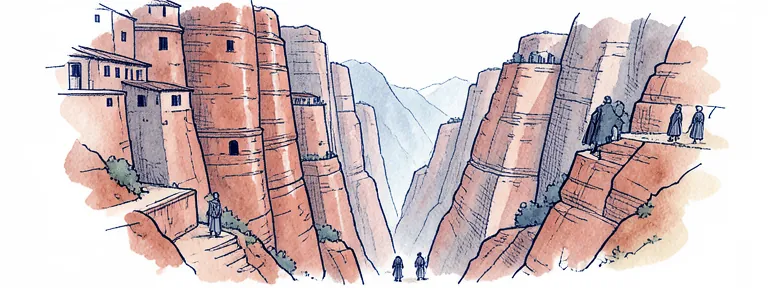
Obadiah is a single oracle, or message from God, just twenty-one verses long, against Edom. Edom was the nation descended from Jacob’s brother Esau, in the rugged hill country south-east of the Dead Sea. Its mountain strongholds made Edom proud: “Who will bring me down to the ground?” (1:3). God answers that even if its nest is “set among the stars,” he will bring it down (1:4).
The charge is betrayal. When foreigners entered Jerusalem’s gates and cast lots for the city, Edom “stood on the other side” (1:11), then gloated, looted and handed over survivors. Obadiah widens the judgement to every nation: “As you have done, it will be done to you” (1:15). The book ends with the exiles returning, Mount Zion holy, and the promise that “the kingdom will be Yahweh’s” (1:21).
Author and date
The book is headed “The vision of Obadiah” (1:1) and says nothing more about him. The name was a common one. The main question is which disaster in Jerusalem it describes.
Traditional view
Jewish tradition (the Talmud) identifies him with the Obadiah who hid the prophets from Ahab and Jezebel (1 Kings 18). Some traditional scholars link the book to the Philistine and Arab raid on Jerusalem under King Jehoram in the 9th century (2 Chronicles 21:16–17). That would make it one of the earliest prophetic books. Others accept a 6th-century setting.
Academic view
Most scholars connect the book with the Babylonian destruction of Jerusalem in 586 BC, when Edom is remembered as siding with the conquerors (Psalm 137:7, Ezekiel 25:12–14). Some see the closing verses, about the day of Yahweh when God judges every nation, as a later extension of an oracle first aimed at Edom alone.
Both views note that 1:1–9 closely overlaps Jeremiah’s oracle against Edom (Jeremiah 49:7–22). They explain this either as one prophet drawing on the other, or as both drawing on an older oracle.
Audience and setting
Obadiah speaks about Edom but for Judah, a people who had seen their city plundered and been betrayed by their kin. Behind it lies the rivalry of two brother nations, Jacob and Esau, which runs from Genesis 25 through the whole Old Testament. Obadiah calls Edom’s crime “the violence done to your brother Jacob” (1:10).
Genre, and how to read it
Obadiah is a short, intense poem that reads well in one sitting. It moves from Edom’s pride to its crimes. The crimes are told as a string of commands, such as “don’t look down on your brother in the day of his disaster” (1:12), as though the prophet stood in that moment urging Edom to stop. Then it turns to the day of Yahweh.
Readers sometimes find its anger hard. Many take it as a word to victims, a promise that betrayal will not have the last word and that a just God rules the nations. It is the fourth book of the Twelve, the shorter prophets gathered on one scroll in the Hebrew Bible, It picks up the mention of “the remnant of Edom” near the end of Amos, the book before it (Amos 9:12).
The day of Yahweh
“The day of Yahweh”, the day God comes in judgement, is named 16 times in the Old Testament, every one of them in the prophets, and 5 of them in Joel. Again and again it is near
or at hand
. Amos turns the hope on its head, telling those who long for it that it is darkness, and not light
.
- Isaiah 2
- Ezekiel 1
- Joel 5
- Amos 3
-
Obadiah 1
- 1:15
the day of Yahweh is near all the nations
- 1:15
- Zephaniah 3
-
Malachi 1
- 4:5
the great and terrible day of Yahweh
- 4:5
Counted in the site’s Hebrew as yom followed by the divine name. The hollow marks are the Hebrew’s a day for Yahweh, a different turn of phrase that the WEB also renders as Yahweh’s day. Malachi’s is the last in the Old Testament, with Elijah sent before it; at Pentecost Peter quotes Joel’s, before the great and glorious day of the Lord comes
(Acts 2:20).
Outline
- 1:1–1:9 Edom brought down — Pride in its mountain strongholds, and a fall
- 1:10–1:14 Edom’s crimes — Gloating and plunder on the day of Jerusalem’s disaster
- 1:15–1:21 The day of Yahweh — The nations judged, Zion restored, the kingdom Yahweh’s
Key themes
- Pride
- “The pride of your heart has deceived you” (1:3). Edom trusted its heights, and the book brings it down.
- Brotherhood betrayed
- Edom’s guilt is sharper because Judah was its brother (1:10); to stand by and rejoice at his ruin is itself a crime (1:12).
- Deeds repaid
- “Your deeds will return upon your own head” (1:15). The judgement matches the wrong.
- The kingdom of God
- The book ends beyond Edom, with deliverance on Mount Zion (1:17) and the kingdom belonging to Yahweh (1:21).
At a glance
Most mentioned: Esau (Edom), Jacob (Israel), Benjamin (patriarch), Ephraim, Joseph (son of Jacob)
Main places: Mount of Esau, Edom, Jerusalem, Mount Zion, Negeb