Philippians
Written from prison to a church Paul loved, a letter of thanks and joy that holds up Christ’s humility as the pattern for life together.
Overview
Philippians is Paul’s warmest letter. He writes from prison to thank the church for a gift brought by Epaphroditus (4:18), to report on his own situation, and to encourage believers who face opposition and some friction among themselves. His trial could end in death, yet he is calm: “For to me to live is Christ, and to die is gain” (1:21). Joy runs through the letter, down to “Rejoice in the Lord always!” (4:4).
At its centre is a passage many scholars think was an early Christian hymn (2:6–11). Christ, “existing in the form of God” (2:6), “emptied himself, taking the form of a servant” (2:7), and became obedient to death on a cross. For this reason God “highly exalted him” (2:9). Paul offers this as the model for his readers’ own attitude: “Have this in your mind, which was also in Christ Jesus” (2:5). In chapter 3 he warns sharply against those urging circumcision, and counts his own impressive past “as a loss for Christ” (3:7).
Author and date
The letter is from Paul and Timothy (1:1), and it is among the letters almost all scholars accept as Paul’s. Where he was imprisoned is uncertain.
Scholarly consensus
The traditional setting is Paul’s house arrest in Rome around AD 60–62 (Acts 28), which fits his mention of “the whole palace guard” (1:13) and “Caesar’s household” (4:22). Many scholars prefer an imprisonment in Ephesus around AD 54–55, not recorded in Acts. That would better explain the several journeys between Paul and Philippi that the letter mentions. A few suggest Caesarea, around AD 57–59 (Acts 23–26).
Some scholars think Philippians joins two or three shorter letters, pointing to the abrupt change of tone at 3:2 just after “Finally, my brothers” (3:1), and to Paul’s thanks for the gift coming only at the end (4:10–20). Others read it as a single letter.
Audience and setting
Philippi was a Roman colony in Macedonia on the Via Egnatia, the main Roman road across the region. It was settled with army veterans and proud of its Roman status. Paul founded the church on his second journey, and Acts 16 tells of Lydia, a dealer in purple cloth, and of a jailer who believed after an earthquake. The church supported Paul from the start; he says no other church shared with him “in the matter of giving and receiving” (4:15). When he writes, the believers face adversaries (1:28), and two women who had worked beside him, Euodia and Syntyche, are at odds (4:2).
Genre, and how to read it
Philippians reads like a family letter, full of news about Paul, Timothy and Epaphroditus and of the language of friendship. Paul thanks God for the church’s “partnership in furtherance of the Good News” (1:5), and scholars often compare the letter with ancient letters between friends. Its instructions grow out of that relationship: stand firm, be united, rejoice.
The hymn of 2:6–11 is one of the most discussed passages in the New Testament, for what it says about who Christ is and what his self-emptying means. Christians of every tradition draw on it in teaching and worship. In a Roman colony proud of its status, Paul’s line “our citizenship is in heaven” (3:20) had a special point. The popular verse “I can do all things through Christ who strengthens me” (4:13) comes where Paul is speaking of having learned to be content in plenty and in need (4:11).
Joy from prison
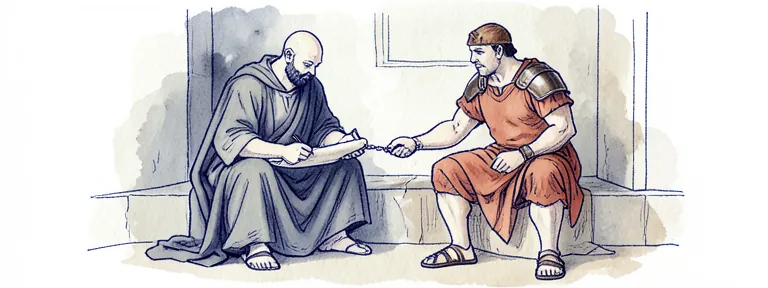
Paul writes Philippians in my bonds
(1:13), and it is the most joyful letter he wrote. Its words for joy, chara (joy), chairō (rejoice) and synchairō (rejoice with), come 16 times in 1,630 Greek words: about one word in a hundred, more than twice as often as in any other letter of his. Four of his letters never use them.
- Philippians 9.8 16 in 1,630
- 1 Thessalonians 4.1 6 in 1,473
- Philemon 3.0 1 in 335
- 2 Corinthians 2.9 13 in 4,469
- Colossians 1.9 3 in 1,575
- Romans 1.0 7 in 7,100
- 1 Corinthians 0.9 6 in 6,820
- 2 Timothy 0.8 1 in 1,237
- Galatians 0.4 1 in 2,228
- Ephesians 0.0 0 in 2,419
- 2 Thessalonians 0.0 0 in 822
- 1 Timothy 0.0 0 in 1,588
- Titus 0.0 0 in 658
Joy in Philippians: 1:4, 1:18 ×2, 1:25, 2:2, 2:17 ×2, 2:18 ×2, 2:28, 2:29, 3:1, 4:1, 4:4 ×2, 4:10
Counted in the site’s Greek, against each letter’s length in Greek words; Philemon’s rate is one word in a very short letter. The bonds come in chapter 1, where his bonds have become known to the whole palace guard
(1:13); the joy runs through the whole letter, to Rejoice in the Lord always!
(4:4). The fourth mention of bonds is 1:16 in the WEB, which keeps verses 16 and 17 in the other order from the Greek.
Outline
- 1:1–1:11 Greeting, thanks and prayer — Partners in the Good News
- 1:12–1:26 Paul in prison — The Good News advances; to live is Christ
- 1:27–2:18 Humility — Christ’s self-emptying as the pattern
- 2:19–2:30 Timothy and Epaphroditus — Two trusted messengers
- 3:1–4:1 Warnings and Paul’s past — Loss for Christ, pressing on toward the goal
- 4:2–4:9 Appeals — A plea to Euodia and Syntyche, joy, the peace of God
- 4:10–4:23 Thanks for the gift — Contentment, generosity and greetings
Key themes
- Joy
- Joy and rejoicing run through all four chapters. Paul rejoices that Christ is proclaimed even by rivals (1:18) and asks the church to “be glad and rejoice with me” (2:18).
- The humble Christ
- Because Christ humbled himself (2:8), “at the name of Jesus every knee should bow” (2:10).
- Partnership
- The church has shared in Paul’s work from the first (1:5), and their gift is “a sweet-smelling fragrance, an acceptable and well-pleasing sacrifice to God” (4:18).
- Knowing Christ
- Paul counts everything a loss “for the excellency of the knowledge of Christ Jesus, my Lord” (3:8), and presses on “toward the goal” (3:14).
- Peace
- “In nothing be anxious” (4:6), and “the peace of God, which surpasses all understanding, will guard your hearts and your thoughts in Christ Jesus” (4:7).
At a glance
Most mentioned: Jesus Christ, Epaphroditus, Timotheus, Benjamin (patriarch), Clement
Main places: Macedonia, Philippi, Thessalonica