Ruth
A Moabite widow’s loyalty to her Israelite mother-in-law leads to a new family and, in time, to King David.
Overview
Ruth is set “in the days when the judges judged” (1:1) and could hardly be more different from Judges. A famine drives an Israelite family from Bethlehem to Moab, where the father and both sons die. Naomi, the widowed mother, returns home empty with her daughter-in-law Ruth, a Moabite who refuses to leave her: “Your people will be my people, and your God my God” (1:16).
In Bethlehem Ruth gleans in the fields of Boaz, a relative of Naomi’s husband. Through a night scene at the threshing floor and a legal negotiation at the town gate, Boaz redeems the family’s land and marries Ruth. Their son Obed is the grandfather of David (4:17), and the book ends with a genealogy that turns a family story into the story of where Israel’s king came from.
Author and date
Ruth does not name its author, and its date is genuinely uncertain.
Traditional view
Jewish tradition (the Talmud, the classic collection of rabbinic teaching) credits Samuel. The closing genealogy ends with David, which fits a date early in his family’s rise.
Academic view
Scholars are divided. Some date it to the monarchy because its Hebrew is in the classical style of that period. Others place it after the Babylonian exile and read its sympathetic Moabite heroine as a quiet answer to the ban on foreign marriages in Ezra and Nehemiah.
Audience and setting
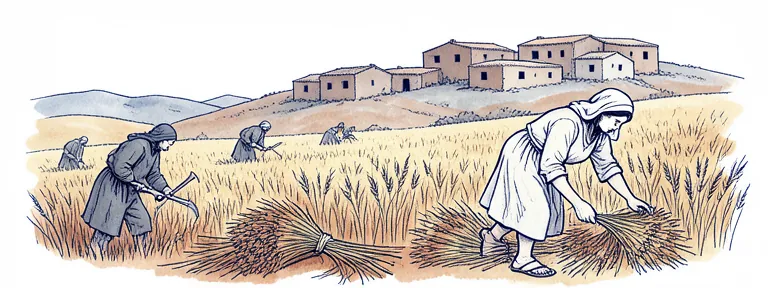
Ruth was written for Israel, and its readers would know what Moab meant: a people descended from Lot, barred from the assembly in Deuteronomy 23, and remembered as an enemy. The setting is Bethlehem in Judah at barley and wheat harvest: its fields, its threshing floor and its town gate, where legal business was done before the elders.
Genre, and how to read it
Ruth is a carefully built short story in four scenes, one per chapter, with most of its meaning carried by dialogue and by repeated words. Naomi, whose name means “pleasant,” asks to be called Mara, “bitter” (1:20). The story is about how her emptiness becomes fullness.
Two customs make it work. Gleaning let the poor gather what harvesters left behind (Leviticus 19:9–10). And a “redeemer” (Hebrew go’el), a near relative, was responsible for buying back family land and caring for a dead man’s family. Ruth’s request that Boaz “spread the corner of your garment over your servant” (3:9) asks him to be that redeemer.
Return, kindness, redeem
Ruth turns on two Hebrew words. Chapter 1 is about going back: shuv, return, comes 12 times in its 22 verses, as three widows decide who will return where. Chapters 3 and 4 are about buying back: ga’al, redeem, comes 23 times, 5 of them in one verse at the town gate. English half hides it: the WEB says redeem
for the act but near kinsman
for the one who does it.
shuv return 15
- 1:6 that she might return
- 1:7 to return to the land of Judah
- 1:8 return each of you
- 1:10 we will return with you
- 1:11 Go back, my daughters
- 1:12 Go back, my daughters, go your way
- 1:15 has gone back to her people
- 1:15 Follow your sister-in-law
- 1:16 to return from following you
- 1:21 brought me home again
- 1:22 So Naomi returned
- 1:22 who returned out of the country of Moab
- 2:6 who came back with Naomi
- 4:3 who has come back
- 4:15 a restorer of life
chesed kindness 3
- 1:8 deal kindly with you
- 2:20 his kindness
- 3:10 more kindness
ga’al redeem 23
- 2:20 one of our near kinsmen
- 3:9 you are a near kinsman
- 3:12 I am a near kinsman
- 3:12 a kinsman nearer than I
- 3:13 the part of a kinsman
- 3:13 the kinsman’s duty
- 3:13 will not do the duty of a kinsman
- 3:13 I will do the duty of a kinsman
- 4:1 the near kinsman of whom Boaz spoke
- 4:3 He said to the near kinsman
- 4:4 If you will redeem it
- 4:4 redeem it; but
- 4:4 if you will not redeem it
- 4:4 no one to redeem it
- 4:4 I will redeem it
- 4:6 The near kinsman said
- 4:6 I can’t redeem it for myself
- 4:6 Take my right
- 4:6 my right of redemption
- 4:6 for I can’t redeem it
- 4:7 concerning redeeming
- 4:8 So the near kinsman said
- 4:14 without a near kinsman
reqam empty 2
- 1:21 brought me home again empty
- 3:17 Don’t go empty
Counted in the site’s Hebrew; in 4:6 its text carries one word twice, as written and as read, and it is counted once. Naomi comes home empty
(1:21), and Boaz sends Ruth back to her with barley so she does not go empty
(3:17). At the end the women call the child a restorer of life
(4:15), the same verb that opened the book: the one who brings back.
Outline
- 1:1–1:22 From Moab to Bethlehem — Famine, three deaths, and Ruth’s pledge to Naomi
- 2:1–2:23 In Boaz’s field — Ruth gleans, and Boaz shows her kindness
- 3:1–3:18 At the threshing floor — Naomi’s plan, and Ruth’s request
- 4:1–4:22 At the town gate — The redemption, the marriage, and the line to David
Key themes
- Loyal love
- The Hebrew word hesed, loyalty that goes beyond duty, runs through the book: in Ruth toward Naomi, in Boaz toward both, and in God behind them all (2:20).
- The outsider welcomed
- A Moabite woman comes to Israel’s God, “under whose wings” she takes refuge (2:12), and becomes an ancestor of David and, in Matthew’s genealogy, of Jesus.
- Redemption
- Boaz’s act as redeemer (4:9) gives a human face to a word that later biblical writers use for God.
- Providence in ordinary life
- God does nothing miraculous here. Ruth simply “happened” to glean in Boaz’s field (2:3), and the story lets the reader see the hand behind the chance.
At a glance
Most mentioned: Naomi, Boaz, Ruth, Moab, Elimelech
In the Almanac: Ephah