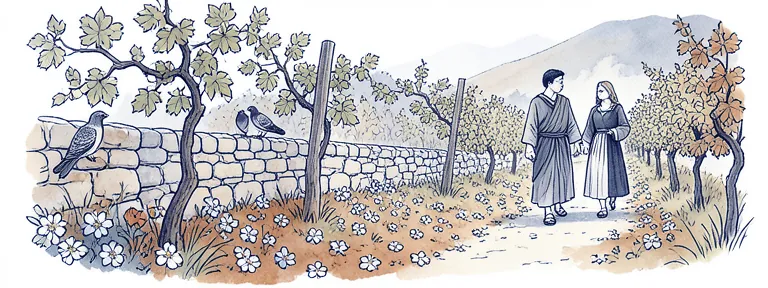
Song of Solomon
A sequence of love poems in which a woman and a man speak of their desire for each other, and of love “strong as death.”
Overview
The Song of Songs, also called the Song of Solomon, is a collection of love poetry. Its title, “The Song of songs” (1:1), means the greatest of songs. Most of it is spoken by two lovers, a young woman and the man she calls “my beloved,” with a chorus of “daughters of Jerusalem.” They praise each other’s beauty in rich images drawn from gardens, vineyards, spices, animals and the landscape of Israel, and they long for each other when apart.
The woman speaks more than anyone else in the book, and she opens it: “Let him kiss me with the kisses of his mouth” (1:2). Twice she searches for her beloved at night through the city streets. Three times she charges the daughters of Jerusalem “that you not stir up, nor awaken love, until it so desires” (2:7). Near the end comes the book’s central claim: “love is strong as death” (8:6).
Author and date
The title reads “which is Solomon’s” (1:1), and Solomon is named several times in the poems, though he does not appear to be the speaker throughout.
Traditional view
Jewish and Christian tradition take the title as a statement of authorship. 1 Kings 4:32 says that Solomon’s songs numbered 1,005, and the poems’ images of Lebanon, Tirzah, Jerusalem and En Gedi fit his day, when Israel was still a single kingdom.
Academic view
Many scholars note that the Hebrew phrase in the title can also mean “for Solomon” or “about Solomon.” Some date the poems late, in the Persian or Hellenistic (Greek) period, because of features of their Hebrew and words borrowed from other languages. Others argue for an early date, or see an anthology of love songs from different periods.
Audience and setting
The poems may first have been sung at weddings or other celebrations, though the book gives no setting of its own. Its imagery ranges over the whole land, from Lebanon and Mount Hermon in the north to En Gedi by the Dead Sea, and it comes back often to Jerusalem. In Jewish practice the Song is read at Passover.
Genre, and how to read it
The Song is poetry, and it is not always clear who is speaking; many translations add headings for the woman, the man and the friends. Readers disagree on its structure. Some find a story with a wedding at its centre (3:6–5:1); some even find a drama with a king and a rival shepherd. Others read a loosely linked collection held together by refrains.
For most of its history the Song was read as allegory. Jewish interpreters, including the Targum (an ancient Aramaic paraphrase), read it as the love between God and Israel, and Rabbi Akiva called it the holy of holies among the scriptures. Christian writers such as Origen and Bernard of Clairvaux read it as the love between Christ and the church, or Christ and the soul. Many modern readers take it first as poetry celebrating love between a man and a woman, and many hold the two readings together.
My beloved, my love
The Song’s two lovers have their own words for each other. Her name for him is dod, my beloved
, and the word comes 39 times in all, 13 of them in chapter 5, where she searches the city for him and the daughters of Jerusalem ask what makes him better than any other. His for her is ra‘yah, my love
, 9 times. And three times the same oath stops the poem, I adjure you, daughters of Jerusalem
, that you not stir up, nor awaken love, until it so desires
(2:7).
dod beloved 39
- 1:2 your love is better than wine
- 1:4 We will praise your love more than wine
- 1:13 My beloved is to me
- 1:14 My beloved is to me
- 1:16 you are beautiful, my beloved
- 2:3 so is my beloved among the sons
- 2:8 The voice of my beloved!
- 2:9 My beloved is like a roe
- 2:10 My beloved spoke
- 2:16 My beloved is mine
- 2:17 turn, my beloved
- 4:10 How beautiful is your love
- 4:10 How much better is your love than wine
- 4:16 Let my beloved come into his garden
- 5:1 drink abundantly, beloved
- 5:2 the voice of my beloved who knocks
- 5:4 My beloved thrust his hand
- 5:5 I rose up to open for my beloved
- 5:6 I opened to my beloved
- 5:6 but my beloved left
- 5:8 If you find my beloved
- 5:9 How is your beloved better
- 5:9 than another beloved, you fairest
- 5:9 How is your beloved better than another beloved, that
- 5:9 another beloved, that you do so adjure us
- 5:10 My beloved is white and ruddy
- 5:16 This is my beloved
- 6:1 Where has your beloved gone
- 6:1 Where has your beloved turned
- 6:2 My beloved has gone down
- 6:3 I am my beloved’s
- 6:3 and my beloved is mine
- 7:9 smoothly for my beloved
- 7:10 I am my beloved’s. His desire
- 7:11 Come, my beloved!
- 7:12 There I will give you my love.
- 7:13 stored up for you, my beloved
- 8:5 leaning on her beloved
- 8:14 Come away, my beloved!
ra‘yah my love 9
shava adjure 5
Counted in the site’s Hebrew. Dod also means love itself, so a few uses read your love
, and in 4:10 it is the man who says it; the WEB keeps both senses. The refrain comes at 2:7, 3:5 and 8:4; at 5:8 the oath turns into a request to find him, and at 5:9 the daughters throw it back. Who speaks each line is not marked in the Hebrew, though the grammar usually shows whether a man or a woman is speaking.
Outline
- 1:1–2:7 Longing — The title, and the lovers’ first words to each other
- 2:8–3:5 Spring, and a search at night — “Arise, my love,” and the beloved lost and found
- 3:6–5:1 The wedding — Solomon’s procession, praise of the bride, the garden
- 5:2–6:3 Lost again — A second night search, and the woman’s praise of her beloved
- 6:4–8:4 Praise renewed — The man praises the woman, and she longs for him
- 8:5–8:14 Love strong as death — The seal on the heart, the vineyard, a last call
Key themes
- Love and desire
- The book celebrates physical love openly and without embarrassment: “My beloved is mine, and I am his” (2:16).
- Mutuality
- The lovers speak as equals, and the woman’s voice leads. The refrain is turned both ways: “I am my beloved’s, and my beloved is mine” (6:3).
- Patience
- The warning not to “awaken love, until it so desires” (2:7, 3:5, 8:4) sets love in its proper time.
- Love’s strength
- “Many waters can’t quench love” (8:7). The book’s one possible mention of God comes here, when love’s flashes are called “a very flame of Yah” (8:6).
At a glance
Most mentioned: Solomon, David, Kedar, Pharaoh (of the Exodus)
Main places: Jerusalem, Lebanon, Gilead, Amana, Baal-hamon