Titus
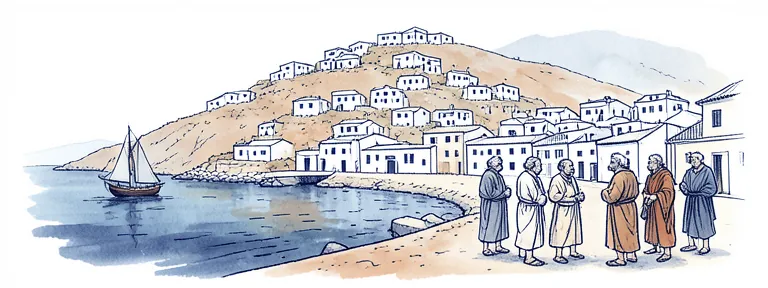
Paul’s instructions to Titus on Crete: appoint trustworthy elders, silence empty talkers, and teach a way of life that shows the grace of God.
Overview
Paul has left Titus on Crete “that you would set in order the things that were lacking and appoint elders in every city” (1:5). The letter sets out what such elders must be: blameless in family life and character, and able to hold to sound teaching (1:9). They are needed because there are “many unruly men, vain talkers and deceivers” (1:10) upsetting whole households. Paul quotes a Cretan poet, traditionally identified as Epimenides, against them: “Cretans are always liars, evil beasts, and idle gluttons” (1:12).
Chapter 2 gives instructions for older and younger men and women and for slaves, each to live so as to “adorn the doctrine of God, our Savior, in all things” (2:10). Twice the letter roots this way of life in a brief summary of the gospel. The first says “the grace of God has appeared, bringing salvation to all men” (2:11); the second, that God saved us “not by works of righteousness which we did ourselves” but “through the washing of regeneration and renewing by the Holy Spirit” (3:5). The letter closes with travel plans: Titus is to join Paul at Nicopolis, where Paul means to spend the winter (3:12).
Author and date
The letter names Paul as its author and Titus as its recipient (1:1–4). It is one of the three Pastoral Epistles (1 and 2 Timothy and Titus, letters to individuals caring for churches), whose authorship is widely debated.
Traditional view
Acts mentions Crete only as a stop on Paul’s voyage to Rome as a prisoner (Acts 27). So this view places the mission there after his release from his first imprisonment in Rome. Paul then left Titus behind and planned to winter at Nicopolis, probably the city of that name in western Greece. Titus shares the style of 1 Timothy because Paul wrote both at about the same time.
Academic view
Most academic scholars think that Titus, like the other Pastorals, was written by someone else in Paul’s name. Some see it as the most formal of the three: a set of rules for church life in the form of a letter, with little personal material. They read its concern for elders, sound teaching and respectable household life as the concerns of a church settling in for the long term.
Both views note that the elders of 1:5 are called “the overseer” in 1:7, and many on both sides take this to mean the two titles were still used for the same leaders.
Audience and setting
Titus was a Greek co-worker of Paul. Paul took him to a meeting in Jerusalem without his being circumcised (Galatians 2:3), and later sent him to Corinth during the crisis described in 2 Corinthians. The churches on Crete were young or unorganised, and the troublemakers included “those of the circumcision” (1:10), apparently teachers promoting “Jewish fables and commandments of men” (1:14) and rules about purity (1:15).
Genre, and how to read it
Titus is short and practical, close to 1 Timothy in its concerns, and is best read alongside it. Its three chapters move from church leaders, to conduct in the household, to life in wider society, where believers are “to be in subjection to rulers and to authorities” and ready “for every good work” (3:1).
The two gospel summaries (2:11–14 and 3:4–7) are among the fullest in the Pastorals. 2:13 speaks of “our great God and Savior, Jesus Christ,” often cited for the divinity of Christ, though the Greek can also be read as naming God and Christ separately. The “washing of regeneration” (3:5) is read by many Catholic, Orthodox, Lutheran and Anglican Christians as a reference to baptism, and by others as the spiritual cleansing that baptism signifies.
What an overseer must be
Two letters give a list of what an overseer must be, one to Timothy in Ephesus and one to Titus in Crete. They agree on 9 qualities, 5 of them in the same Greek word: the husband of one wife, sensible, hospitable, no drinker, not violent. Each also has its own. Only 1 Timothy rules out a new convert and asks for a good name with outsiders; only Titus asks that he be holy, fair and self-controlled, and calls him God’s steward
.
-
without reproach
1 Timothy 3:2 Above reproach different words, same idea Titus 1:6blameless
-
the husband of one wife
1 Timothy 3:2 One wife same Greek word Titus 1:6the husband of one wife
-
sensible
1 Timothy 3:2 Sensible same Greek word Titus 1:8sober minded
-
hospitable
1 Timothy 3:2 Hospitable same Greek word Titus 1:8given to hospitality
-
good at teaching
1 Timothy 3:2 Able to teach different words, same idea Titus 1:9able to exhort in the sound doctrine
-
not a drinker
1 Timothy 3:3 No drinker same Greek word Titus 1:7not given to wine
-
not violent
1 Timothy 3:3 Not violent same Greek word Titus 1:7not violent
-
not covetous
1 Timothy 3:3 Not after money different words, same idea Titus 1:7not greedy for dishonest gain
-
having children in subjection
1 Timothy 3:4 His children different words, same idea Titus 1:6having children who believe
-
temperate
1 Timothy 3:2 Temperate only in 1 Timothy -
modest
1 Timothy 3:2 Respectable only in 1 Timothy -
gentle
1 Timothy 3:3 Gentle only in 1 Timothy -
not quarrelsome
1 Timothy 3:3 Not quarrelsome only in 1 Timothy -
not a new convert
1 Timothy 3:6 Not a new convert only in 1 Timothy -
good testimony from those who are outside
1 Timothy 3:7 Well thought of outside only in 1 Timothy -
God’s steward only in Titus
Titus 1:7
as God’s steward
-
Not self-willed only in Titus
Titus 1:7
not self-pleasing
-
Not quick-tempered only in Titus
Titus 1:7
not easily angered
-
Loves what is good only in Titus
Titus 1:8
a lover of good
-
Fair only in Titus
Titus 1:8
fair
-
Holy only in Titus
Titus 1:8
holy
-
Self-controlled only in Titus
Titus 1:8
self-controlled
Matched in the site’s Greek. Titus names the same men elders first, appoint elders in every city
(Titus 1:5), then overseers. In 1 Timothy 3:3 the WEB also has not greedy for money
, from manuscripts that repeat Titus’ word; the site’s Greek there has only aphilargyros, not covetous. 1 Timothy goes on to a second list, for servants or deacons (1 Timothy 3:8).
Outline
- 1:1–1:4 Greeting — To Titus, “my true child according to a common faith”
- 1:5–1:9 Elders in every city — Blameless, and holding to the faithful word
- 1:10–1:16 Empty talkers — A Cretan proverb, and the pure and the defiled
- 2:1–2:15 Sound teaching for every household — Old and young, slaves, the grace that trains
- 3:1–3:11 Good works in the world — Saved by mercy; avoiding quarrels
- 3:12–3:15 Plans and greetings — Nicopolis, Zenas and Apollos
Key themes
- Sound doctrine
- “But say the things which fit sound doctrine” (2:1).
- Good works
- Christ gave himself to make a people “zealous for good works” (2:14), and believers are to “be careful to maintain good works” (3:8).
- Grace that trains
- God’s grace is “instructing us” to “live soberly, righteously, and godly in this present age” (2:12).
- Saved by mercy
- God saved his people “according to his mercy” (3:5), “that being justified by his grace, we might be made heirs according to the hope of eternal life” (3:7).
- Character in leaders
- An overseer must be “not self-pleasing, not easily angered, not given to wine, not violent” (1:7).
At a glance
Most mentioned: Jesus Christ, Apollos, Artemas, Paul, Titus