Covenants
The agreements God makes and keeps, in the order they are cut — who each one is with, when it was made, where scripture records it, and the stretch of text it governs.
The Edenic Covenant
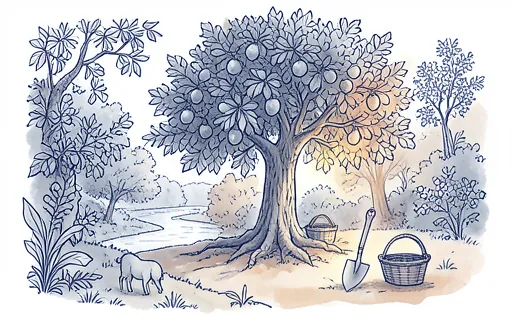
The terms of life in the garden before the Fall: fill the earth and subdue it, rule the creatures, eat freely of every tree but one. The penalty for the single prohibition is death.
Everything in it is given before anything is asked. The garden, the creatures, the work of naming and keeping them, and every tree but one all come first; the single prohibition arrives last and is the only place a penalty appears. Read as a covenant, it is the one arrangement in scripture made with someone who had not yet disobeyed — every covenant after it is made with people who had.
- Between God and Adam, on behalf of mankind.
- Its reach is All mankind, through one man.
- Made with Adam.
Where it is made
What it covers
Called a covenant by inference. Genesis never calls this a covenant. The word first appears at Genesis 6:18, with Noah; the arrangement here is read back as one because it has parties, terms and a penalty.
The Adamic Covenant
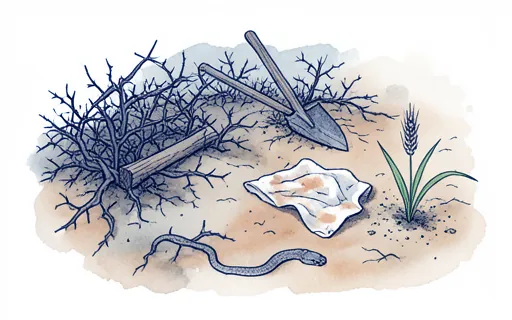
The sentence after the Fall — on the serpent, on childbearing, on the ground, and death at the end of it — carrying inside it the first promise of the seed who would crush the serpent’s head.
It is a sentence rather than an offer, and nobody agrees to it: the serpent, the woman and the ground are addressed in turn, and the terms hold whether or not anyone consents. What keeps it among the covenants is the line buried inside the curse on the serpent — that the woman’s offspring would bruise his head — which the rest of scripture keeps returning to as the first promise of a deliverer.
- Between God and Adam, after the Fall.
- Its reach is All mankind, under one sentence.
- Made with Adam.
Where it is made
What it covers
Called a covenant by inference. Also not called a covenant in Genesis. It is grouped with the covenants because the sentence God passes is permanent and universal, and because it carries the first promise of a deliverer.
The Noahic Covenant
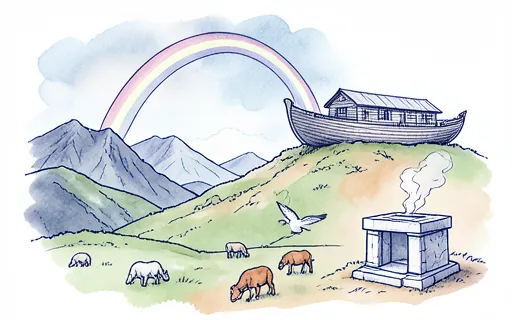
After the Flood, God binds himself never again to destroy the earth by water, and guarantees the ordinary course of the seasons. It is made with all flesh, not with one family — the widest covenant in scripture.
The terms run one way. Noah is asked for nothing, and the parties named include the animals that came off the ark and every living creature of all flesh after them, which makes this the only covenant in scripture whose scope is not limited to people. Its sign is set in the sky rather than in the flesh or on a tablet — visible to everyone, owned by nobody, and pointed at God rather than at the people it reassures.
- Between God and Noah, and every living creature.
- Its reach is All flesh — every living creature.
- Made with Noah.
- Its sign is the rainbow.
Where it is made
What it covers
The Abrahamic Covenant
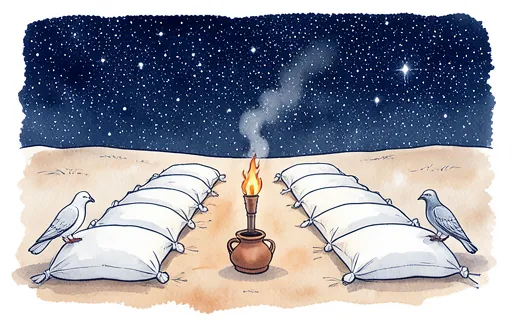
Land, offspring and blessing, promised to one man and through him to all the families of the earth. Cut three times over: spoken as a call, sworn between the pieces, and sealed in the flesh.
Cut three times over because it is enlarged each time: a call carrying a promise in Genesis 12, an oath in Genesis 15 where a smoking firepot passes between the divided animals while Abram sleeps, and a sign in the flesh in Genesis 17. The middle scene is the one that governs what follows — the party that walks between the pieces is the party that bears the penalty for breaking them, and only one party walked.
- Between God and Abraham, and his offspring after him.
- Its reach is One family, and all families through it.
- Made with Abraham.
- Its sign is circumcision.
Where it is made
What it covers
The Mosaic Covenant
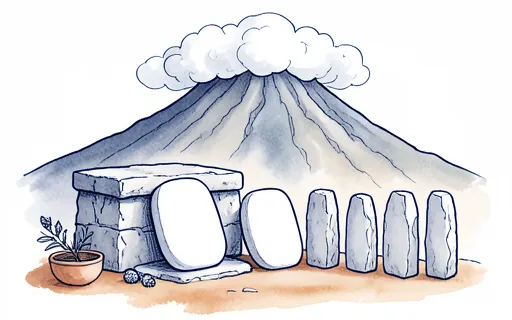
The law given at Sinai and ratified with blood: a nation set apart to be a kingdom of priests, with blessing for obedience and curse for breaking it. Conditional in a way the promises to Abraham were not.
The only one of the seven whose continuation is conditional. Sinai attaches blessing to obedience and curse to breaking it, and Deuteronomy sets both out at length before the nation enters the land. That does not undo what was promised to Abraham — land, offspring and blessing were never made to depend on Israel’s conduct — but it does mean what Israel held under the law could be lost, and was.
- Between God and the nation of Israel, through Moses at Sinai.
- Its reach is One nation.
- Made with Moses.
- Its sign is the Sabbath.
Where it is made
What it covers
The Davidic Covenant
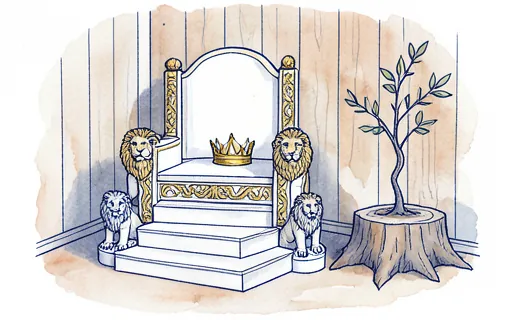
A house, a kingdom and a throne established for ever. David asks to build God a house and is told instead that God will build him one — the promise the gospels open by claiming for Jesus.
David offers to build God a house and is told he will not; God will build him one instead, and the word house turns from a building into a dynasty in the middle of the answer. The promise then outlives the thing it was about: the throne stands empty from the Exile onward, and Psalm 89 holds God to his word while the monarchy lies in ruins. Matthew opens his gospel by calling Jesus the son of David, and Luke’s angel promises him the throne of his father David.
- Between God and David, and his house after him.
- Its reach is One house.
- Made with David.
Where it is made
What it covers
The New Covenant
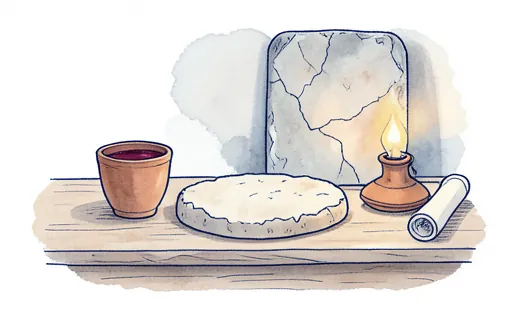
The law written on the heart rather than on stone, sins remembered no more, and everyone knowing God directly. Announced through Jeremiah while Jerusalem fell, and ratified six centuries later in a borrowed upper room.
Announced while Jerusalem was falling, to a nation about to lose the land, the temple and the throne — the least likely moment to be promised anything. What is new in it is where the law sits and who has to be taught: written on the heart rather than on stone, and known directly by everyone from the least to the greatest. Hebrews argues at length that calling a covenant new says the first was ageing, and that the first was never meant to be the last word.
- Between God and the house of Israel and the house of Judah — and, in Christ, all who believe.
- Its reach is All who believe, of every nation.
- Made with Jesus Christ.
- Its sign is the cup of the Lord’s Supper.