1 Chronicles
Israel’s story retold from Adam to David for the Jews back from exile, centred on David, worship and the temple to come.
Overview
1 Chronicles begins, remarkably, with nine chapters of names: from Adam (1:1) through the patriarchs and the twelve tribes to the families who returned from Babylon. It is a way of saying that the small community rebuilding Jerusalem still belonged to the whole story of Israel.
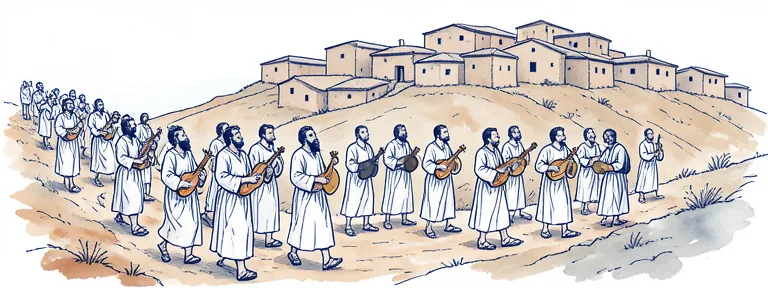
The narrative proper begins with Saul’s death in a single chapter and then gives the rest of the book to David. In this telling David is above all the founder of Israel’s worship. He brings the ark to Jerusalem with music and celebration and receives God’s promise of a lasting dynasty (17:14). He spends his last years gathering materials and organising priests, Levites (the tribe who served at the temple), singers and gatekeepers for the temple Solomon will build. Much of the darker material in 2 Samuel, including Bathsheba and Absalom’s revolt, is not retold.
Author and date
1 and 2 Chronicles are one book in the Hebrew Bible, where it comes last of all. It does not name its author, and cites earlier works, such as the histories of Samuel, Nathan and Gad (29:29).
Traditional view
Jewish tradition (the Talmud) credits Ezra the scribe, noting that Chronicles ends with the same decree of Cyrus with which the book of Ezra begins.
Academic view
Most academic scholars attribute the book to an unnamed author they call “the Chronicler,” writing in the late Persian or early Greek period. The genealogy of David’s descendants in chapter 3 runs several generations past the return, which points to a date well after it. Whether the same writer also produced Ezra–Nehemiah is debated.
Both views see Chronicles as written for the community after the exile, using Samuel and Kings as its main source.
Audience and setting
Chronicles speaks to Jews in Persian-ruled Judah: a small province with a rebuilt temple and no king. It reminds them who they are, and that worship at the temple, rightly ordered, is the heart of their life as God’s people.
Genre, and how to read it
Read Chronicles alongside Samuel and Kings, not as a repeat of them. Where it follows them closely, the changes are the message: what it adds, drops or reframes shows what the author wanted a later generation to see. It focuses on Judah, David’s line and the temple, and has little to say about the northern kingdom.
The genealogies are easy to skip, but they carry meaning. Occasional notes, like the prayer of Jabez (4:10), break into the lists. And their shape, from Adam to the returned exiles, makes Israel’s history part of the history of humanity.
Nine chapters of names
Chronicles opens with nine chapters of names, and they are far from even. Judah has a hundred verses, David’s line among them, and Levi, the tribe of the temple, eighty-one; Naphtali has one, and Zebulun and Dan, though named among Jacob’s sons (2:1–2), have none.
- Reuben 10 verses 5:1
- Simeon 20 verses 4:24
- Levi 81 verses 6:1
- Judah 100 verses 2:3, 3:1, 4:1
- Issachar 5 verses 7:1
- Zebulun 0 verses
- Dan 0 verses
- Ephraim 10 verses 7:20
- Manasseh 6 verses 7:14
- Benjamin 47 +10 verses 7:6, 8:1
- Naphtali 1 verses 7:13
- Gad 7 verses 5:11
- Asher 11 verses 7:30
Verses are counted from where the text names each tribe (The sons of Judah
, The sons of Levi
) to where the next begins. Judah’s hundred includes David’s line (3:1–24); Benjamin’s +10 is Saul’s family, given twice (9:35–44). Reuben, Gad and the eastern half of Manasseh also share nine verses together (5:18–26), not counted to any one of them. Some read Hushim, the sons of Aher
(7:12) as Dan’s, since Genesis gives Dan a son Hushim; the text does not say so.
Outline
- 1:1–9:44 Genealogies — From Adam, through the tribes, to those who returned
- 10:1–10:14 Saul’s death — The first king’s end, in one chapter
- 11:1–16:43 David king, and the ark — Jerusalem taken, his mighty men, the ark brought up with song
- 17:1–21:30 The promise, the wars, the census — God’s covenant with David, and the site of the temple chosen
- 22:1–29:30 Preparing the temple — Materials, priests, Levites and singers, and Solomon made king
Key themes
- Continuity
- The genealogies tie the returned exiles to Adam and to all twelve tribes: the story of God’s people has not ended.
- Worship
- David organises music and praise, and the refrain “Oh give thanks to Yahweh, for he is good, for his loving kindness endures forever” (16:34) echoes through both books.
- The Davidic promise
- God’s promise to settle David’s offspring “in my house and in my kingdom forever” (17:14) keeps hope alive for a people without a king. See the Davidic covenant.
- Faithfulness rewarded
- Chronicles often ties blessing and judgement to a king’s own faithfulness, as with Saul, who “died for his trespass” (10:13).
At a glance
Most mentioned: David, Solomon, Joab, Manasseh (son of Joseph), Merari