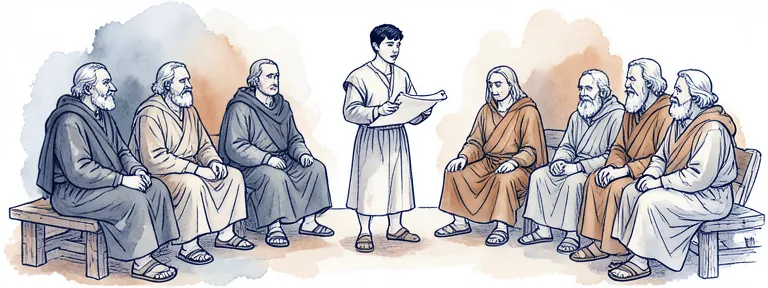
1 Timothy
Instructions to Timothy at Ephesus on false teaching, prayer, church leaders, widows and money, so that he “may know how men ought to behave themselves in God’s house.”
Overview
1 Timothy, 2 Timothy and Titus have been known since the 18th century as the Pastoral Epistles, or Pastorals, because they are addressed to individuals caring for churches. Paul, leaving for Macedonia, has asked Timothy to stay in Ephesus and stop certain teachers from spreading “a different doctrine” (1:3) and paying attention to “myths and endless genealogies” (1:4). The goal, he says, “is love from a pure heart, a good conscience, and sincere faith” (1:5).
The letter then sets out how the church should order its life: prayer “for all men” (2:1), conduct in worship, the qualities required of overseers and servants (deacons), care for widows, honour for elders, and the duties of slaves. It ends with warnings about the desire for wealth, since “the love of money is a root of all kinds of evil” (6:10), and a closing charge, “Fight the good fight of faith” (6:12). Throughout, sound teaching and godly living are treated as belonging together.
Author and date
The letter names Paul as its author and Timothy, his long-time co-worker, as its recipient (1:1–2). Whether Paul wrote the Pastoral Epistles is one of the most debated authorship questions in the New Testament.
Traditional view
The church received the Pastorals as Paul’s from at least the late second century, and many scholars still hold that view. The journeys they mention do not fit the story in Acts, so this view dates the letters to a further period of travel, after Paul’s release from his first imprisonment in Rome. Differences in vocabulary and style are explained by the new subject, Paul’s age, or his use of a secretary.
Academic view
Most academic scholars think the Pastorals were written after Paul’s death by someone writing in his name for a later generation. They point to vocabulary and style unlike the undisputed letters (the seven that nearly all scholars accept as Paul’s). They also note a more settled church with established offices, and “the faith” used for a body of teaching. And the travel details are hard to fit into Paul’s known life. Some suggest the writer drew on genuine notes of Paul’s, especially in 2 Timothy.
Both views treat the three Pastorals together, since they share vocabulary, concerns and setting, and both see them as concerned with handing on sound teaching to the next generation of leaders.
Audience and setting
Timothy came from Lystra, the son of a Jewish mother and a Greek father (Acts 16:1), and travelled with Paul for years, often as his envoy. Here he is in Ephesus (see Ephesians), a large and established church, where teachers from within the congregation were spreading “what is falsely called knowledge” (6:20). Their teaching seems to have involved speculation about genealogies and strict rules of self-denial that forbade marriage and certain foods (4:3). The letter is personal in form, but much of it is plainly meant to be heard by the church.
Genre, and how to read it
Read 1 Timothy as a manual for a church and a letter to a younger colleague at once. Short sayings are marked out with the formula “This is a faithful saying” (3:1) or a variation of it (1:15, 4:9), and 3:16 preserves what may be an early hymn about Christ, beginning “God was revealed in the flesh.”
Several passages are central to present-day disagreements between churches. The instruction “I don’t permit a woman to teach, nor to exercise authority over a man” (2:12) is read by some traditions as a lasting rule for church leadership and by others as addressed to a particular situation in Ephesus. The qualifications for overseers and servants in chapter 3 are applied to bishops, priests, elders and deacons in different ways by churches governed by bishops, by elders or by the whole congregation.
What an overseer must be
Two letters give a list of what an overseer must be, one to Timothy in Ephesus and one to Titus in Crete. They agree on 9 qualities, 5 of them in the same Greek word: the husband of one wife, sensible, hospitable, no drinker, not violent. Each also has its own. Only 1 Timothy rules out a new convert and asks for a good name with outsiders; only Titus asks that he be holy, fair and self-controlled, and calls him God’s steward
.
-
without reproach
1 Timothy 3:2 Above reproach different words, same idea Titus 1:6blameless
-
the husband of one wife
1 Timothy 3:2 One wife same Greek word Titus 1:6the husband of one wife
-
sensible
1 Timothy 3:2 Sensible same Greek word Titus 1:8sober minded
-
hospitable
1 Timothy 3:2 Hospitable same Greek word Titus 1:8given to hospitality
-
good at teaching
1 Timothy 3:2 Able to teach different words, same idea Titus 1:9able to exhort in the sound doctrine
-
not a drinker
1 Timothy 3:3 No drinker same Greek word Titus 1:7not given to wine
-
not violent
1 Timothy 3:3 Not violent same Greek word Titus 1:7not violent
-
not covetous
1 Timothy 3:3 Not after money different words, same idea Titus 1:7not greedy for dishonest gain
-
having children in subjection
1 Timothy 3:4 His children different words, same idea Titus 1:6having children who believe
-
temperate
1 Timothy 3:2 Temperate only in 1 Timothy -
modest
1 Timothy 3:2 Respectable only in 1 Timothy -
gentle
1 Timothy 3:3 Gentle only in 1 Timothy -
not quarrelsome
1 Timothy 3:3 Not quarrelsome only in 1 Timothy -
not a new convert
1 Timothy 3:6 Not a new convert only in 1 Timothy -
good testimony from those who are outside
1 Timothy 3:7 Well thought of outside only in 1 Timothy -
God’s steward only in Titus
Titus 1:7
as God’s steward
-
Not self-willed only in Titus
Titus 1:7
not self-pleasing
-
Not quick-tempered only in Titus
Titus 1:7
not easily angered
-
Loves what is good only in Titus
Titus 1:8
a lover of good
-
Fair only in Titus
Titus 1:8
fair
-
Holy only in Titus
Titus 1:8
holy
-
Self-controlled only in Titus
Titus 1:8
self-controlled
Matched in the site’s Greek. Titus names the same men elders first, appoint elders in every city
(Titus 1:5), then overseers. In 1 Timothy 3:3 the WEB also has not greedy for money
, from manuscripts that repeat Titus’ word; the site’s Greek there has only aphilargyros, not covetous. 1 Timothy goes on to a second list, for servants or deacons (1 Timothy 3:8).
Outline
- 1:1–1:2 Greeting — To Timothy, “my true child in faith”
- 1:3–1:20 False teachers and Paul’s story — Myths and genealogies; the chief of sinners
- 2:1–2:15 Prayer and worship — Prayer for all people; men and women in the assembly
- 3:1–3:13 Overseers and servants — The character of church leaders
- 3:14–3:16 The household of God — The mystery of godliness
- 4:1–4:16 Timothy’s example — False self-denial; godliness and teaching
- 5:1–6:2 Widows, elders and slaves — Honour and care within the church
- 6:3–6:21 Money and the good fight — Contentment, the rich, the final charge
Key themes
- Sound teaching
- The letter contrasts “sound words” (6:3) with myths and controversies, and ends with the charge, “guard that which is committed to you” (6:20).
- Salvation for all
- God “desires all people to be saved” (2:4), and “there is one God and one mediator between God and men, the man Christ Jesus” (2:5).
- Grace to the worst
- “Christ Jesus came into the world to save sinners, of whom I am chief” (1:15).
- The church’s order
- The church is “God’s house, which is the assembly of the living God, the pillar and ground of the truth” (3:15).
- Contentment
- “But godliness with contentment is great gain” (6:6), and the rich are to set their hope “on the living God” (6:17).
At a glance
Most mentioned: Jesus Christ, Timotheus, Adam, Satan, Alexander