2 Samuel
David’s reign: a kingdom united, Jerusalem made its capital, a promise of an everlasting throne and a family torn apart by his own sin.
Overview
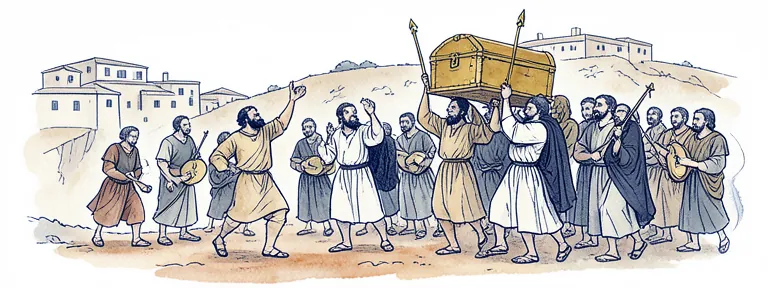
2 Samuel opens with David’s lament for Saul and Jonathan, “How the mighty have fallen!” (1:19), and follows his reign from Hebron, where Judah crowns him, to his rule over all Israel. He captures Jerusalem, brings the ark there, and wants to build God a temple. Instead God promises to build David a “house,” a dynasty whose throne will be established forever (7:16).
At the height of his power David takes Bathsheba and has her husband Uriah killed. The prophet Nathan confronts him with a parable and a verdict, “You are the man!” (12:7). David repents, but the consequences unfold in his own household: rape, murder and his son Absalom’s rebellion, which drives David from Jerusalem. The book closes with an appendix of songs, lists of warriors and a census that brings a plague.
Author and date
2 Samuel is the second half of one book with 1 Samuel, and shares its questions of authorship.
Traditional view
Jewish tradition credits the prophets Nathan and Gad, who appear in the story, with completing what Samuel began.
Academic view
Most academic scholars see 2 Samuel as part of the history running from Deuteronomy to Kings. Chapters 9–20, together with 1 Kings 1–2, are often called the Succession Narrative: a court history of who would succeed David, which some date close to Solomon’s reign.
Audience and setting
2 Samuel was written for Israel, to show both the promise attached to David’s line and the cost of his failures. Its setting is roughly 1010–970 BC: Hebron, Jerusalem (the Jebusite city David makes his capital), and wars reaching from Philistia to Edom, Moab, Ammon and Aram.
Genre, and how to read it
The middle of the book is some of the finest prose narrative of the ancient world, spare and psychologically sharp, and it rarely tells you what to think. David’s grief for Absalom, “my son, my son” (18:33), is left to speak for itself.
Chapter 7 is the hinge. God’s promise to David becomes the foundation for Israel’s hope of a future king, taken up by the psalms and prophets and, in the New Testament, applied to Jesus as the “son of David.”
Who will sit on the throne
The second half of 2 Samuel, and the first two chapters of 1 Kings, answer one question: who will sit on the throne of my lord the king after him
(1 Kgs 1:20). Six sons were born to David at Hebron, in order. Three are never named again. The book tells the stories of the other three, Amnon, Absalom and Adonijah, and all three were killed. The throne went to Solomon, the tenth son the text names and the second Bathsheba bore.
-
Amnon son of Ahinoam
killed the firstborn, killed at Absalom’s order:
The servants of Absalom did to Amnon as Absalom had commanded.
(2 Sam 13:29) - Chileab son of Abigail not heard of again never named again; 1 Chronicles calls him Daniel (2 Sam 3:3)
-
Absalom son of Maacah
killed took the throne for a time; killed by Joab’s men:
struck Absalom, and killed him
(2 Sam 18:15) -
Adonijah son of Haggith
killed said “I will be king”; killed at Solomon’s order:
he fell on him, so that he died
(1 Kgs 2:25) - Shephatiah son of Abital not heard of again never named again (2 Sam 3:4)
- Ithream son of Eglah not heard of again never named again (2 Sam 3:5)
-
Bathsheba’s first son son of Bathsheba
died unnamed; died a week old:
On the seventh day, the child died.
(2 Sam 12:18) -
Solomon son of Bathsheba
king the tenth son named; anointed king:
Long live King Solomon!
(1 Kgs 1:39)
Adonijah, who was born after Absalom
(1 Kgs 1:6), said I will be king.
(1 Kgs 1:5), and David answered by having Solomon anointed. 1 Chronicles gives Chileab another name, the second, Daniel, of Abigail
(1 Chr 3:1). The Jerusalem-born list begins Shammua, Shobab, Nathan, Solomon
(2 Sam 5:14): Luke traces Jesus not through Solomon but through his brother, the son of Nathan, the son of David
(Luke 3:31).
Outline
- 1:1–4:12 King in Hebron — The lament for Saul and Jonathan, war with Saul’s house
- 5:1–10:19 The kingdom established — Jerusalem taken, the ark brought up, God’s covenant with David
- 11:1–12:31 Bathsheba and Nathan — Adultery, murder, and “You are the man!”
- 13:1–20:26 Absalom — Amnon and Tamar, a son’s revolt, David’s flight and return
- 21:1–24:25 Appendix — A famine, David’s song, his mighty men, the census
Key themes
- The Davidic covenant
- God promises David an offspring whose throne he will “establish … forever” (7:13). The Covenants page follows it forward.
- Sin and its consequences
- David is forgiven (12:13), but his sin with Bathsheba sets off violence in his family that he cannot stop.
- Repentance
- Unlike Saul, David confesses when confronted, and the book presents that difference as decisive.
- God as refuge
- David’s song near the end, “Yahweh is my rock, my fortress, and my deliverer” (22:2), also appears as Psalm 18.
At a glance
Most mentioned: David, Joab, Absalom, Abner, Judah (patriarch)
Main places: Jerusalem, Hebron, Jordan, Geshur, Gibeon
Covenants made here: The Davidic Covenant
In the Almanac: Hittites, Ephod, Ark of the covenant, Tabernacle