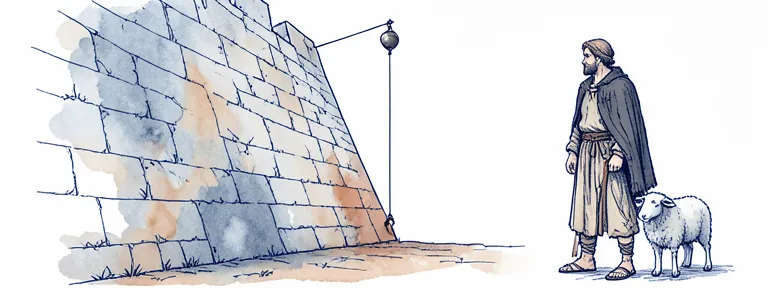
Amos
A herdsman from Judah goes north to tell prosperous Israel that its worship means nothing to God while it crushes the poor.
Overview
Amos prophesied in the northern kingdom during the long and prosperous reign of Jeroboam II, “two years before the earthquake” (1:1). He came from Tekoa, a village south of Bethlehem in Judah, and insisted he was no professional prophet: “I was a herdsman, and a farmer of sycamore figs” (7:14). He opens with judgements on Israel’s neighbours: Damascus, Gaza, Tyre, Edom, Ammon, Moab and Judah. Each follows the same pattern, first heard in “For three transgressions of Damascus, yes, for four” (1:3). Then the pattern falls on Israel itself (2:6).
The middle chapters indict the rich of Samaria, the “cows of Bashan” who “oppress the poor” (4:1), with their houses of ivory and lavish feasts, while the needy are sold “for a pair of sandals” (2:6). Their worship at Bethel and Gilgal does not impress God: “I hate, I despise your feasts” (5:21). Five visions follow in chapters 7–9, interrupted when the priest of Bethel orders Amos home (7:10–17). The book ends with a promise to rebuild “the tent of David who is fallen” (9:11).
Author and date
The book presents “The words of Amos” (1:1). The account of his clash with Amaziah, the priest of Bethel, is told in the third person (7:10–17), which suggests others helped collect them. Most agree that the core comes from Amos.
Traditional view
The whole book comes from Amos or was gathered from his preaching soon afterwards, including its closing promise. On this reading the hope of 9:11–15 completes his message: judgement will not be the end for the people of David.
Academic view
Most academic scholars trace the core of the book to Amos but see later additions, many from Judah. Three kinds of passage are often dated later: the oracles, or messages from God, against Tyre, Edom and Judah; the hymn fragments praising the Creator (4:13, 5:8–9, 9:5–6); and the promise to raise the fallen tent of David (9:11–15), which seems to assume Jerusalem’s fall.
Both views date Amos to the middle of the 8th century BC, a generation before Samaria fell, which makes him one of the earliest prophets whose words form a book.
Audience and setting
Amos spoke to Israel, the northern kingdom, at the height of its wealth and confidence. Jeroboam II had restored its borders (2 Kings 14:25), and its leading families kept a winter house and a summer house (3:15) and lay on beds of ivory (6:4). His stage was Bethel, “the king’s sanctuary” (7:13). His hearers were the wealthy of Samaria, who expected the day of Yahweh, when God would come to act, to bring them more of the same.
Genre, and how to read it
Amos is the third book of the Twelve, the shorter prophets gathered on one scroll in the Hebrew Bible, and one of the most carefully built. The oracles against the nations draw the listener in as Israel’s enemies are condemned one by one, until the circle closes on Israel. Chapters 3–6 are held together by calls to listen (3:1, 4:1, 5:1) and by warnings of woe (5:18, 6:1). The visions of chapters 7–9 turn on what Amos sees: locusts, fire, a plumb line, a basket of summer fruit and the Lord beside the altar.
Some of the visions work by wordplay. The basket of summer fruit (Hebrew qayits) becomes a word about the end (qets): “The end has come on my people Israel” (8:2). Amos also overturns expectations. Being chosen by God makes Israel accountable: “I have chosen only you of all the families of the earth. Therefore I will punish you for all of your sins” (3:2). The day of Yahweh that Israel longs for “is darkness, and not light” (5:18).
The day of Yahweh
“The day of Yahweh”, the day God comes in judgement, is named 16 times in the Old Testament, every one of them in the prophets, and 5 of them in Joel. Again and again it is near
or at hand
. Amos turns the hope on its head, telling those who long for it that it is darkness, and not light
.
- Isaiah 2
- Ezekiel 1
- Joel 5
- Amos 3
-
Obadiah 1
- 1:15
the day of Yahweh is near all the nations
- 1:15
- Zephaniah 3
-
Malachi 1
- 4:5
the great and terrible day of Yahweh
- 4:5
Counted in the site’s Hebrew as yom followed by the divine name. The hollow marks are the Hebrew’s a day for Yahweh, a different turn of phrase that the WEB also renders as Yahweh’s day. Malachi’s is the last in the Old Testament, with Elijah sent before it; at Pentecost Peter quotes Joel’s, before the great and glorious day of the Lord comes
(Acts 2:20).
Outline
Judgement on the nations (1–2)
- 1:1–2:5 Israel’s neighbours — Damascus, Gaza, Tyre, Edom, Ammon, Moab and Judah
- 2:6–2:16 Israel — The poor sold for silver and sandals, and no escape
Words against Israel (3–6)
- 3:1–4:13 The lion has roared — Samaria’s luxury, the cows of Bashan, and “prepare to meet your God”
- 5:1–5:27 Seek me and live — A lament, a plea for justice, and the day of Yahweh
- 6:1–6:14 At ease in Zion — Woe to the complacent rich
Visions (7–9)
- 7:1–7:17 Three visions, and Amaziah — Locusts, fire, the plumb line and Amos ordered out of Bethel
- 8:1–8:14 Summer fruit — The end has come, and a famine of hearing God’s words
- 9:1–9:10 The Lord at the altar — No hiding place, and Israel sifted
- 9:11–9:15 The tent of David raised — Ruins rebuilt, vineyards planted, the people replanted in their land
Key themes
- Justice
- “Let justice roll on like rivers, and righteousness like a mighty stream” (5:24). Martin Luther King Jr. quoted the verse often, including in his “I Have a Dream” speech.
- Worship and life
- God rejects feasts, offerings and songs from people who trample the poor (5:21), and asks instead: “Seek me, and you will live” (5:4).
- God of the nations
- The same God judges Damascus and Moab, and brought “the Philistines from Caphtor, and the Syrians from Kir” as he brought Israel out of Egypt (9:7).
- The prophetic word
- “The Lord Yahweh has spoken. Who can but prophesy?” (3:8). A people who silence the prophets will face a famine “of hearing Yahweh’s words” (8:11).
- Hope beyond judgement
- The book ends with the fallen tent of David raised (9:11), words James quotes at the Jerusalem council to welcome Gentiles (Acts 15:16–17). The Covenants page follows the promise to David.
At a glance
Most mentioned: Jacob (Israel), Amos, Esau (Edom), Jeroboam, Amaziah
Main places: Egypt, Bethel (of Palestine), Edom, Samaria, Damascus