Hosea
A prophet’s marriage to an unfaithful wife becomes a picture of Israel’s unfaithfulness to God, and of a love that will not let them go.
Overview
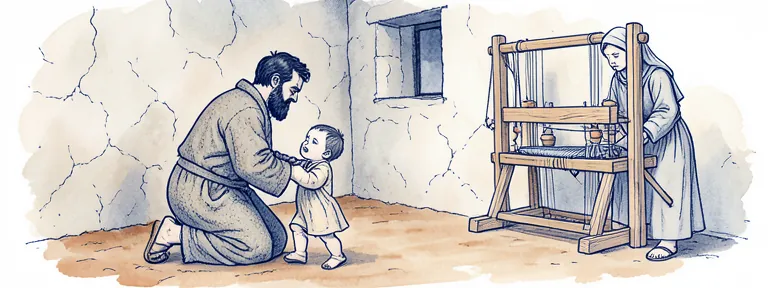
Hosea prophesied in the northern kingdom of Israel in its last decades, from the prosperous reign of Jeroboam II (1:1) toward the fall of Samaria to Assyria in 722 BC. God tells him to take “a wife of prostitution” (1:2), and he marries Gomer. Their three children are given names that are messages: Jezreel, for the bloodshed at Jezreel to be avenged on Jehu’s dynasty; Lo-Ruhamah, “no mercy”; and Lo-Ammi, “not my people” (1:9). In chapter 3 Hosea is told to “Go again, love a woman loved by another” (3:1), as God loves Israel.
Chapters 4–14 are oracles, messages the prophet delivers from God. They are often abrupt and hard to translate, and they are aimed at a nation that worships Baal, courts Egypt and Assyria by turns, and changes kings by assassination. God’s charge is that there is “no truth, nor goodness, nor knowledge of God in the land” (4:1). Judgement is never the last word. The book swings between anger and longing, and reaches its height in 11:8: “How can I give you up, Ephraim?” It ends with a call to return and a promise of healing (14:4).
Author and date
The book names Hosea son of Beeri as the prophet (1:1), and most readers accept that the oracles are substantially his. The debate is over how and when they were collected and edited.
Traditional view
Hosea spoke over several decades, from Jeroboam II’s reign (Jeroboam died c. 753 BC) to the years around Samaria’s fall, and his words were gathered by him or his disciples. The mentions of Judah and the promises of restoration belong to his own message about the whole people of God.
Academic view
Most academic scholars also trace the core to Hosea, but think his words were carried south after Samaria fell and edited in Judah. They often date some of the references to Judah to that later stage, along with some promises of restoration, such as the return to “David their king” (3:5).
Both views place Hosea’s preaching in the northern kingdom in the generation before its fall, and hear in it a northerner speaking to his own people.
Audience and setting
Hosea addressed Israel, the northern kingdom, which he often calls Ephraim after its largest tribe. His hearers lived through prosperity under Jeroboam II and then collapse: six kings in about thirty years, four of them assassinated, and Assyrian armies taking territory until Samaria fell. The places he names were the centres of that kingdom’s worship and politics: Samaria, Bethel (which he mocks as Beth Aven, “house of wickedness”), Gilgal and Jezreel.
Genre, and how to read it
Hosea is the first book of the Twelve, the collection of shorter prophets that the Hebrew Bible keeps on a single scroll. Its first three chapters frame the rest. Readers have long debated the marriage. Some take it literally, as a prophet told to marry a woman who was or would become unfaithful. Others read it as an acted parable or a vision. Some think Gomer strayed only after the wedding, and that 1:2 is told with hindsight.
The poetry of chapters 4–14 moves fast and piles up images: Israel’s love is “like a morning cloud” (6:4), and the people “sow the wind, and they will reap the whirlwind” (8:7). Much of it retells Israel’s history (the exodus, the wilderness, Jacob) to show a people who have forgotten who they are. The book closes with a wisdom saying (14:9) that asks the reader to take its message to heart.
Prostitution, return, knowledge, love
Hosea’s marriage is his message, and four Hebrew words carry it. Prostitution, the charge against a people chasing other gods, comes 22 times, 21 of them by chapter 6. Return, shuv, comes 22 times and closes the book’s last call: Israel, return to Yahweh your God
. Knowing God comes 20 times, as what is missing and what is promised. And chesed, steadfast love, is what God asks for instead of sacrifice.
zanah prostitution 22
- 1:2 a wife of prostitution
- 1:2 children of unfaithfulness
- 1:2 the land commits great adultery
- 1:2 great adultery, forsaking Yahweh
- 2:2 let her put away her prostitution
- 2:4 they are children of unfaithfulness
- 2:5 their mother has played the prostitute
- 3:3 You shall not play the prostitute
- 4:10 They will play the prostitute, and will not increase
- 4:11 Prostitution, wine, and new wine
- 4:12 the spirit of prostitution has led them astray
- 4:12 they have been unfaithful to their God
- 4:13 your daughters play the prostitute
- 4:14 your daughters when they play the prostitute
- 4:14 the men consort with prostitutes
- 4:15 Though you, Israel, play the prostitute
- 4:18 They play the prostitute
- 4:18 the prostitute continually
- 5:3 you have played the prostitute
- 5:4 the spirit of prostitution is within them
- 6:10 There is prostitution in Ephraim
- 9:1 you were unfaithful to your God
shuv return 22
- 2:7 return to my first husband
- 2:9 I will take back my grain
- 3:5 the children of Israel shall return
- 4:9 will repay them for their deeds
- 5:4 to turn to their God
- 5:15 I will go and return to my place
- 6:1 Let’s return to Yahweh
- 6:11 when I restore the fortunes
- 7:10 they haven’t returned to Yahweh
- 7:16 They return, but not to the Most High
- 8:13 They will return to Egypt.
- 9:3 Ephraim will return to Egypt
- 11:5 They won’t return into the land of Egypt
- 11:5 they refused to repent
- 11:9 I will not return to destroy Ephraim
- 12:2 according to his deeds he will repay him
- 12:6 Therefore turn to your God
- 12:14 his Lord will repay his contempt
- 14:1 Israel, return to Yahweh your God
- 14:2 and return to Yahweh
- 14:4 my anger is turned away from them
- 14:7 Men will dwell in his shade. They will revive
yada know 20
- 2:8 she didn’t know that I gave her
- 2:20 you shall know Yahweh
- 4:1 nor knowledge of God in the land
- 4:6 destroyed for lack of knowledge
- 4:6 you have rejected knowledge
- 5:3 I know Ephraim
- 5:4 they don’t know Yahweh
- 5:9 I have made known
- 6:3 Let’s acknowledge Yahweh
- 6:3 Let’s press on to know Yahweh
- 6:6 the knowledge of God more than burnt offerings
- 7:9 Strangers have devoured his strength, and he doesn’t realize it
- 7:9 gray hairs are here and there on him, and he doesn’t realize it
- 8:2 we, Israel, acknowledge you!
- 8:4 I didn’t approve
- 9:7 Israel will consider the prophet to be a fool
- 11:3 they didn’t know that I healed them
- 13:4 you shall acknowledge no god but me
- 13:5 I knew you in the wilderness
- 14:9 that he may know them
chesed steadfast love 6
- 2:19 in loving kindness
- 4:1 nor goodness
- 6:4 your love is like a morning cloud
- 6:6 I desire mercy
- 10:12 reap according to kindness
- 12:6 Keep kindness and justice
Counted in the site’s Hebrew; prostitution counts the verb and both its nouns, and know counts the verb with its noun, knowledge. The two meet in one verse: I desire mercy, and not sacrifice; and the knowledge of God more than burnt offerings
(6:6), which Jesus quotes twice in Matthew (9:13, 12:7). English hides shuv by giving it many words: return, turn, repay, repent, restore, take back.
Outline
Hosea’s marriage (1–3)
- 1:1–1:11 Gomer and her children — Jezreel, Lo-Ruhamah and Lo-Ammi, and a promise that reverses their names
- 2:1–2:23 The unfaithful wife — Israel accused, then led back into the wilderness and betrothed again
- 3:1–3:5 Love her again — Hosea buys back his wife
The charge against Israel (4–11)
- 4:1–6:3 No knowledge of God — Priests and people who have forgotten the law
- 6:4–8:14 Love like a morning cloud — Kings, alliances and calf idols, and the whirlwind to come
- 9:1–11:11 Exile, and a father’s love — Harvests fail and Israel is sent away, yet God cannot give Ephraim up
Jacob’s children (11–14)
- 11:12–13:16 Jacob remembered — Israel’s story retold, from the patriarch to the fall of Samaria
- 14:1–14:9 Return and healing — A last call to return, and God’s promise to love them freely
Key themes
- Loyal love
- Loyal love (Hebrew hesed) is what God wants most: “For I desire mercy, and not sacrifice; and the knowledge of God more than burnt offerings” (6:6). Jesus quotes the verse twice in Matthew’s Gospel.
- Knowing God
- “My people are destroyed for lack of knowledge” (4:6). For Hosea, knowing God is a relationship, like knowing a husband, and forgetting him is the root of Israel’s other sins.
- Covenant as marriage
- Hosea is the earliest prophet whose book pictures the covenant as a marriage and idolatry as adultery, an image Jeremiah and Ezekiel take up. Israel has “broken my covenant” (8:1), yet God promises to betroth her again “in righteousness, in justice, in loving kindness, and in compassion” (2:19). The Covenants page follows the covenant Hosea has in mind.
- God as parent
- “When Israel was a child, then I loved him, and called my son out of Egypt” (11:1). Matthew applies the verse to the child Jesus returning from Egypt (Matthew 2:15).
- Names reversed
- The children’s names are undone: those who were “not my people” will hear “You are my people” (2:23), a promise Paul and Peter apply to the church (Romans 9:25–26, 1 Peter 2:10).
At a glance
Most mentioned: Ephraim, Jacob (Israel), Jezreel, Baal, Hosea