Jeremiah
A reluctant prophet warns Judah for forty years that Babylon will destroy Jerusalem, lives to see it happen, and promises a new covenant beyond the ruins.
Overview
Jeremiah, a priest’s son from Anathoth, was called as a young man in 627 BC, the thirteenth year of King Josiah (1:2). God told him, “Before I formed you in the womb, I knew you” (1:5). For four decades, through the reigns of Judah’s last kings, he warned that the nation’s idolatry and injustice would bring disaster from the north. He preached against trust in the temple itself (7:4), was beaten, put in the stocks, thrown into a cistern and branded a traitor for urging surrender to Babylon.
Jerusalem fell in 586 BC, as he had said. Jeremiah stayed in the ruined land until a group of survivors took him, against his advice, to Egypt (43:7). Amid the warnings are some of the Bible’s strongest promises of hope: a letter telling the exiles to seek the welfare of Babylon (29:7), a field bought during the siege as a sign that the land would be restored (32:15), and a “new covenant” written on the heart (31:31).
Author and date
The book names Jeremiah and describes his scribe Baruch writing down his words from dictation, twice (36:4, 36:32).
Traditional view
Jewish and Christian tradition hold that Jeremiah’s words were written down by Baruch and gathered in the prophet’s lifetime or soon after. The Talmud credits Jeremiah with the book, along with Kings and Lamentations.
Academic view
Most scholars distinguish three kinds of material: Jeremiah’s poetic oracles; prose accounts of his life, often credited to Baruch; and prose sermons in the style of Deuteronomy, which many assign to later editors. The ancient Greek translation is about one-eighth shorter and places the oracles against the nations in the middle of the book. Hebrew copies of both versions were found among the Dead Sea Scrolls at Qumran.
Both views start from the book’s own account of a scroll dictated, burned by King Jehoiakim and written again, with “many similar words” added (36:32).
Audience and setting
Jeremiah first addressed Jerusalem and Judah in the years when Assyria collapsed and Babylon rose, from Josiah’s reforms to the city’s destruction. His later words reached the exiles in Babylon and the refugees in Egypt. The book ends with a historical appendix on the fall of Jerusalem (chapter 52) that closely parallels 2 Kings 24–25.
Genre, and how to read it
Jeremiah is not arranged in chronological order, which can make it hard to follow. Poetry and prose alternate. Oracles, sermons, symbolic actions and stories of the prophet’s life are grouped by theme, and the kings named in the headings can jump backward and forward in time. It helps to notice the headings and dates.
The book lets the reader hear the prophet’s own anguish. In a series of complaints to God, sometimes called his confessions, Jeremiah protests that God has overpowered him (20:7) and curses the day he was born (20:14). Yet he cannot stop speaking: God’s word is “as it were a burning fire shut up in my bones” (20:9).
Out of order
Jeremiah’s headings name the king, but the book is not in their order. Joined chapter by chapter, the headings go back in time three times: from Zedekiah to Jehoiakim at chapter 25 and again at 35, and from the refugees in Egypt back to Jehoiakim’s fourth year at 45. Passages are grouped by theme, not date.
- Josiah
- 1:2 Jeremiah’s call 3:6 Faithless Israel
- Jehoiakim
- 25:1 Seventy years 26:1 The temple sermon on trial 35:1 The Rechabites 36:1 The scroll burned 45:1 A word for Baruch 46:2 Egypt at Carchemish
- Zedekiah
- 21:1 Zedekiah asks for a word 24:1 Two baskets of figs 27:1 The yoke 28:1 Hananiah breaks the yoke 29:2 A letter to the exiles 32:1 Buying a field 34:2 Under siege 37:1 Jeremiah imprisoned 39:1 Jerusalem falls 49:34 Elam 51:59 A scroll sunk in the Euphrates 52:4 The siege, told again
- After the fall
- 40:1 Set free at Ramah 41:1 Gedaliah murdered 43:7 Into Egypt 44:1 To the Jews in Egypt 52:31 Jehoiachin set free
Ringed points are where the book goes back in time. 27:1 reads In the beginning of the reign of Jehoiakim
, but the chapter is addressed to Zedekiah (27:12) and the next opens That same year
; it is drawn under Zedekiah, hollow. Jehoiachin’s three months have no heading of their own. Chapter 52 retells the fall from 2 Kings 25.
Outline
Warnings to Judah (1–25)
- 1:1–1:19 The call — A prophet before birth, an almond branch and a boiling pot
- 2:1–10:25 Faithless Judah — Broken cisterns, the temple sermon, idols
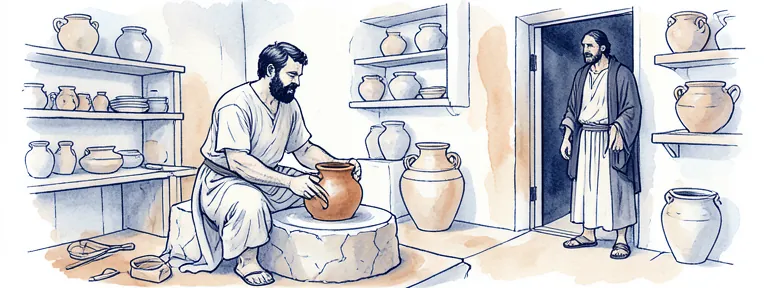
- 11:1–20:18 The prophet in conflict — Plots, laments, the potter’s house, the stocks
- 21:1–25:38 Kings and prophets — Judah’s last kings, false prophets, seventy years under Babylon
Stories and hope (26–45)
- 26:1–29:32 Prophet against prophet — Jeremiah on trial, the yoke, Hananiah, the letter to the exiles
- 30:1–33:26 The book of consolation — Restoration, the new covenant, a field bought in Anathoth
- 34:1–39:18 The last days of Jerusalem — The Rechabites, the burned scroll, the cistern, the city’s fall
- 40:1–45:5 After the fall — The governor Gedaliah murdered, flight to Egypt, a word for Baruch
The nations (46–52)
- 46:1–51:64 Oracles against the nations — Egypt, Philistia, Moab, Edom and others, and at length Babylon
- 52:1–52:34 Jerusalem falls — A historical appendix
Key themes
- Covenant broken
- Judah has “forsaken me, the spring of living waters” for “broken cisterns that can’t hold water” (2:13).
- Judgement from the north
- Jeremiah’s commission is “to uproot and to tear down, to destroy and to overthrow, to build and to plant” (1:10), and Babylon is the instrument of judgement, for “seventy years” (25:11).
- The human heart
- “The heart is deceitful above all things” (17:9), and God shapes his people as a potter shapes clay (18:6).
- The new covenant
- God promises: “I will put my law in their inward parts, and I will write it in their heart” (31:33). The New Testament quotes this passage in full (Hebrews 8). See the Covenants page.
- Hope in exile
- The exiles are to build houses and pray for Babylon, for God has “thoughts of peace, and not of evil, to give you hope and a future” (29:11).
At a glance
Most mentioned: Jeremiah, Zedekiah, Nebuchadnezzar, Moab, Jehoiakim
Main places: Babylon, Jerusalem, Egypt, Moab, Mizpah
Covenants made here: The New Covenant
In the Almanac: Finger, Ark of the covenant