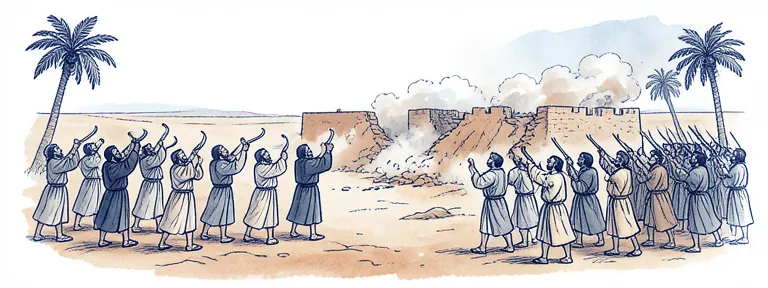
Joshua
Israel crosses the Jordan under Joshua, takes the land promised to Abraham, divides it among the tribes and is called to serve God alone.
Overview
Joshua picks up the moment Moses dies. Joshua, Moses’ assistant and now Israel’s leader, is told three times to “be strong and courageous” (1:9). The book follows Israel across the Jordan, around the walls of Jericho and through campaigns in the south and north of Canaan. Then it slows down to record, tribe by tribe and town by town, how the land was shared out.
The book is framed as a promise kept: “Nothing failed of any good thing which Yahweh had spoken to the house of Israel. All came to pass” (21:45). But it also notes the land left untaken and the peoples left in it, and it ends with Joshua gathering the tribes at Shechem to make them choose whom they will serve (24:15). The question of faithfulness, not only of possession, is handed on to the next generation.
Author and date
Joshua does not name its author. It says Joshua wrote the covenant at Shechem “in the book of the law of God” (24:26), and in places it speaks of things remaining “to this day,” which implies some distance from the events.
Traditional view
Jewish tradition credits Joshua with most of the book, with the account of his death and a few notes added by later hands such as Eleazar or Phinehas. The date follows the date taken for the exodus.
Academic view
Most academic scholars read Joshua as part of a history running from Deuteronomy to Kings. They think it was written in the late monarchy and revised in the Babylonian exile, drawing on older stories and administrative lists. Archaeology complicates the picture of a single sweeping conquest: Jericho and Ai show little sign of occupation at the likely dates, and many scholars picture a slower settlement.
Both views note that Judges 1 describes the conquest as partial and gradual, and that Joshua itself records land still to be taken (13:1).
Audience and setting
Joshua was written for Israel, to explain how they came to hold the land and on what terms they would keep it. Its setting is Canaan in the Late Bronze Age (roughly 1550–1200 BC): Jericho in the Jordan valley, Gibeon and the hill country, Hazor in the north and Shechem, where the book ends.
Genre, and how to read it
The first half is battle narrative; the second reads more like a land registry. Both matter: the boundary lists show the promise to Abraham made concrete, down to named towns and springs.
The conquest accounts raise hard questions for modern readers, above all the command to devote cities to destruction, killing those who lived in them. Readers respond in different ways. Some take the language as ancient war rhetoric, which the book itself qualifies: Rahab and the Gibeonites are spared, and much of the population remains. Others read it as describing a unique judgement on Canaan. The book’s own emphasis falls less on Israel’s strength than on God fighting for them and on Israel’s obedience.
The land shared out
Joshua shares the land out tribe by tribe, first the tribes east of the Jordan that Moses had already given land, then the rest by lot, and counts as it goes: the towns of each tribe where it gives a number, the cities every tribe gave the Levites, who received no land of their own, and the six cities of refuge. Each number below is one the text states.
| Tribe | Towns the text counts | Cities given to the Levites | City of refuge |
|---|---|---|---|
| Reuben | not counted | 4, to Merari 21:37 | Bezer 20:8 |
| Gad | not counted | 4, to Merari 21:39 | Ramoth in Gilead 20:8 |
| Manasseh, east | not counted | 2, to Gershon 21:27 | Golan 20:8 |
| Judahwith Simeon | 112 15:32, 15:36, 15:41, 15:44, 15:51, 15:54, 15:57, 15:59, 15:60, 15:62 | 9, to Aaron’s descendants, the priests 21:16 | Hebron 20:7 |
| Ephraim | not counted | 4, to the rest of Kohath 21:22 | Shechem 20:7 |
| Manasseh, west | not counted | 2, to the rest of Kohath 21:25 | |
| Benjamin | 26 18:24, 18:28 | 4, to Aaron’s descendants, the priests 21:18 | |
| Simeoninside Judah (19:9); its Levite cities are counted with Judah’s | 17 19:6, 19:7 | with Judah’s | |
| Zebulun | 12 19:15 | 4, to Merari 21:35 | |
| Issachar | 16 19:22 | 4, to Gershon 21:29 | |
| Asher | 22 19:30 | 4, to Gershon 21:31 | |
| Naphtali | 19 19:38 | 3, to Gershon 21:32 | Kedesh in Galilee 20:7 |
| Dan | not counted | 4, to the rest of Kohath 21:24 |
Judah’s 112 is the sum of its districts’ own totals (15:21–62), not counting the Philistine towns of 15:45–47, which are given no number. The Levites’ cities come to forty-eight cities with their pasture lands
(21:41): 13 for Aaron’s descendants, 10 for the rest of Kohath, 13 for Gershon and 12 for Merari (21:4–7). Every city of refuge is one of them.
Outline
Into the land (1–12)
- 1:1–2:24 Joshua commissioned, and the spies — “Be strong and courageous,” and Rahab in Jericho
- 3:1–5:15 Crossing the Jordan — The river parts, twelve stones at Gilgal, the commander of Yahweh’s army
- 6:1–8:35 Jericho and Ai — The walls fall, Achan’s theft, the covenant read at Mount Ebal
- 9:1–12:24 The campaigns — The Gibeonites, the day the sun stood still, the northern kings, the defeated kings listed
Dividing the land (13–21)
- 13:1–19:51 The tribes’ inheritance — Boundaries and towns, east and west of the Jordan
- 20:1–21:45 Cities of refuge and of the Levites — Safe towns for accidental killers, towns for the Levites and every promise kept
Keeping the land (22–24)
- 22:1–22:34 The altar by the Jordan — The eastern tribes return home, and a near civil war
- 23:1–24:33 Joshua’s farewell — Warnings, the covenant at Shechem, and the burials of Joshua, Joseph’s bones and Eleazar
Key themes
- Promise kept
- The land promised to Abraham in Genesis is given, and the book insists that not one word failed (21:45).
- Courage and the law
- Joshua’s strength is tied to the book of the law: “you shall meditate on it day and night” (1:8).
- God fights for Israel
- The decisive moments are not Israel’s doing: the Jordan stops, and Jericho’s wall falls “down flat” at a shout (6:20).
- Outsiders brought in
- A Canaanite prostitute, Rahab, is saved and joins Israel (6:25), while an Israelite, Achan, is lost (7:25). Belonging depends on faith, not birth alone.
- Choosing whom to serve
- “Choose today whom you will serve … as for me and my house, we will serve Yahweh” (24:15).
At a glance
Most mentioned: Joshua, Jacob (Israel), Moses, Manasseh (son of Joseph), Judah (patriarch)
Main places: Jordan, Ai, Jericho, Hebron, Egypt
In the Almanac: Levites, Casting lots, Ark of the covenant