Judges covers the unsettled centuries after Joshua’s death, before Israel had a king. Its introduction sets out a pattern that the rest of the book repeats. Israel does “that which was evil in Yahweh’s sight” (2:11) and falls under an oppressor. The people cry out, and God raises up a judge, a military and tribal leader rather than a courtroom judge, who rescues them. When the judge dies, the cycle begins again (2:19).
Twelve judges appear, six told at length: Othniel, Ehud, Deborah with Barak, Gideon, Jephthah and Samson. The cycle does not simply repeat; it spirals down. Each deliverer is more compromised than the last, until Samson fights the Philistines alone and mostly for himself. The book closes with two stories of idolatry and atrocity and a refrain that explains them: “In those days there was no king in Israel. Everyone did that which was right in his own eyes” (21:25).
Author and date
Judges does not name its author. Its refrain about there being no king suggests it was written, or at least finished, once Israel had one.
Traditional view
Samuel · 11th century BC
Jewish tradition (the Talmud, the classic collection of rabbinic teaching) credits Samuel, writing early in the monarchy, which fits the book’s interest in why Israel needed a king.
Academic view
Part of a longer history · 7th–6th century BC
Most academic scholars see Judges as part of a longer history running from Deuteronomy to Kings, built from older hero stories that were once local traditions of separate tribes. The Song of Deborah in chapter 5 is widely thought to be one of the oldest texts in the Bible.
Both views read the book as an argument, not only a chronicle: its arrangement is designed to show Israel’s decline.
Audience and setting
Judges was written for Israel under the monarchy or later, looking back on a time without central government. The setting is Canaan tribe by tribe: the hill country of Ephraim, the valley of Jezreel, Gilead east of the Jordan and the Philistine border in the south-west. Israel still shares the land with Canaanites, Midianites, Moabites and Philistines.
Genre, and how to read it
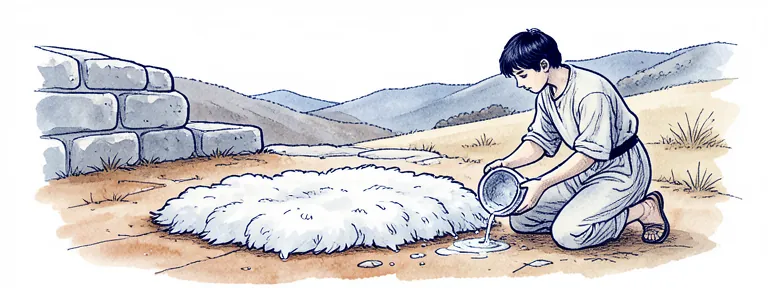
Read the stories as stories, often vivid and sometimes darkly comic, like Ehud’s dagger lost in the fat king (3:22). The narrator rarely comments, so the judgements are carried by the pattern and the details: Gideon asking for sign after sign, Jephthah’s rash vow, Samson breaking every part of his Nazirite calling, the vow that set him apart to God from birth.
The judges are not models. Several of the book’s worst deeds are done by its heroes, and the violence of the last chapters, against a woman and then between the tribes, is told without softening. The book shows what happens when a people forgets its God; it does not endorse what it describes.
The cycle, in years
Each round starts the same way: Israel “did that which was evil”, an oppressor rules for a set number of years, the people cry out, and a deliverer brings rest (2:11–19). Laid out in the text’s own figures, the rounds change as the book goes on. The oppressions grow from eight years to forty. The rest stops after Gideon. In the last round nobody cries out at all.
under an oppressor
“the land had rest”
judged Israel
Laid end to end
1 Kings dates the temple to “the four hundred and eightieth year” after the Exodus (1 Kings 6:1). The years the text states for that stretch already come to more than that before Joshua and Samuel are counted.
The rest stops
“The land had rest” comes four times: forty years after Othniel (3:11), eighty after Ehud (3:30), forty after Deborah (5:31) and forty after Gideon (8:28). After that the book counts only the years each judge judged.
The cry stops
Israel cries to Yahweh under Cushan, Eglon, Jabin, Midian and Ammon (3:9; 3:15; 4:3; 6:6; 10:10). Under the Philistines, forty years and the longest oppression in the book (13:1), no cry is recorded. Samson is raised up without one.
Two readings: in sequence, or side by side?
One after another
The judges follow each other across the whole land, and the 480 years of 1 Kings 6:1 is read as a round figure, twelve generations of forty, rather than a sum.
Overlapping
Many judges were local, and their years overlapped. The text itself puts two oppressions at once, “into the hand of the Philistines and into the hand of the children of Ammon” (10:7): Ammon in the east under Jephthah, the Philistines in the west under Samson.
Outline
Why it went wrong (1–3)
1:1–2:5
An unfinished conquest — The tribes fail to drive out the peoples of the land
2:6–3:6
The cycle explained — A new generation that did not know Yahweh
The judges (3–16)
3:7–3:31
Othniel, Ehud and Shamgar — The pattern at its cleanest, and a left-handed assassin
4:1–5:31
Deborah and Barak — A prophetess, a tent peg, and the Song of Deborah
6:1–8:35
Gideon — The fleece, three hundred men, and a golden ephod
9:1–10:5
Abimelech — A son of Gideon makes himself king and destroys Shechem
10:6–12:15
Jephthah — An outcast leader, a rash vow and a civil war over the word “Shibboleth”
13:1–16:31
Samson — A Nazirite, the Philistines, Delilah and the temple of Dagon
No king in Israel (17–21)
17:1–18:31
Micah’s idol and the tribe of Dan — A household shrine, a hired priest, a stolen god
19:1–21:25
Gibeah and the war against Benjamin — An atrocity, and a tribe almost wiped out
Key themes
The cycle
Sin, oppression, crying out and rescue (2:16), repeated and worsening, is the book’s shape and its warning.
God’s patience
The rescues come because God is moved by Israel’s groaning (2:18), not because they deserve it.
Unlikely deliverers
A left-handed Benjamite, a woman judge, the least member of a small clan, a prostitute’s son driven out by his brothers: God works through people Israel would overlook, and through their weaknesses as well.
The need for a king
The refrain “there was no king in Israel” (17:6, 21:25) prepares for Samuel, Saul and David, and for the question of what kind of king Israel needs.
Faithfulness as the missing piece
The root problem is named at the start: a generation “who didn’t know Yahweh” (2:10). Leadership cannot replace that knowledge.