Lamentations
Five poems of grief over the destruction of Jerusalem, with a stubborn hope in God’s mercy at their centre.
Overview
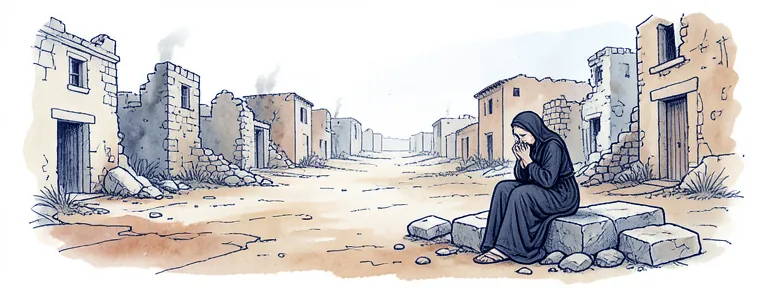
Lamentations mourns the fall of Jerusalem to Babylon in 586 BC: the siege, the famine, the burning of the temple, the exile of the people and the shame of the survivors. Its Hebrew title is its first word, “How” (1:1), the cry that opens a funeral song: “How the city sits solitary, that was full of people!” In the first two poems Jerusalem is pictured as a widow and speaks for herself: “Is it nothing to you, all you who pass by?” (1:12).
The book does not soften what happened. It describes children fainting in the streets (2:11) and admits that the city’s sin brought the disaster, yet it also protests that the suffering is too great. At its centre, in the third poem, a single sufferer turns from despair to hope: “his mercies don’t fail. They are new every morning. Great is your faithfulness” (3:22–23). The last poem is a community prayer that ends with the question still open (5:22).
Author and date
Lamentations does not name its author.
Traditional view
The ancient Greek translation opens with a note that Jeremiah sat weeping and spoke this lament over Jerusalem, and Jewish and Christian tradition have followed it. 2 Chronicles 35:25 also records that Jeremiah composed laments for King Josiah, and English Bibles place the book after Jeremiah.
Academic view
Most scholars see the poems as anonymous, perhaps by more than one poet, and written in Judah within a generation of the fall. They point to differences of style and outlook between the poems, and between them and the book of Jeremiah. In the Hebrew Bible, Lamentations stands in the third section, the Writings, apart from the prophets.
Both views place the poems close to the events they describe, written by someone who saw Jerusalem destroyed.
Audience and setting
Lamentations gave the survivors of Jerusalem’s fall, in Judah and in exile, words for their grief, and it may have been used at fasts that marked the destruction. In Jewish practice it is still read on the fast of the Ninth of Av, which remembers the destruction of the temple.
Genre, and how to read it
The first four poems are alphabetic acrostics: each verse, or in chapter 3 each group of three verses, begins with the next letter of the Hebrew alphabet. This is why chapters 1, 2 and 4 have 22 verses and chapter 3 has 66. The form gives order to grief, a lament from A to Z. The fifth poem keeps the 22 verses but drops the alphabet. The Almanac’s alphabet poems entry sets all four out letter by letter, beside the alphabet psalms, and shows where pe comes before ayin.
Read the book slowly and let its voices speak in turn: the narrator, the city, the lone sufferer of chapter 3 and the community. It moves from description to confession, protest and prayer. Its hope is real and is placed at the centre, but it is surrounded on every side by grief.
No one to comfort her
Lamentations is five poems over the fall of Jerusalem. Three of them open with the same cry, eikhah, How
, which is the book’s Hebrew name. The first poem says five times that the city, pictured as a widow, has no one to comfort her. At the centre, in the long third poem, the speaker turns: They are new every morning. Great is your faithfulness.
(3:23). The exact middle of its 154 verses falls a few lines later: For he does not afflict willingly
(3:33).
Counted in the site’s Hebrew; 4:2 repeats eikhah inside the fourth poem. The third poem is three times the length of the others because it gives each letter of the alphabet three verses (see the Almanac’s Alphabet poems). The book ends without comfort, But you have utterly rejected us
(5:22); in synagogue reading the prayer before it, Turn us to yourself, Yahweh, and we will be turned
(5:21), is read again so the book does not end there.
Outline
- 1:1–1:22 The deserted city — Jerusalem as a widow, speaking for herself
- 2:1–2:22 The Lord’s anger — God as enemy, and children fainting in the streets
- 3:1–3:66 The man who has seen affliction — One voice, and mercies new every morning
- 4:1–4:22 Gold grown dim — The siege remembered
- 5:1–5:22 A prayer — The community asks God to remember and restore
Key themes
- Grief
- The book gives lament a place in scripture: “Look, and see if there is any sorrow like my sorrow” (1:12).
- Judgement
- The poems accept that the destruction was the Lord’s doing, “the rod of his wrath” (3:1), brought on by the people’s sin.
- Faithfulness
- In the darkest place comes the confession, “Yahweh is my portion … Therefore I will hope in him” (3:24).
- Unanswered prayer
- The book ends with a plea, “Turn us to yourself, Yahweh” (5:21), followed by a fear that God has “utterly rejected us” (5:22), and no answer is given.
At a glance
Most mentioned: Jacob (Israel), Esau (Edom)
Main places: Jerusalem, Edom, Egypt, Mount Zion, Sodom
In the Almanac: Alphabet poems