Micah
A prophet from the country denounces the powerful of Samaria and Jerusalem, foresees Zion ruined, and promises a ruler from Bethlehem and a God who pardons.
Overview
Micah came from Moresheth, a town in the lowlands south-west of Jerusalem, and prophesied under Jotham, Ahaz and Hezekiah (1:1), in the same years as Isaiah. His words concern both capitals: Samaria in the north and Jerusalem in Judah. He condemns those who “devise iniquity” at night and seize fields and houses by morning (2:1), rulers “who hate the good, and love the evil” (3:2), and priests and prophets who work for pay (3:11). The outcome is stark: “Zion for your sake will be plowed like a field” (3:12).
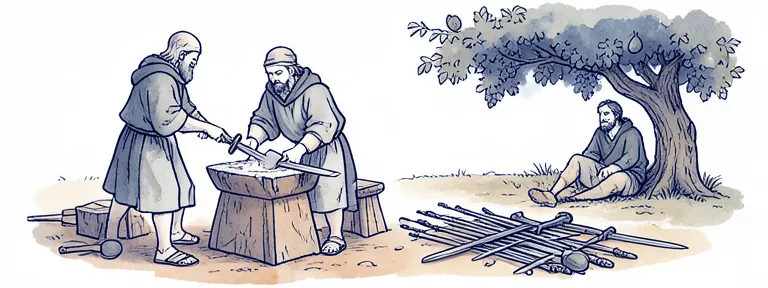
Judgement and hope alternate through the book. In the latter days the nations will stream to Zion, “beat their swords into plowshares” (4:3), and sit each “under his vine and under his fig tree” (4:4). A ruler will come from little Bethlehem (5:2). In chapter 6 God puts his people on trial before the mountains, and the prophet sums up what God asks: “to act justly, to love mercy, and to walk humbly with your God” (6:8). The book ends with a hymn to a God who pardons (7:18).
Author and date
The book names Micah of Moresheth (1:1). A century later, elders in Jerusalem still remembered his warning about Zion and quoted it word for word (Jeremiah 26:18).
Traditional view
The whole book comes from Micah, spoken over several reigns and collected by him or his followers. The hope of chapters 4–5 and 7 belongs with the judgement: the prophet who foresaw Jerusalem’s ruin also foresaw its restoration.
Academic view
Most academic scholars attribute much of chapters 1–3 to Micah, and see chapters 4–7 as a collection that grew over later centuries. The mention of Babylon in 4:10 and the promises of return from exile are often dated to the exile or later.
Both views note that 4:1–3 is almost identical to Isaiah 2:2–4, and discuss whether one prophet drew on the other or both drew on an older song of Zion.
Audience and setting
Micah spoke to Judah in the late 8th century BC. In those years Assyria destroyed Samaria (722 BC), and the Assyrian king Sennacherib’s army swept through the Judean lowlands (701 BC), taking towns such as Lachish near Micah’s home (1:13). He speaks for the country people whose land was being taken by the powerful, and against the leaders in Jerusalem who said, “Isn’t Yahweh among us? No disaster will come on us” (3:11).
Genre, and how to read it
Micah is usually read in three cycles, each opening with a call to listen (1:2, 3:1, 6:1) and each moving from judgement to hope. The prophet loves wordplay. The lament in 1:10–16 puns on the names of towns in his home region, which translations can rarely show.
The closing hymn plays on his own name, “who is like Yahweh?” when it asks, “Who is a God like you, who pardons iniquity” (7:18). Its promise that God will “cast all their sins into the depths of the sea” (7:19) gives its name to Tashlikh, the Jewish New Year custom of symbolically casting away sins into flowing water. Micah is sixth in the Twelve, the shorter prophets kept on one scroll in the Hebrew Bible.
The mountain of Yahweh, twice
Micah and Isaiah preached in the same years, and both books hold the same vision of the nations streaming to Zion to learn God’s ways and beating their swords into plowshares. In the Hebrew, 54 of Micah’s 64 words over the three verses stand in Isaiah too, in the same order. Where the two differ, they differ in small, deliberate ways.
-
Micah 4:1But in the latter days, it will happen that the mountain of Yahweh’s temple will be established on the top of the mountains, and it will be exalted above the hills; and peoples will stream to it.Isaiah 2:2It shall happen in the latter days, that the mountain of Yahweh’s house shall be established on the top of the mountains, and shall be raised above the hills; and all nations shall flow to it.12 of 16 Hebrew words shared, in order Isaiah has “all nations” stream to the mountain, Micah “peoples”.
-
Micah 4:2Many nations will go and say, “Come! Let’s go up to the mountain of Yahweh, and to the house of the God of Jacob; and he will teach us of his ways, and we will walk in his paths.” For the law will go out of Zion, and Yahweh’s word from Jerusalem;Isaiah 2:3Many peoples shall go and say, “Come, let’s go up to the mountain of Yahweh, to the house of the God of Jacob; and he will teach us of his ways, and we will walk in his paths.” For the law shall go out of Zion, and Yahweh’s word from Jerusalem.23 of 24 Hebrew words shared, in order Then they trade back: Isaiah’s “many peoples” go up, Micah’s “many nations”.
-
Micah 4:3and he will judge between many peoples, and will decide concerning strong nations afar off. They will beat their swords into plowshares, and their spears into pruning hooks. Nation will not lift up sword against nation, neither will they learn war any more.Isaiah 2:4He will judge between the nations, and will decide concerning many peoples. They shall beat their swords into plowshares, and their spears into pruning hooks. Nation shall not lift up sword against nation, neither shall they learn war any more.19 of 24 Hebrew words shared, in order Micah adds that the nations are “strong” and “afar off”.
Then Micah alone: every man will sit under his vine and under his fig tree
(Micah 4:4).
Then Isaiah alone: let’s walk in the light of Yahweh
(Isaiah 2:5).
And Joel turns it round: Beat your plowshares into swords
(Joel 3:10).
Matched in the site’s Hebrew, word by word in order; the English differs more than the Hebrew does, because the WEB translates the two books in slightly different words. Scholars still discuss whether one prophet took the vision from the other, or both from an older song of Zion.
Outline
First cycle (1–2)
- 1:1–1:16 Samaria and Judah judged — God comes down, and a lament over the lowland towns
- 2:1–2:13 Those who seize fields — Woe to the land-grabbers, and a promise to gather the remnant
Second cycle (3–5)
- 3:1–3:12 Leaders, priests and prophets — Justice for sale, and Zion plowed like a field
- 4:1–4:13 The mountain of Yahweh — Swords into plowshares, and the scattered gathered
- 5:1–5:15 A ruler from Bethlehem — A shepherd for Israel, and a purified people
Third cycle (6–7)
- 6:1–6:16 God’s case against Israel — The mountains as witnesses, and what Yahweh requires
- 7:1–7:20 Lament and hope — A society unravelling, and a God who pardons
Key themes
- Justice
- After a list of ever costlier offerings (6:6–7) comes the answer: “He has shown you, O man, what is good” (6:8), and it is justice, mercy and humility.
- Leaders who fail
- Judges take bribes, priests teach for a price and prophets tell fortunes for money, while all of them claim God is on their side (3:11).
- Peace among the nations
- “Nation will not lift up sword against nation, neither will they learn war any more” (4:3).
- The ruler from Bethlehem
- Out of Bethlehem, “small among the clans of Judah,” will come a ruler for Israel (5:2). Matthew cites the verse in the story of the magi (Matthew 2:6).
- Pardon
- God “delights in loving kindness” (7:18) and keeps faith with “Abraham, as you have sworn to our fathers” (7:20). The Covenants page follows that oath.
At a glance
Most mentioned: Jacob (Israel), Aaron, Abraham, Ahab, Ahaz