Proverbs
Practical wisdom for everyday life, rooted in one conviction: “The fear of Yahweh is the beginning of knowledge.”
Overview
Proverbs sets out to teach wisdom: how to live well in God’s world, at home, at work, in the marketplace and at court. Its first nine chapters are longer speeches, mostly from a father to a son, urging him to choose wisdom over folly. Wisdom herself appears as a woman calling in the streets (1:20), and in chapter 8 she speaks of being with God at creation. Folly is a rival woman with her own house and her own invitation.
From chapter 10 the book turns to short sayings, most of them two lines long, on speech, money, work, laziness, anger, friendship, marriage, justice and the king. They are arranged loosely, sometimes by a shared word or theme. The book closes with the sayings of two otherwise unknown men, Agur and Lemuel, and a poem in praise of “a worthy woman” (31:10), each verse beginning with the next letter of the Hebrew alphabet. The motto of the whole comes near the start: “The fear of Yahweh is the beginning of knowledge” (1:7).
Author and date
Proverbs is a collection of collections. It opens with Solomon’s name (1:1) and gives separate headings to the words of the wise, to Solomon’s proverbs copied by Hezekiah’s men, and to Agur and Lemuel.
Traditional view
Jewish and Christian tradition credit Solomon with the core of the book, following its headings and 1 Kings 4:32, which says he spoke three thousand proverbs. The book itself names other contributors and says Hezekiah’s scribes copied out more of Solomon’s proverbs around 700 BC (25:1).
Academic view
Many scholars see Solomon as the patron of Israel’s wisdom tradition more than the author of particular sayings. They date the sayings collections to the time of the kings and place chapters 1–9 later, as an introduction to the whole. They also point to close parallels between 22:17–24:22 and the Instruction of Amenemope, an Egyptian book of advice.
Both views agree that the book was edited in stages, since it records its own history: Hezekiah’s men were copying Solomon’s proverbs more than two centuries after his reign (25:1).
Audience and setting
Proverbs addresses a young man, “my son,” on the edge of adult life, and much of it probably served in the education of scribes and officials at court. Its sayings also carry the wisdom of farm and household. Wisdom was an international pursuit in the ancient Near East. Proverbs shares forms and even some content with Egyptian and Mesopotamian books of instruction, but it grounds everything in the fear of Yahweh.
Genre, and how to read it
A proverb is a generalisation: a compressed observation about how life usually goes. Reading one as a promise or a law misreads it. The book shows this itself by setting two sayings side by side: “Don’t answer a fool according to his folly” and “Answer a fool according to his folly” (26:4–5). Knowing which one fits the moment is the wisdom the book is trying to teach.
- 1:1 Proverbs of Solomon
- 10:1 Proverbs of Solomon
- 22:17 Words of the wise
- 24:23 Sayings of the wise
- 25:1 Hezekiah’s men
- 30:1 Agur
- 31:1 King Lemuel
Read the sayings slowly, a few at a time. Many work by contrast (“A wise son makes a glad father; but a foolish son brings grief to his mother,” 10:1) or by comparison drawn from nature. Christian readers have long connected Wisdom’s speech in chapter 8, where she was with God “in the beginning of his work” (8:22), with the portrait of Christ as the Word in John 1.
My son, the wise and the fool
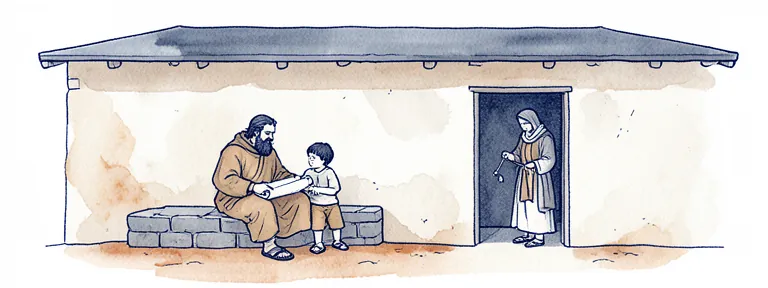
Proverbs opens as a father talking to his son, My son, listen to your father’s instruction
(1:8), and that voice fills chapters 1–9: 15 of the book’s 22 uses of my son
are there. From chapter 10, The proverbs of Solomon. A wise son makes a glad father
(10:1), the book turns to short sayings, and its two characters take over: the wise man (46 times) and the fool (49).
Counted in the site’s Hebrew: my son
is beni; wise is chakam; fool is kesil, the most common of Proverbs’ several words for one. Chapter 26 gathers the fools, and holds the famous pair that seem to contradict each other: Don’t answer a fool according to his folly
(26:4) and Answer a fool according to his folly
(26:5). The father returns in chapters 23–24, My son, if your heart is wise
(23:15).
Outline
Wisdom calling (1–9)
- 1:1–9:18 Instruction for a son — A father’s speeches, and Wisdom and Folly each calling
The collections (10–31)
- 10:1–22:16 The proverbs of Solomon — Hundreds of two-line sayings
- 22:17–24:22 Words of the wise — Longer sayings, close to an Egyptian book of advice
- 24:23–24:34 More sayings of the wise — Justice, and the sluggard’s field
- 25:1–29:27 Copied by Hezekiah’s men — Comparisons from nature, the court and the home
- 30:1–30:33 The words of Agur — Humility before God, and numbered sayings
- 31:1–31:9 The words of King Lemuel — A mother’s advice to a king
- 31:10–31:31 The worthy woman — An alphabetic poem
Key themes
- The fear of Yahweh
- Wisdom begins with reverence for God (1:7, 9:10), and the book ends by praising “a woman who fears Yahweh” (31:30).
- Wisdom and folly
- Two ways of life compete for the reader, pictured as two women each inviting the simple into her house (9:1).
- Trust
- “Trust in Yahweh with all your heart, and don’t lean on your own understanding” (3:5). Human plans have their place, but “Yahweh directs his steps” (16:9).
- Words
- Speech is the book’s most frequent subject: gossip, flattery, lies, a gentle answer, a word in season.
- Work and wealth
- The book praises diligence, mocks the sluggard, warns against debt and quick riches, and insists on fairness to the poor.
At a glance
Most mentioned: Solomon, Lemuel, Agur, David, Hezekiah
In the Almanac: Casting lots, Alphabet poems