2 Corinthians
Paul’s most personal letter: after a painful break with the Corinthian church, he defends his ministry and finds God’s power in his own weakness.
Overview
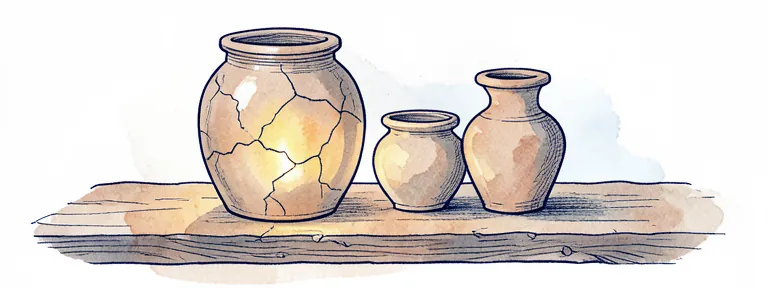
Between 1 and 2 Corinthians, relations broke down. Paul made a visit he describes as coming “in sorrow” (2:1), then sent a severe letter written “with many tears” (2:4), and waited anxiously for news. When Titus met him in Macedonia with word that the church had turned back to him (7:6), Paul wrote with relief. The first seven chapters explain his changes of plan and reflect on serving “a new covenant” (3:6). Here Paul writes that “we have this treasure in clay vessels” (4:7), and that “if anyone is in Christ, he is a new creation” (5:17).
Chapters 8 and 9 appeal for gifts to the collection Paul was gathering for the poor believers in Jerusalem. Then the tone changes sharply. In chapters 10–13 Paul confronts rivals he calls, with irony, “the very best apostles” (11:5), whose followers mocked his unimpressive presence (10:10). He says they have driven him to boast, and he lists beatings, shipwrecks and dangers, and a “thorn in the flesh” that God did not remove (12:7). The answer he received from the Lord, “My grace is sufficient for you, for my power is made perfect in weakness” (12:9), shapes the whole letter.
Author and date
The letter is from Paul and Timothy (1:1). That Paul wrote it is not in doubt; whether he wrote it as one letter is debated.
Scholarly consensus
Paul writes from Macedonia, where Titus found him (7:5–6), probably within a year or so of 1 Corinthians and before the winter in Greece described in Acts 20:2–3. The letter is addressed to Corinth “with all the saints who are in the whole of Achaia” (1:1).
Many scholars think 2 Corinthians joins two or more of Paul’s letters. The main reason is the sharp change of tone at chapter 10. Some identify chapters 10–13 with the tearful letter of 2:4; others see them as a later letter, written when fresh trouble arose. Chapters 8 and 9 may once have been separate notes about the collection. Some also read 6:14–7:1 as an insertion, since 7:2 picks up where 6:13 left off. Others read the whole as a single letter whose mood shifts as Paul turns from the reconciled majority to his rivals.
Audience and setting
The church at Corinth (see 1 Corinthians) had welcomed visiting preachers who came with “letters of commendation” (3:1) and spoke impressively. These visitors questioned Paul’s credentials and his refusal to take payment from the church (11:7). Paul writes to a congregation that has disciplined an offender at his request (2:6) but is still divided in its loyalty.
Genre, and how to read it
Read 2 Corinthians as one side of a correspondence in the middle of a strained relationship. Paul refers to visits and letters the reader never sees, and much has to be pieced together from hints. A likely sequence is Paul’s founding visit (Acts 18), a lost letter, 1 Corinthians, the painful visit, the tearful letter, Titus’s report and this letter, with a third visit still ahead (13:1).
The letter holds some of Paul’s most quoted lines on reconciliation: “God was in Christ reconciling the world to himself” (5:19), and “We are therefore ambassadors on behalf of Christ” (5:20). Its account of strength in weakness has spoken to readers in illness and hardship across Christian traditions. Chapters 8–9 are the New Testament’s fullest teaching on giving, including the line “God loves a cheerful giver” (9:7).
Five times forty lashes less one
When rivals in Corinth boast, Paul answers with a list of what he has suffered, and he numbers it: five floggings, three beatings, a stoning, three shipwrecks, a night and a day in the sea. That is 13 counted sufferings, and Acts, written later about the same years, narrates only 2 of them before he wrote. The rest are known from this one passage.
-
Forty lashes less one
Five times I received forty stripes minus one
(11:24) not in Acts -
Beaten with rods
Three times I was beaten with rods
(11:25)commanded them to be beaten with rods
(Acts 16:22) -
Stoned
Once I was stoned
(11:25)they stoned Paul
(Acts 14:19) -
Shipwrecked
Three times I suffered shipwreck
(11:25)they ran the vessel aground
(Acts 27:41), later -
A night and a day in the sea
I have been a night and a day in the deep
(11:25) not in Acts -
Imprisoned
in prisons more abundantly
(11:23)they threw them into prison
(Acts 16:23)left Paul in bonds
(Acts 24:27), laterPaul was allowed to stay by himself
(Acts 28:16), later -
Let down in a basket
I was let down in a basket through a window
(11:33)lowering him in a basket
(Acts 9:25)
Most date 2 Corinthians to Paul’s journey through Macedonia (Acts 20:2), so the shipwreck on Malta and the long imprisonments come after it. The five floggings of thirty-nine lashes were a synagogue punishment, and the three beatings with rods a Roman one; Acts tells of one beating, at Philippi, using the same rare verb Paul uses here. The Greek numbers are his own: five times, three times, once.
Outline
Reconciled (1–7)
- 1:1–1:11 Greeting and comfort — The God of all comfort, and a crisis in Asia
- 1:12–2:13 Changed plans — The painful visit and the tearful letter
- 2:14–7:4 The ministry of the new covenant — Letter and Spirit, treasure in clay vessels, reconciliation
- 7:5–7:16 Titus’s good news — Grief that led to repentance
The collection (8–9)
- 8:1–9:15 Giving for Jerusalem — Macedonian generosity, and Christ who became poor
Paul’s defence (10–13)
- 10:1–13:14 Against the rival apostles — Paul’s boasting, the thorn in the flesh, a third visit
Key themes
- Comfort in affliction
- God is “the Father of mercies and God of all comfort” (1:3), who comforts his people so that they can comfort others (1:4).
- The new covenant
- Paul writes that “the letter kills, but the Spirit gives life” (3:6), and believers are “transformed into the same image from glory to glory” (3:18). The Covenants page follows the new covenant through the Bible.
- Reconciliation
- “For him who knew no sin he made to be sin on our behalf, so that in him we might become the righteousness of God” (5:21).
- Generosity
- The collection rests on Christ’s own example: “though he was rich, yet for your sakes he became poor” (8:9).
- Power in weakness
- Paul’s boast is a list of sufferings (11:24–25), and his conclusion is “when I am weak, then am I strong” (12:10).
At a glance
Most mentioned: Jesus Christ, Titus, Moses, Satan, Jacob (Israel)