Deuteronomy
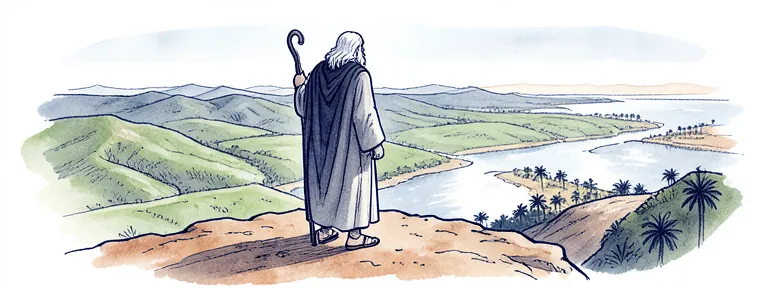
Moses’ last words to Israel on the edge of the promised land: remember what God has done, love him with everything, and choose life.
Overview
Deuteronomy is set on a single day, or close to it, on the plains of Moab as Israel waits to cross the Jordan. Moses, who will not enter the land, speaks to the new generation. He reviews the forty years, restates the Ten Commandments, gives the laws for life in the land and calls the people to renew the covenant their parents made at Sinai. The book ends with his song, his blessing of the tribes, and his death (34:5).
Its English name comes from the Greek for “second law,” but it is not a new law so much as the old one preached. The word “today” recurs throughout, and the speeches press every hearer to make the covenant their own: “I have set before you life and death, the blessing and the curse. Therefore choose life” (30:19).
Author and date
Deuteronomy presents itself as Moses’ own words and says he wrote “this law” down (31:9, 31:24). The account of his death and burial in chapter 34 is written by someone else.
Traditional view
Jewish and Christian tradition hold that Moses wrote the book shortly before his death, with the closing chapter added afterwards. One old Jewish tradition credits Joshua with its final verses.
Academic view
Most academic scholars link the core of Deuteronomy (chapters 12–26) to “the book of the law” found in the temple in King Josiah’s reign, around 622 BC (2 Kings 22). They connect it with his reforms and think the framing speeches were added later. Many also see Deuteronomy as the opening of a longer history running through Joshua, Judges, Samuel and Kings.
Both views note that the book is shaped like an ancient Near Eastern treaty: a history, then terms, blessings and curses, and witnesses. They differ over which century’s treaties it most resembles.
Audience and setting
Moses speaks to the generation born in the wilderness, who were children or unborn when their parents stood at Sinai. The setting is the plains of Moab, east of the Jordan opposite Jericho, and the future he describes is life in the land: kings, courts, prophets, harvests and the pull of other gods.
Genre, and how to read it
Deuteronomy is preaching. Even its laws are urged rather than simply stated, with reasons, warnings and memories attached. Four headings divide it, each opening a new section of Moses’ address.
- 1:1 “These are the words”
- 4:44 “This is the law”
- 29:1 “The words of the covenant”
- 33:1 “This is the blessing”
Read it as the book the rest of the Old Testament measures itself by. The histories that follow judge Israel’s kings by its standard of worshipping God alone at the place he chooses, and the prophets echo its warnings and promises. It is also among the books most quoted in the New Testament: when Jesus is tempted in the wilderness, all three of his answers come from Deuteronomy (Matthew 4:1–11).
The place he will choose
Deuteronomy sends Israel, again and again, to the place which Yahweh your God shall choose
(12:5): 21 times, most of them in the laws of chapters 12–18. Sacrifices, tithes, the Passover and the feasts, hard cases at law: all of it goes to one place. The book never says where; it never names Jerusalem.
- Offerings and vows
- 12:5
you shall seek his habitation
- 12:11
your burnt offerings, your sacrifices, your tithes
- 12:14
there you shall offer your burnt offerings
- 12:18
you shall eat them before Yahweh your God
- 12:21
If the place which Yahweh your God shall choose to put his name is too far from you
- 12:26
your holy things which you have, and your vows
- Tithes and firstborn
- 14:23
the tithe of your grain, of your new wine, and of your oil
- 14:24
is too far from you
- 14:25
then you shall turn it into money
- 15:20
You shall eat it before Yahweh your God year by year
- The feasts
- 16:2
You shall sacrifice the Passover
- 16:6
there you shall sacrifice the Passover at evening
- 16:7
You shall roast and eat it
- 16:11
You shall rejoice before Yahweh your God
- 16:15
You shall keep a feast to Yahweh your God seven days
- 16:16
Three times in a year all of your males shall appear before Yahweh your God
- Justice and the Levites
- 17:8
If there arises a matter too hard for you in judgment
- 17:10
the decisions of the verdict which they shall give you from that place
- 18:6
If a Levite comes from any of your gates
- Firstfruits and the law
- 26:2
some of the first of all the fruit of the ground
- 31:11
you shall read this law before all Israel
Found in the site’s Hebrew text, where maqom, place, is followed by bachar, choose; at 23:16 the same words describe where an escaped slave chooses to live, and are left out. The shaded chapters are the laws (12–26).
Outline
Looking back (1–4)
- 1:1–4:43 The first address — Forty years remembered, from Horeb to the Jordan
The covenant law (4–28)
- 4:44–11:32 The heart of the law — The Ten Commandments, the Shema, “beware lest you forget”
- 12:1–26:19 The laws for life in the land — Worship, leaders, justice, family, the poor
- 27:1–28:68 Blessings and curses — Mount Ebal and Mount Gerizim, and what each path leads to
Looking ahead (29–34)
- 29:1–30:20 The covenant renewed — Return after exile, and “choose life”
- 31:1–32:52 Joshua, and the Song of Moses — The law written down and a song to witness against them
- 33:1–34:12 Blessing and death — Moses blesses the tribes, sees the land, and dies
Key themes
- One God, loved wholly
- The Shema, “Hear, Israel: Yahweh is our God. Yahweh is one” (6:4), is followed by the command to love him “with all your heart, with all your soul, and with all your might” (6:5). Jesus calls it the greatest commandment.
- Remember
- Forgetting is the great danger once life in the land is easy. The wilderness taught “that man does not live by bread only” (8:3), and prosperity must not erase the lesson.
- Choice
- The covenant is set out as a choice between blessing and curse, with consequences for the nation (28:1), and ends in an appeal: “choose life” (30:19).
- Justice and care
- Because Israel was once a slave in Egypt, its laws protect the widow, the orphan, the foreigner and the poor. They even limit the powers of the king (17:14).
- A prophet like Moses
- Moses promises that God will raise up “a prophet … like me” (18:15), and the book closes by saying none has yet arisen (34:10). The New Testament sees the promise fulfilled in Jesus (Acts 3:22).
At a glance
Most mentioned: Moses, Jacob (Israel), Sihon, Og, Joshua
Main places: Egypt, Jordan, Bashan, Moab, Mount Sinai
In the Almanac: Sabbath, Sabbatical year, Rephaim, Amalekites, Levites