John
Jesus, the Word who was with God, becomes flesh and, through signs, long conversations, his death and his resurrection, makes the Father known, so that readers may believe and have life.
Overview
John begins before creation: “In the beginning was the Word, and the Word was with God, and the Word was God” (1:1). A few verses later John makes clear that the Word is Jesus: “The Word became flesh and lived among us” (1:14). The first half of the book, often called the Book of Signs, follows Jesus between Galilee and Jerusalem. It is built around miracles that John calls signs, from water turned to wine at Cana (2:11) to the raising of Lazarus. Each is joined to conversations and debates about who Jesus is.
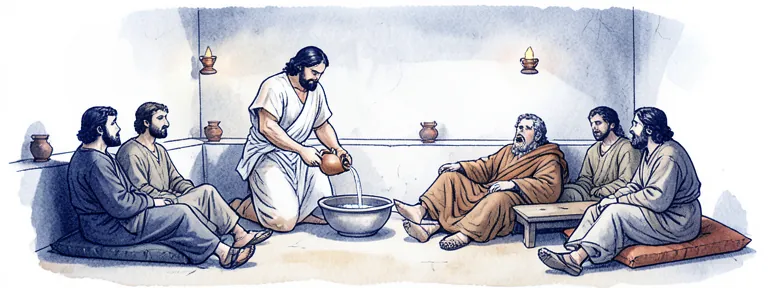
From chapter 13 the pace slows. Jesus washes his disciples’ feet, and five chapters record what he says to them and to the Father on his last night. The arrest, trials and crucifixion follow, then appearances to Mary Magdalene, to the disciples and to Thomas. The book gives its own purpose, saying these signs “are written that you may believe that Jesus is the Christ, the Son of God, and that believing you may have life in his name” (20:31). A last chapter, set by the lake, shows the risen Jesus restoring Peter.
Author and date
The Gospel does not name its author. Its closing verses credit “the disciple whom Jesus loved” with its testimony, and add, “We know that his witness is true” (21:20–24).
Traditional view
Beginning with Irenaeus, a bishop writing around AD 180, the church identified the beloved disciple as John, one of the Twelve. It held that he wrote the Gospel late in life at Ephesus. The book’s close knowledge of places and customs in Judea is taken to support an eyewitness source.
Academic view
Many academic scholars see the Gospel as the work of a community that looked back to the beloved disciple as its founder and witness. They think it was written in stages and edited by others, pointing to the “We know” of 21:24. Some think the beloved disciple was someone other than John son of Zebedee. One suggestion is John the Elder, whom Papias, an early 2nd-century bishop, seems to treat as a different person from the apostle.
Both views date the Gospel’s final form toward the end of the 1st century, making it the latest of the four. Both also find in it traditions about Judea and Jerusalem that the other Gospels lack.
Audience and setting
John writes so that readers “may believe” (20:31), which could mean coming to faith or continuing in it. At this point the Greek manuscripts differ by a single letter. The book explains Jewish festivals and Aramaic terms, and speaks of “the Jews” in a way that suggests a community in bitter conflict with the synagogue. Tradition places it in Ephesus. Its setting moves between Galilee and Jerusalem across three Passovers.
Genre, and how to read it
John differs in shape from the other three Gospels. It has no exorcisms, no parables of the kind found in the other three and no account of the bread and cup at the Last Supper. It gives more room to long dialogues, with Nicodemus, the Samaritan woman and the crowds. It also has sayings in which Jesus says “I am” with an image: the bread of life (6:35), the light of the world (8:12), the door (10:9), the good shepherd (10:11), the resurrection and the life (11:25), the way, the truth and the life (14:6), and the true vine (15:1).
Two passages raise questions about what the original text contained. The story of the woman caught in adultery (7:53–8:11) is missing from the earliest manuscripts and appears in different places in later ones. Most modern Bibles print it with a note, and the reading text here includes it. The explanation of an angel stirring the pool (5:4) is also absent from the oldest copies.
John’s calendar of feasts
John marks the time by the feasts of Jerusalem: three Passovers, an unnamed feast, Booths and Dedication. Set on a calendar, they span at least two years; set side by side, they show the opposition growing from one feast to the next until they took counsel that they might put him to death
(11:53).
-
Passover 2:13
- Jesus
- Jerusalem
Jesus went up to Jerusalem
2:13 - There
Don’t make my Father’s house a marketplace!
2:16- Against him
- none yet:
many believed in his name
2:23
-
“a feast of the Jews” 5:1
- Jesus
- Jerusalem
Jesus went up to Jerusalem
5:1 - There
- heals a man ill
thirty-eight years
5:5 on a Sabbath - Against him
the Jews sought all the more to kill him
5:18
-
Passover 6:4
- Jesus
- Galilee stays in Galilee:
the other side of the sea of Galilee
6:1 - There
- feeds the five thousand;
I am the bread of life
6:35 - Against him
he wouldn’t walk in Judea, because the Jews sought to kill him
7:1
-
Booths (Tabernacles) 7:2
- Jesus
- Jerusalem
not publicly, but as it were in secret
7:10 - There
If anyone is thirsty, let him come to me and drink!
7:37- Against him
they took up stones to throw at him
8:59
-
Dedication 10:22
- Jesus
- Jerusalem
It was winter, and Jesus was walking in the temple, in Solomon’s porch
10:23 - There
I and the Father are one
10:30- Against him
the Jews took up stones again to stone him
10:31
-
Passover 11:55
- Jesus
- Jerusalem
six days before the Passover, Jesus came to Bethany
12:1 - There
- the last supper
before the feast of the Passover
13:1 and the cross onthe Preparation Day of the Passover
19:14 - Against him
from that day forward they took counsel that they might put him to death
11:53
John does not name the feast of 5:1, so its place between the first two Passovers is not known; some read it as another Passover, which would add a year. The other gospels narrate only one Passover in Jesus’ ministry, the last, so the length of the ministry rests mostly on John.
The axis counts in months from the first Passover, by the feasts’ seasons: Passover in spring, Booths in autumn, Dedication in winter (It was winter
10:23). No years are given in the text, and none are shown.
One week, a third of the book
Every gospel slows down at the end. From the entry into Jerusalem to the last page is a single week, and it fills more than a third of Matthew, Mark and John and a quarter of Luke. A century ago Martin Kähler called the gospels passion narratives with extended introductions.
- Matthew 36% 389 of 1,071 verses week from Matthew 21:1; first prediction Matthew 16:21
- Mark 37% 253 of 678 verses week from Mark 11:1; first prediction Mark 8:31
- Luke 25% 286 of 1,151 verses week from Luke 19:28; first prediction Luke 9:22
- John 38% 332 of 879 verses week from John 12:12
Verses as the WEB numbers them, so these are shares of the text, not of time. Mark’s count includes the longer ending (16:9–20), which the earliest manuscripts lack; without it, its last week is 36%. Luke spends its middle on the road, ten chapters from Luke 9:51 to the city. John has no prediction like the others’; its turn comes at the supper, Jesus knowing that his time had come
(John 13:1). The week itself, day by day, is in the Almanac’s Holy Week.
Each gospel’s favourite words
Each gospel has words it reaches for. Counted in the site’s Greek text, Matthew alone speaks of the kingdom of heaven
, Mark says immediately
more than all the others together, Luke dwells on the Holy Spirit and on today
, and John has believe
almost a hundred times and the doubled amen, amen
that no other gospel uses.
| Phrase | Matthew | Mark | Luke | John |
|---|---|---|---|---|
| the kingdom of heaven ἡ βασιλεία τῶν οὐρανῶν WEB: the Kingdom of Heaven | 32 times | 0 times | 0 times | 0 times |
| the kingdom of God ἡ βασιλεία τοῦ θεοῦ WEB: God’s Kingdom | 4 times | 14 times | 32 times | 2 times |
| immediately εὐθύς, εὐθέως WEB: immediately | 19 times | 43 times | 9 times | 6 times |
| the Holy Spirit τὸ πνεῦμα τὸ ἅγιον WEB: the Holy Spirit | 5 times | 4 times | 13 times | 3 times |
| today σήμερον WEB: today | 8 times | 1 times | 11 times | 0 times |
| believe πιστεύω WEB: believe | 11 times | 14 times | 9 times | 98 times |
| I am ἐγώ εἰμι WEB: I am | 9 times | 5 times | 9 times | 38 times |
| amen, amen ἀμὴν ἀμήν WEB: Most certainly | 0 times | 0 times | 0 times | 25 times |
Circles are sized by how often the gospel uses the phrase per 10,000 Greek words, so short Mark and long Luke compare fairly; the number is the count. Counted in the Nestle 1904 text by Strong’s number. The WEB renders amen
as Most certainly
, whether single or doubled, and writes the kingdom of God as God’s Kingdom
. I am
counts the Greek ἐγώ εἰμι wherever it stands, not only in the sayings with an image.
Outline
Prologue (1)
- 1:1–1:18 The Word — In the beginning, and the Word made flesh
The Book of Signs (1–12)
- 1:19–2:25 The first witnesses and the first sign — John the Baptist, the first disciples, water into wine, the temple cleared
- 3:1–4:54 New birth and living water — Nicodemus, the Samaritan woman, the official’s son
- 5:1–6:71 Sabbath and bread — The healing at the pool, the feeding, the bread of life
- 7:1–10:42 At the festivals — The Feast of Tabernacles, the light of the world, the man born blind, the good shepherd
- 11:1–12:50 Lazarus, and the hour comes — The raising of Lazarus, the anointing, the entry into Jerusalem
The Book of Glory (13–21)
- 13:1–17:26 The last night — The foot-washing, the farewell speeches, Jesus’ prayer
- 18:1–19:42 Arrest, trial and cross — Before Annas, Caiaphas and Pilate, and “It is finished!”
- 20:1–20:31 The risen Jesus — Mary Magdalene, the disciples, Thomas and the book’s purpose
Epilogue (21)
- 21:1–21:25 By the lake — The catch of fish, Peter restored, the beloved disciple
Key themes
- The Word made flesh
- The one who “was God” (1:1) becomes flesh and makes the unseen God known (1:18).
- Signs and belief
- The signs reveal Jesus’ glory and call for faith (2:11). Thomas’s “My Lord and my God!” (20:28) is the book’s high point of confession.
- Life
- “For God so loved the world, that he gave his only born Son, that whoever believes in him should not perish, but have eternal life” (3:16). In John eternal life begins now, as knowing God through Jesus.
- The hour
- At Cana Jesus says, “My hour has not yet come” (2:4). Later he says, “The time has come for the Son of Man to be glorified” (12:23), and John treats the cross itself as that glory.
At a glance
Most mentioned: Jesus Christ, Simon Peter, Pontius Pilate, John the Baptist, Lazarus
Main places: Galilee, Jerusalem, Judea, Capernaum, Nazareth
In the Almanac: Stadion, What things cost, Holy Week, Tabernacles, Dedication, Hours of the day, Samaritans, Pharisees, Sanhedrin, Casting lots, Solomon's temple