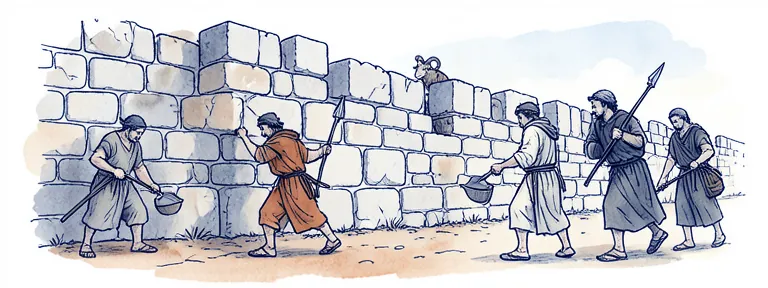
Nehemiah
A Jewish official at the Persian court rebuilds Jerusalem’s walls in fifty-two days and leads the people in renewing their covenant.
Overview
Nehemiah is cupbearer to the Persian king Artaxerxes in Susa when he hears that Jerusalem’s walls are still in ruins. He prays, asks the king for leave, and arrives as governor in 445 BC, “the twentieth year of Artaxerxes” (2:1). Much of the book is his own direct, practical account. He organises the rebuilding family by family, faces down mockery, threats and plots, and finishes the wall “in fifty-two days” (6:15).
The second half turns from walls to people. Ezra reads the law aloud to the assembled community, with interpreters giving “the sense, so that they understood” (8:8). The people weep, celebrate the Feast of Tabernacles, confess their history and sign a covenant. Jerusalem is repopulated and the walls dedicated. The book ends with Nehemiah back for a second term, confronting the same failures again: sabbath trading, unpaid Levites (the temple workers) and mixed marriages.
Author and date
Nehemiah is the second half of one book with Ezra. It opens “The words of Nehemiah” (1:1), and much of it is written in his own first-person voice.
Traditional view
Jewish tradition credits Ezra with the combined book, and Nehemiah with the memoir it preserves.
Academic view
Most academic scholars accept the Nehemiah memoir as a genuine 5th-century source and see the book as compiled later, joining it with Ezra material, lists and the covenant document.
Outside the Bible, letters from the Jewish community at Elephantine in Egypt, dated around 407 BC, name Sanballat as governor of Samaria, matching one of Nehemiah’s opponents.
Audience and setting
Nehemiah was written for the community in Jerusalem and Judah under Persian rule, to show how a vulnerable city became a defended and dedicated one. The setting is Susa, the Persian capital, and Jerusalem, 445–c. 430 BC.
Genre, and how to read it
Nehemiah’s memoir is one of the most personal voices in the Old Testament. He breaks off to pray short, sharp prayers in the middle of events (“Remember me, my God, for good,” 13:31) and reports his own anger and his own shrewdness frankly.
The lists of builders, residents and signatories can be skipped on a first reading, but they are part of the point: the city was rebuilt by named families, gate by gate.
The wall, gate by gate
Chapter 3 walks the whole wall, starting and ending at the Sheep Gate, and names who built each stretch: Next to him…
, After him…
. Here are its 41 stretches in that order, coloured by who built them. Point at the ring or the list to match them up.
- Sheep Gate Eliashib the high priest and the priests, priests and Levites 3:1
- the men of Jericho, men of another town 3:2
- Zaccur son of Imri, other named men and families 3:2
- Fish Gate the sons of Hassenaah, other named men and families 3:3
- Meremoth son of Uriah, other named men and families 3:4
- Meshullam son of Berechiah, other named men and families 3:4
- Zadok son of Baana, other named men and families 3:4
- the Tekoites, though their nobles refused, men of another town 3:5
- Old Gate Joiada and Meshullam, other named men and families 3:6
- the men of Gibeon and Mizpah, men of another town 3:7
- Uzziel, of the goldsmiths, goldsmiths, perfumers, merchants 3:8
- Hananiah, one of the perfumers, goldsmiths, perfumers, merchants 3:8
- Rephaiah, ruler of half the district of Jerusalem, district rulers 3:9
- Jedaiah, across from his house, opposite their own house 3:10
- Hattush son of Hashabneiah, other named men and families 3:10
- Malchijah and Hasshub, other named men and families 3:11
- Shallum, ruler of half the district of Jerusalem, and his daughters, district rulers 3:12
- Valley Gate Hanun and the people of Zanoah, men of another town 3:13
- Dung Gate Malchijah, ruler of Beth Haccherem, district rulers 3:14
- Spring Gate Shallun, ruler of Mizpah, district rulers 3:15
- Nehemiah son of Azbuk, ruler of half Beth Zur, district rulers 3:16
- the Levites, under Rehum, priests and Levites 3:17
- Hashabiah, ruler of half Keilah, district rulers 3:17
- Bavvai, ruler of half Keilah, district rulers 3:18
- Ezer, ruler of Mizpah, district rulers 3:19
- Baruch son of Zabbai, “earnestly”, other named men and families 3:20
- Meremoth son of Uriah, a second stretch, other named men and families 3:21
- the priests, men of the surrounding area, priests and Levites 3:22
- Benjamin and Hasshub, across from their house, opposite their own house 3:23
- Azariah, beside his own house, opposite their own house 3:23
- Binnui son of Henadad, other named men and families 3:24
- Palal son of Uzai, other named men and families 3:25
- Water Gate (named, not rebuilt) Pedaiah son of Parosh, other named men and families 3:25
- the Tekoites, a second stretch, men of another town 3:27
- Horse Gate (named, not rebuilt) the priests, each across from his own house, priests and Levites 3:28
- Zadok son of Immer, across from his house, opposite their own house 3:29
- East Gate (named, not rebuilt) Shemaiah, keeper of the east gate, other named men and families 3:29
- Hananiah and Hanun, other named men and families 3:30
- Meshullam, across from his room, opposite their own house 3:30
- Gate of Hammiphkad (named, not rebuilt) Malchijah, one of the goldsmiths, goldsmiths, perfumers, merchants 3:31
- the goldsmiths and the merchants, goldsmiths, perfumers, merchants 3:32
Shallum… he and his daughters made repairs
(3:12): the only women among the builders.
The Tekoites build two stretches (3:5, 3:27), though their nobles didn’t put their necks to the Lord’s work
(3:5).
Hanun and Zanoah repair the Valley Gate and one thousand cubits of the wall to the dung gate
(3:13), the only stretch the text measures.
So the wall was finished in the twenty-fifth day of Elul, in fifty-two days.
(6:15)
The ring is a diagram, not a map: every stretch is drawn the same size and placed in the text’s order, because the wall’s true line and the stretches’ lengths are not given. Nehemiah’s night inspection (dashed) goes out by the Valley Gate, past the Dung Gate to the Spring Gate, and back (2:13–15). The text calls it the spring gate; its place page names it the Gate of the Fountain.
One return, two lists
Ezra 2 and Nehemiah 7 give the same list of those who came back from Babylon with Zerubbabel, family by family and town by town, and both end The whole assembly together was forty-two thousand three hundred sixty
(Ezra 2:64; Nehemiah 7:66). Add up either list, though, and it comes to far less, and the two lists differ in 19 of their 41 lines.
Line by line
| Family or town | Ezra 2 | Nehemiah 7 | Difference |
|---|---|---|---|
| Families | |||
| Parosh | 2,172 2:3 | 2,172 7:8 | |
| Shephatiah | 372 2:4 | 372 7:9 | |
| Arah | 775 2:5 | 652 7:10 | −123 |
| Pahath-moab | 2,812 2:6 | 2,818 7:11 | +6 |
| Elam | 1,254 2:7 | 1,254 7:12 | |
| Zattu | 945 2:8 | 845 7:13 | −100 |
| Zaccai | 760 2:9 | 760 7:14 | |
| Bani / Binnui | 642 2:10 | 648 7:15 | +6 |
| Bebai | 623 2:11 | 628 7:16 | +5 |
| Azgad | 1,222 2:12 | 2,322 7:17 | +1,100 |
| Adonikam | 666 2:13 | 667 7:18 | +1 |
| Bigvai | 2,056 2:14 | 2,067 7:19 | +11 |
| Adin | 454 2:15 | 655 7:20 | +201 |
| Ater, of Hezekiah | 98 2:16 | 98 7:21 | |
| Bezai | 323 2:17 | 324 7:23 | +1 |
| Jorah / Hariph | 112 2:18 | 112 7:24 | |
| Hashum | 223 2:19 | 328 7:22 | +105 |
| Gibbar / Gibeon | 95 2:20 | 95 7:25 | |
| Towns | |||
| Bethlehem and Netophah | 179 2:21–22 | 188 7:26 | +9 |
| Anathoth | 128 2:23 | 128 7:27 | |
| Azmaveth | 42 2:24 | 42 7:28 | |
| Kiriath Arim / Jearim, Chephirah and Beeroth | 743 2:25 | 743 7:29 | |
| Ramah and Geba | 621 2:26 | 621 7:30 | |
| Michmas | 122 2:27 | 122 7:31 | |
| Bethel and Ai | 223 2:28 | 123 7:32 | −100 |
| Nebo | 52 2:29 | 52 7:33 | |
| Magbish | 156 2:30 | no such line | only in Ezra |
| Families | |||
| the other Elam | 1,254 2:31 | 1,254 7:34 | |
| Harim | 320 2:32 | 320 7:35 | |
| Towns | |||
| Lod, Hadid and Ono | 725 2:33 | 721 7:37 | −4 |
| Jericho | 345 2:34 | 345 7:36 | |
| Senaah | 3,630 2:35 | 3,930 7:38 | +300 |
| Priests | |||
| Jedaiah | 973 2:36 | 973 7:39 | |
| Immer | 1,052 2:37 | 1,052 7:40 | |
| Pashhur | 1,247 2:38 | 1,247 7:41 | |
| Harim | 1,017 2:39 | 1,017 7:42 | |
| Temple staff | |||
| Levites | 74 2:40 | 74 7:43 | |
| singers | 128 2:41 | 148 7:44 | +20 |
| gatekeepers | 139 2:42 | 138 7:45 | −1 |
| temple servants and Solomon’s servants | 392 2:58 | 392 7:60 | |
| Without records | |||
| could not prove their family | 652 2:60 | 642 7:62 | −10 |
Neither book says who the remaining eleven or twelve thousand were. Readers have suggested people from tribes other than Judah and Benjamin, those who could not show their fathers’ houses
(Ezra 2:59), or women and children; others point out that numbers in copied lists drift. The figure sets out the sums and leaves the question open.
Both lists add the same male servants and their female servants
, 7,337, and the same horses, mules, camels and donkeys; the singing men and women are 200 in Ezra (2:65) and 245 in Nehemiah (7:67).
Lines are paired by name: Nehemiah has Hariph for Jorah and Gibeon for Gibbar, joins Bethlehem and Netophah into one line (Ezra 2:21–22 gives 123 and 56) and has no Magbish. The sums are of every number in each list, as the WEB gives them.
Outline
The walls (1–7)
- 1:1–2:20 Nehemiah’s prayer and mission — Bad news in Susa, the king’s permission, a night ride round the ruins
- 3:1–7:73 The wall rebuilt — Every family a section, opposition faced and the returnees listed
The people (8–13)
- 8:1–10:39 The law and the covenant — Ezra reads, Tabernacles kept, confession, a signed pledge
- 11:1–13:31 The city filled and dedicated — Settlers chosen, walls dedicated, Nehemiah’s last reforms
Key themes
- Prayer and action
- Nehemiah prays and plans in the same breath; when the builders are threatened, “we made our prayer to our God, and set a watch” (4:9).
- Rebuilding together
- “Let’s rise up and build” (2:18): the work belongs to the whole community.
- Scripture understood
- The law is read and explained so all can understand (8:8), and understanding leads to joy: “the joy of Yahweh is your strength” (8:10).
- Old problems return
- The last chapter shows the same problems returning, and the book ends with a prayer rather than a triumph.
At a glance
Most mentioned: Tobiah, Sanballat, Ezra, Jacob (Israel), David
Main places: Jerusalem, Dung Gate, Water Gate, Gate of the Fountain, Geba
In the Almanac: Nisan, Urim and Thummim