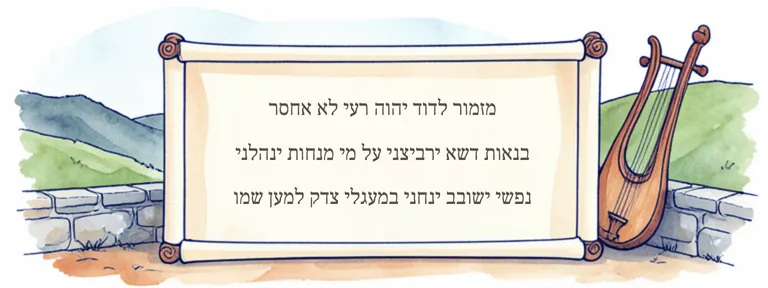
Psalms
Israel’s book of songs and prayers: 150 poems of praise, lament, thanks and trust, gathered into five books.
Overview
Psalms is the longest book in the Bible and the one most used in worship, by Jews and Christians alike. Its 150 poems cover almost every human situation: the joy of the festival crowd, the fear of the hunted man, guilt, sickness, national defeat, old age and the wonder of creation.
The collection is arranged in five books, each closing with a blessing of God (41:13, 72:18–19, 89:52, 106:48). Psalm 150 closes the whole collection with a final burst of praise: “Let everything that has breath praise Yah!” (150:6). Two psalms stand at the entrance like a preface: Psalm 1, on the blessed man who delights in Yahweh’s law, and Psalm 2, on God’s anointed king. Across the five books the tone moves, unevenly, from lament toward praise.
Author and date
Psalms is an anthology from many hands. Most psalms carry a heading that names a person, an occasion or a tune; some have none.
Traditional view
Jewish and Christian tradition read the headings as notes of authorship: 73 psalms “of David” in the Hebrew text, others of Asaph, the sons of Korah, Solomon, Heman, Ethan and Moses. The New Testament cites several psalms as David’s own words (Acts 2:25–35). Holders of this view see the book gathered in stages, with the last psalms added after the exile.
Academic view
Most academic scholars treat the headings as later additions, noting that the Hebrew phrase translated “of David” can also mean “for David” or “belonging to the David collection.” They date individual psalms from the monarchy to after the exile and see the collection completed in the Persian or Hellenistic (Greek) period. The Psalms scroll found among the Dead Sea Scrolls at Qumran arranges the later psalms in a different order.
Both views agree that the book grew over centuries. It includes a psalm headed as a prayer of Moses (Psalm 90) and a lament by the rivers of Babylon (Psalm 137). It also notes, “This ends the prayers by David” (72:20), yet more psalms of David follow.
Audience and setting
The psalms were sung and prayed in Israel’s worship, many of them at the temple in Jerusalem. Some headings give instructions for the choir director or name tunes and instruments. Others read as private prayers later taken up by the congregation. The book has served as the prayer book of the synagogue and the church ever since, and the New Testament quotes it more than almost any other part of the Old Testament.
Genre, and how to read it
Psalms is Hebrew poetry, and its basic unit is the parallel line: a second line that echoes, extends or contrasts with the first. “Your word is a lamp to my feet, and a light for my path” (119:105) says one thing twice. The word “Selah,” which appears in many psalms, is probably a musical or liturgical direction; its exact meaning is unknown. Some psalms are acrostics, working through the Hebrew alphabet letter by letter: Psalm 119 gives eight verses to each letter.
It helps to recognise the main types. Hymns praise God for who he is. Laments, the most common type, bring complaint and petition, and usually turn toward trust by the end. Thanksgiving psalms tell of a rescue, royal psalms concern the king, and wisdom psalms teach. Jesus quoted a lament on the cross: “My God, my God, why have you forsaken me?” (22:1). Note that some older Bibles number the psalms one lower for most of the book, following the ancient Greek and Latin translations.
Five books, and the names in their headings
Most psalms open with a heading, such as A Psalm of David
, and many headings name someone. Here are all 150 psalms, book by book, coloured by the name in each heading. David fills the first book and most of the second; Asaph and the sons of Korah take the third; the fourth is mostly without headings; the fifth mixes David, the songs of ascents and psalms with no heading at all.
- 73 David
- 12 Asaph
- 11 the sons of Korah
- 2 Solomon
- 1 each Moses, Heman, Ethan
- 34 no heading
Book I Psalms 1–41 · 41
- 1
- 2
- 3
- 4
- 5
- 6
- 7
- 8
- 9
- 10
- 11
- 12
- 13
- 14
- 15
- 16
- 17
- 18
- 19
- 20
- 21
- 22
- 23
- 24
- 25
- 26
- 27
- 28
- 29
- 30
- 31
- 32
- 33
- 34
- 35
- 36
- 37
- 38
- 39
- 40
- 41
- David 37
- no heading 4
Closes with Blessed be Yahweh, the God of Israel, from everlasting and to everlasting! Amen and amen.
(41:13)
Book II Psalms 42–72 · 31
- David 18
- Korah 7
- Asaph 1
- Solomon 1
- heading, no name 2
- no heading 2
Closes with Blessed be his glorious name forever! Let the whole earth be filled with his glory! Amen and amen.
(72:19)
Then: This ends the prayers by David, the son of Jesse
(72:20). Eighteen more psalms name David after it.
Book III Psalms 73–89 · 17
- David 1
- Korah 4
- Asaph 11
- Ezrahite 1
Closes with Blessed be Yahweh forever more. Amen, and Amen.
(89:52)
Book IV Psalms 90–106 · 17
- David 2
- Moses 1
- heading, no name 4
- no heading 10
Closes with Blessed be Yahweh, the God of Israel, from everlasting even to everlasting! Let all the people say, “Amen.” Praise Yah!
(106:48)
Book V Psalms 107–150 · 44
- 107
- 108
- 109
- 110
- 111
- 112
- 113
- 114
- 115
- 116
- 117
- 118
- 119
- 120
- 121
- 122
- 123
- 124
- 125
- 126
- 127
- 128
- 129
- 130
- 131
- 132
- 133
- 134
- 135
- 136
- 137
- 138
- 139
- 140
- 141
- 142
- 143
- 144
- 145
- 146
- 147
- 148
- 149
- 150
- David 15
- Solomon 1
- heading, no name 10
- no heading 18
Closes with Let everything that has breath praise Yah! Praise Yah!
(150:6)
Psalms 120–134 (underlined) are each headed A song of ascents
in the BSB; four of them also name David, and one Solomon.
Headings as given in the BSB, which follows the Hebrew; the WEB prints them apart from the verses. “Of David” translates a Hebrew phrase that can mean by, for or belonging to David, so the figure records the name in the heading, not a claim about who wrote the psalm. Psalm 88 names both the sons of Korah and Heman the Ezrahite. A heading with no name is one like A Psalm of thanksgiving
(100).
From 176 verses to two
The 150 psalms run to 2,461 verses, and they could hardly differ more in size. Psalm 119, a meditation on God’s word that gives eight verses to each letter of the alphabet, has 176: about one verse in fourteen in the whole book. Psalm 117 has two, and is the shortest chapter in the Bible: Praise Yahweh, all you nations! Extol him, all you peoples!
Verses as the WEB numbers them; where a psalm has a heading, many Hebrew Bibles count it as verse 1, so their numbers run one higher. Psalm 119’s best-known line is its 105th, Your word is a lamp to my feet, and a light for my path.
(Psalm 119:105).
Outline
- 1:1–41:13 Book One (Psalms 1–41) — Almost all headed “of David,” many of them laments
- 42:1–72:20 Book Two (Psalms 42–72) — The sons of Korah, more psalms of David and a psalm for the king
- 73:1–89:52 Book Three (Psalms 73–89) — Asaph and the sons of Korah, ending with doubt over God’s covenant with David
- 90:1–106:48 Book Four (Psalms 90–106) — A prayer of Moses, and psalms proclaiming that Yahweh reigns
- 107:1–150:6 Book Five (Psalms 107–150) — Psalm 119, the Songs of Ascents, and a closing burst of praise
Key themes
- Praise
- The Hebrew title means “praises,” and the book ends with five psalms that each close with “Praise Yah!” (150:6).
- Lament
- More psalms complain than celebrate. “How long, Yahweh? Will you forget me forever?” (13:1) gives believers permission to bring anger and grief to God.
- God as king
- The psalms celebrate Yahweh’s rule over creation and the nations, and his chosen king on Zion (2:7). Psalm 89 recalls God’s oath to David, “I have made a covenant with my chosen one” (89:3); the Covenants page follows that promise.
- Refuge
- “God is our refuge and strength, a very present help in trouble” (46:1). Pictures of God as shepherd, rock, fortress and shelter run through the book, most famously in Psalm 23.
- The way of the righteous
- Psalm 1 opens the book with the person whose “delight is in Yahweh’s law” (1:2), and wisdom psalms such as 37 and 119 return to the contrast between two ways of life.
At a glance
Most mentioned: Jacob (Israel), David, Asaph (Levite), Aaron, Moses
Main places: Jerusalem, Egypt, Bashan, Edom, Lebanon
In the Almanac: Handbreadth, Leviathan, Alphabet poems, The name YHWH