1 Samuel
Israel moves from judges to kings: Samuel the last judge, Saul the first king, and the rise of the shepherd David.
Overview
1 Samuel opens with Hannah, a childless woman, praying at Shiloh. Her son Samuel becomes the prophet and last judge who bridges two eras. When Israel asks for “a king to judge us like all the nations” (8:5), God tells Samuel that the people have rejected God himself as king (8:7), yet grants the request.
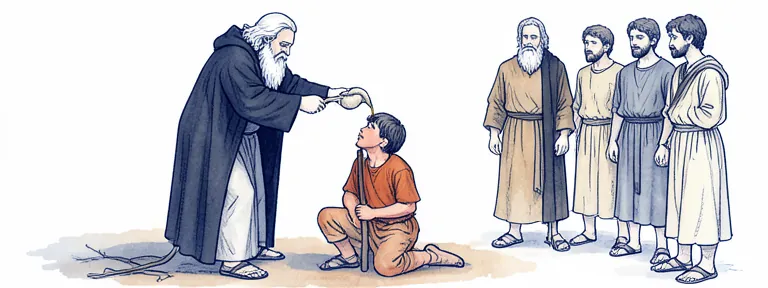
Saul, tall and impressive, starts well and unravels through disobedience. God sends Samuel to anoint a shepherd boy instead, because “man looks at the outward appearance, but Yahweh looks at the heart” (16:7). The rest of the book follows David’s rise and Saul’s decline side by side: Goliath, David’s friendship with Saul’s son Jonathan, Saul’s jealousy and David’s years on the run, when he twice spares Saul’s life. It ends with Saul and Jonathan dead on Mount Gilboa.
Author and date
1 and 2 Samuel are one book in the Hebrew Bible, divided later in the Greek translation. It does not name its author, and Samuel himself dies partway through the first half (25:1).
Traditional view
Jewish tradition credits Samuel with the part before his death and the prophets Nathan and Gad with the rest, drawing on the histories that 1 Chronicles 29:29 says they wrote.
Academic view
Most academic scholars see Samuel as part of one continuous history running from Deuteronomy to Kings. They think it was built from older sources, some perhaps from close to David’s time: a story of the ark, an account of David’s rise and the court history in 2 Samuel.
Both views note that the book draws on earlier written sources, and that its portrait of David, flaws included, is unusually candid for a royal history.
Audience and setting
1 Samuel was written for Israel under or after the monarchy, to explain how their kings began and why David’s line, not Saul’s, held the throne. Its setting is the central hill country around 1050–1010 BC: Shiloh, Ramah, Gibeah, Bethlehem, the valley of Elah and the Philistine cities to the west.
Genre, and how to read it
Read it as narrative with a strong interest in character. The book compares Saul and David constantly without always saying so: Saul consults a medium, David inquires of God; Saul pursues, David spares. Its songs, Hannah’s at the start (2:1) and David’s in 2 Samuel, frame the whole story with the idea that God “raises up the poor out of the dust” (2:8).
Some episodes are told twice or seem to overlap, such as how David first came to Saul’s court (chapters 16 and 17). Some readers see two sources woven together; others see the narrator’s deliberate arrangement.
Samuel, Saul, David
1 Samuel hands Israel from a prophet to a king, then to the king who replaces him. Count the names and the hand-over shows: Samuel 129 times, most of them before David appears; Saul 297, from chapter 9 to the last; David 291, from chapter 16. Saul is named a little more often than David, though from chapter 16 on the story follows David. And the last chapter, Saul’s death, never names David at all.
- Samuel is born
she named him Samuel
1:20 - Israel asks for a king
Now make us a king to judge us like all the nations.
8:5 - Samuel anoints Saul
Hasn’t Yahweh anointed you to be prince over his inheritance?
10:1 - Saul rejected
Yahweh has rejected you from being king over Israel.
15:26 - Samuel anoints David
Yahweh’s Spirit came mightily on David from that day forward.
16:13 - Samuel dies
Samuel died
25:1 - Samuel brought up at Endor
Why have you disturbed me, to bring me up?
28:15 - Saul dies on Gilboa
So Saul died with his three sons
31:6
Counted in the site’s Hebrew. Chapters 5 and 6, where the captured ark plagues the Philistines, name none of the three. After his death is told (25:1) Samuel comes back once: seven times in chapter 28, when the medium at Endor brings him up to speak to Saul.
Outline
Samuel (1–7)
- 1:1–3:21 Hannah, and Samuel’s call — A prayer answered, a boy at Shiloh, a voice in the night
- 4:1–7:17 The ark lost and returned — Defeat by the Philistines, Dagon falls, Samuel judges Israel
Saul (8–15)
- 8:1–12:25 Israel asks for a king — Samuel’s warning, Saul chosen, Samuel’s farewell
- 13:1–15:35 Saul rejected — An unlawful sacrifice, Jonathan’s victory, the Amalekites
David and Saul (16–31)
- 16:1–17:58 David anointed — The youngest son, the harp and Goliath
- 18:1–26:25 David on the run — Jonathan’s friendship, Saul’s pursuit, David spares Saul twice
- 27:1–31:13 Saul’s end — David among the Philistines, the medium at Endor, Gilboa
Key themes
- Kingship
- Israel wants a king “like all the nations” (8:5). The book asks what a king under God should be, and answers through the contrast of Saul and David.
- The heart
- God chooses by the heart, not the appearance (16:7), and prefers obedience to religious display: “to obey is better than sacrifice” (15:22).
- Reversal
- Hannah’s song celebrates a God who brings down the proud and lifts the lowly (2:8); the barren woman, the shepherd boy and the fallen king all bear it out.
- Faith in battle
- David meets Goliath “in the name of Yahweh of Armies” (17:45), and refuses to seize the throne by killing Saul (24:6).
At a glance
Most mentioned: Saul, David, Samuel, Jonathan, Eli
Main places: Ramah, Gath, Gilgal, Keilah, Egypt
In the Almanac: Cubit, Span, Pim, Philistines, Amalekites, Urim and Thummim, Ephod, Teraphim, Ark of the covenant