Ezekiel
A priest in exile sees God’s glory leave Jerusalem before its fall, and then return to a new temple in a restored land.
Overview
Ezekiel was a priest taken to Babylon with King Jehoiachin in 597 BC. Five years later, by the river Chebar, he saw “visions of God” (1:1): a storm, four living creatures, wheels full of eyes and above them a throne with the “likeness of Yahweh’s glory” (1:28). God appointed him a watchman to Israel (3:17). For the next seven years he told the exiles, through words and strange acted-out signs, that Jerusalem would fall. In a vision he watched God’s glory depart from the temple and the city (10:18, 11:23).
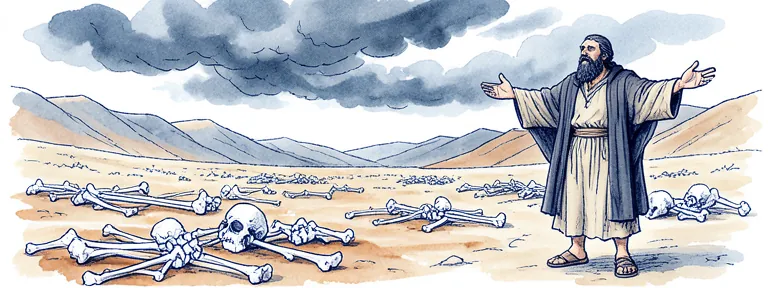
When news came that the city had fallen (33:21), his message turned to restoration. God would shepherd his scattered sheep himself (34:11), give his people “a new heart” (36:26), and raise a valley of dry bones to life (37:1–14). The book ends with a long vision of a new temple, a river flowing from it, and a city named “Yahweh is there” (48:35).
Author and date
Ezekiel is written almost entirely in the first person by “Ezekiel the priest, the son of Buzi” (1:3), and a series of dated headings runs through it (1:2, 8:1, 20:1, 40:1).
Traditional view
Jewish and Christian tradition take the book as Ezekiel’s own record of his visions and oracles, dated from the fifth year of the exile to the twenty-seventh (29:17). The Talmud credits the men of the Great Assembly, the leaders after the return, with writing it down.
Academic view
Most academic scholars accept that the core of the book goes back to Ezekiel himself. They see later additions by a circle of his followers, especially in the prophecy against Gog (chapters 38–39) and the temple vision (chapters 40–48). Some earlier critics doubted the book’s setting in Babylon, a view now rarely held.
Both views see a book unusually unified in style, with its dates and first-person voice placing it close to the prophet’s own time.
Audience and setting
Ezekiel spoke to the first wave of exiles in Babylonia, living at a place called Tel Aviv by the river Chebar, who hoped for a quick return and could not believe Jerusalem would fall. His visions also carry him, in the spirit, back to the temple in Jerusalem. After 586 BC he addressed a people who had lost their city, temple and king.
Genre, and how to read it
Ezekiel is a book of visions, allegories and symbolic actions: the prophet lies on his side for months, shaves his head, packs an exile’s baggage and is forbidden to mourn his wife (24:16). Its allegories of Jerusalem as an unfaithful wife (chapters 16 and 23) are deliberately shocking. More than ninety times God addresses him as “son of man,” meaning simply a mortal.
Follow God’s glory through the book. It appears to Ezekiel in exile, leaves the defiled temple, and returns in the final vision: “Yahweh’s glory filled the house” (43:5). The refrain “you will know that I am Yahweh” (6:7), repeated more than fifty times, states the purpose of both judgement and restoration.
Ezekiel’s dates and refrain
Ezekiel dates his visions by the year of King Jehoiachin’s exile, and repeats one refrain, you will know that I am Yahweh
(6:7). Plotted chapter by chapter, the dates run forward with two steps back, and the book’s latest date sits in the middle of it; the refrain fills the oracles against Jerusalem and the nations and falls silent in the temple vision.
Chapters 1 to 48 across; the refrain occurs 62 times in all.
| Heading | Year of exile | Month | |
|---|---|---|---|
| 1:2 | 5 | fourth | |
| 8:1 | 6 | sixth | |
| 20:1 | 7 | fifth | |
| 24:1 | 9 | tenth | |
| 26:1 | 11 | not given | |
| 29:1 | 10 | tenth | earlier than the heading before it |
| 29:17 | 27 | first | the latest date in the book |
| 30:20 | 11 | first | earlier than the heading before it |
| 31:1 | 11 | third | |
| 32:1 | 12 | twelfth | |
| 32:17 | 12 | not given | |
| 33:21 | 12 | tenth | |
| 40:1 | 25 | first |
Years count from King Jehoiachin’s exile (1:2); the news that Jerusalem has fallen reaches Ezekiel in the twelfth year (33:21). The oracle dated latest, against Egypt in the 27th year (29:17), sits among oracles dated about sixteen years earlier, beside the others on the same subject. The refrain is counted as it stands in the WEB, both know that I am Yahweh
and know that I am the Lord Yahweh
.
The glory goes, and comes back
Ezekiel watches the glory of God leave the temple in stages: up from the cherub to the threshold, out to the east gate, out of the city to the mountain on its east side. Nineteen years later by the book’s own dates, in its vision of a new temple, he sees it come back by the same road, from the east and in at the east gate, and the gate is then shut.
- the house
the glory of the God of Israel was there
(8:4) - the threshold
went up from the cherub, whereupon it was, to the threshold of the house
(9:3) - the threshold
stood over the threshold of the house; and the house was filled with the cloud
(10:4) - the east gate
they stood at the door of the east gate of Yahweh’s house
(10:19) - the mountain to the east
went up from the middle of the city, and stood on the mountain which is on the east side of the city
(11:23) - the mountain to the east
the glory of the God of Israel came from the way of the east
(43:2) - the east gate
came into the house by the way of the gate which faces toward the east
(43:4) - the house
Yahweh’s glory filled the house
(43:5) - the east gate
This gate shall be shut
(44:2)
The glory is kavod in the Hebrew, found in each of these verses but the last. The two journeys are dated 8:1 and 40:1. The book ends by renaming the city: Yahweh is there
(48:35).
Outline
Judgement on Jerusalem (1–24)
- 1:1–3:27 The call — The throne vision by the Chebar, the scroll, the watchman
- 4:1–11:25 Signs and the departing glory — The siege acted out, idols in the temple, the glory leaves
- 12:1–24:27 Why Jerusalem must fall — The vine, the unfaithful wife, the eagles, the death of Ezekiel’s wife
The nations (25–32)
- 25:1–32:32 Oracles against the nations — Ammon, Moab, Edom, Philistia, Tyre and Egypt
Restoration (33–48)
- 33:1–39:29 Hope after the fall — The good shepherd, a new heart, the dry bones, the defeat of Gog
- 40:1–48:35 The new temple — A temple measured, the glory returns, a river from the sanctuary
Key themes
- The glory of God
- The book is framed by visions of Yahweh’s glory, borne by living creatures and cherubim, leaving the temple (10:18) and returning to it (43:2).
- Personal responsibility
- “The soul who sins, he shall die” (18:4): each generation answers for itself, and God says, “I have no pleasure in the death of him who dies … Therefore turn yourselves, and live!” (18:32).
- A new heart
- God promises to replace “the stony heart” with “a heart of flesh” (36:26) and to make “an everlasting covenant” of peace (37:26). See the Covenants page.
- Life from death
- Asked “can these bones live?” (37:3), the prophet watches a valley of bones become a living army, a picture of the nation raised from exile.
- God’s presence
- The last words name the city “Yahweh is there” (48:35).
At a glance
Most mentioned: Jacob (Israel), Pharaoh, Gog, Aholibah, Meshech
Main places: Egypt, Jerusalem, Babylon, Tyre, Chebar
In the Almanac: Cubit, Handbreadth, Reed, Ephah, Homer, Bath, Mina, Cherubim, Living creatures, Teraphim, The name YHWH