Mark
The shortest and fastest-moving Gospel, about Jesus the Son of God, who acts with authority, is misunderstood and goes to the cross “to give his life as a ransom for many.”
Overview
Mark’s first words are “The beginning of the Good News of Jesus Christ, the Son of God” (1:1), and there is no birth story. Within a few verses Jesus has been baptised and tested in the wilderness, and is preaching in Galilee. The first half of the book is crowded with healings, exorcisms and controversies, told in short scenes linked by the word “immediately” (1:21, 1:28).
At Caesarea Philippi Peter answers, “You are the Christ” (8:29), and from then on Jesus teaches that the Son of Man, the title he most often uses of himself, must suffer, be killed and rise again (8:31). Three times on the road to Jerusalem he predicts his death, and three times the disciples miss the point. The last six chapters cover a single week in Jerusalem. At the cross it is a Roman centurion who says, “Truly this man was the Son of God!” (15:39), and the oldest manuscripts end with women running from the empty tomb in fear (16:8).
Author and date
Mark does not name its author. From the early 2nd century it was credited to Mark, Peter’s interpreter. Tradition identifies him with John Mark, a companion of Paul in Acts and later of Peter (1 Peter 5:13).
Traditional view
Papias, a bishop writing early in the 2nd century, reports that Mark was Peter’s interpreter and wrote down accurately, though not in order, what Peter remembered of Jesus’ words and deeds. Later writers place the Gospel in Rome, either during Peter’s lifetime or soon after his death in the mid-60s.
Academic view
Many academic scholars accept that the author may have been called Mark but doubt a close link with Peter, seeing the Gospel as built from traditions that circulated in the churches. Most date it around the Jewish revolt against Rome and the fall of the temple in AD 70. They read Jesus’ warnings in chapter 13 against that crisis. Some place it in Rome, others in Syria or Galilee.
Most scholars, traditional and critical, now regard Mark as the earliest of the four Gospels and a source for Matthew and Luke. A minority argue the reverse, that Mark condenses them.
Audience and setting
Mark explains Jewish customs such as ritual hand-washing (7:3) and translates Aramaic words (5:41), so it seems to have been written largely for Gentile believers. Its stress on suffering and on following Jesus to the cross would speak to a persecuted church, such as the Christians of Rome under Nero. The setting is Galilee and then Jerusalem, around AD 30.
Genre, and how to read it
Mark is quick and vivid, written in plain Greek, often in the present tense and full of small details: a cushion in the stern of the boat (4:38), a young man who runs away naked from Gethsemane (14:51–52). It likes to set one story inside another so that each explains the other. In chapter 11, for example, the fig tree story is split in two, with the scene in the temple in between. The disciples come off worse here than in the other Gospels, slow to understand and quick to run.
The ending is the best-known question in the New Testament about what the original text said. The two oldest complete manuscripts, Codex Sinaiticus and Codex Vaticanus from the 4th century, stop at 16:8, with the women afraid. Most later manuscripts add verses 9–20, a summary of resurrection appearances and a commission, and a few add a shorter ending instead or as well. Many scholars think Mark meant to end at verse 8 or that his ending was lost; others defend the longer ending as original. The reading text on this site includes verses 9–20.
One week, a third of the book
Every gospel slows down at the end. From the entry into Jerusalem to the last page is a single week, and it fills more than a third of Matthew, Mark and John and a quarter of Luke. A century ago Martin Kähler called the gospels passion narratives with extended introductions.
- Matthew 36% 389 of 1,071 verses week from Matthew 21:1; first prediction Matthew 16:21
- Mark 37% 253 of 678 verses week from Mark 11:1; first prediction Mark 8:31
- Luke 25% 286 of 1,151 verses week from Luke 19:28; first prediction Luke 9:22
- John 38% 332 of 879 verses week from John 12:12
Verses as the WEB numbers them, so these are shares of the text, not of time. Mark’s count includes the longer ending (16:9–20), which the earliest manuscripts lack; without it, its last week is 36%. Luke spends its middle on the road, ten chapters from Luke 9:51 to the city. John has no prediction like the others’; its turn comes at the supper, Jesus knowing that his time had come
(John 13:1). The week itself, day by day, is in the Almanac’s Holy Week.
Each gospel’s favourite words
Each gospel has words it reaches for. Counted in the site’s Greek text, Matthew alone speaks of the kingdom of heaven
, Mark says immediately
more than all the others together, Luke dwells on the Holy Spirit and on today
, and John has believe
almost a hundred times and the doubled amen, amen
that no other gospel uses.
| Phrase | Matthew | Mark | Luke | John |
|---|---|---|---|---|
| the kingdom of heaven ἡ βασιλεία τῶν οὐρανῶν WEB: the Kingdom of Heaven | 32 times | 0 times | 0 times | 0 times |
| the kingdom of God ἡ βασιλεία τοῦ θεοῦ WEB: God’s Kingdom | 4 times | 14 times | 32 times | 2 times |
| immediately εὐθύς, εὐθέως WEB: immediately | 19 times | 43 times | 9 times | 6 times |
| the Holy Spirit τὸ πνεῦμα τὸ ἅγιον WEB: the Holy Spirit | 5 times | 4 times | 13 times | 3 times |
| today σήμερον WEB: today | 8 times | 1 times | 11 times | 0 times |
| believe πιστεύω WEB: believe | 11 times | 14 times | 9 times | 98 times |
| I am ἐγώ εἰμι WEB: I am | 9 times | 5 times | 9 times | 38 times |
| amen, amen ἀμὴν ἀμήν WEB: Most certainly | 0 times | 0 times | 0 times | 25 times |
Circles are sized by how often the gospel uses the phrase per 10,000 Greek words, so short Mark and long Luke compare fairly; the number is the count. Counted in the Nestle 1904 text by Strong’s number. The WEB renders amen
as Most certainly
, whether single or doubled, and writes the kingdom of God as God’s Kingdom
. I am
counts the Greek ἐγώ εἰμι wherever it stands, not only in the sayings with an image.
Outline
In Galilee (1–8)
- 1:1–1:13 Preparation — John the Baptist, the baptism, the wilderness
- 1:14–3:35 Authority and opposition — Fishermen called, healings and exorcisms, the first clashes
- 4:1–5:43 Parables and power — The sower, the storm, a man freed from demons, Jairus’ daughter
- 6:1–8:26 Bread and blindness — Rejection at Nazareth, two feedings, a blind man healed in stages
On the way (8–10)
- 8:27–10:52 The road to Jerusalem — Peter’s confession, three predictions of the cross, Bartimaeus
In Jerusalem (11–16)
- 11:1–13:37 Temple and judgement — The entry, the fig tree, debates, the temple’s fall foretold
- 14:1–15:47 The Passion — The anointing, the Last Supper, Gethsemane, the trial and the cross
- 16:1–16:8 The empty tomb — A young man in white, and women who say nothing
- 16:9–16:20 The longer ending — Appearances and commission, absent from the oldest manuscripts
Key themes
- Who is Jesus?
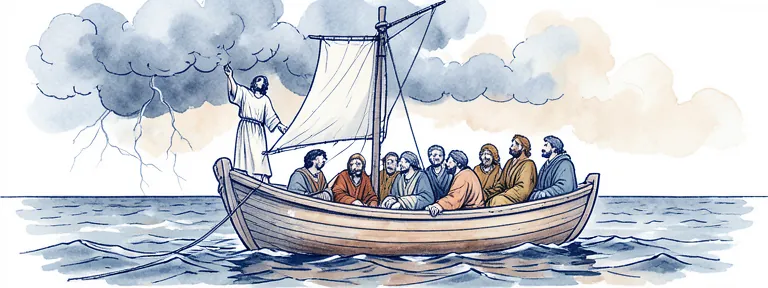
- The disciples ask, “Who then is this, that even the wind and the sea obey him?” (4:41). Demons know, Peter half knows, and the first person in the story to call him the Son of God is the centurion at the cross (15:39).
- The messianic secret
- Jesus repeatedly tells demons, the people he heals and even his own disciples to keep quiet (1:44, 8:30). The scholar William Wrede called this the messianic secret in 1901, and scholars still debate the reason for it.
- The suffering Son of Man
- Jesus says the Son of Man “came not to be served but to serve, and to give his life as a ransom for many” (10:45).
- Following Jesus
- Jesus tells anyone who would come after him to “deny himself, and take up his cross, and follow me” (8:34). Blind Bartimaeus, who “followed Jesus on the way” (10:52), does what the Twelve struggle to do.
At a glance
Most mentioned: Jesus Christ, Simon Peter, John the Baptist, John the Apostle, Pontius Pilate
Main places: Jerusalem, Galilee, Bethany, Jordan, Judea
In the Almanac: Denarius, Quadrans, Lepton, What things cost, Holy Week, Sabbath, Hours of the day, Watches of the night, Herodians, Scribes, The Twelve