Exodus
God rescues Israel from slavery in Egypt, binds them to himself by covenant at Sinai, and comes to live among them.
Overview
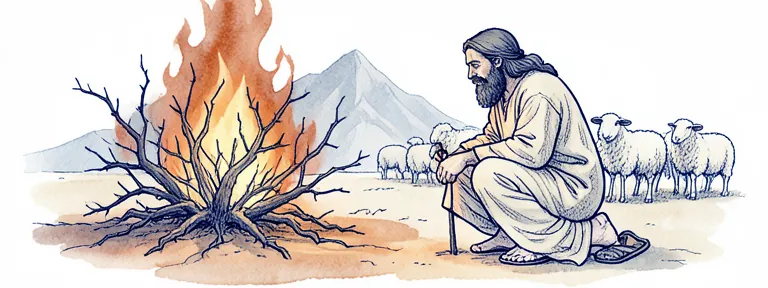
Exodus opens where Genesis left off, with Jacob’s family in Egypt, but centuries later and no longer welcome. A new Pharaoh enslaves them, and God, who “remembered his covenant with Abraham, with Isaac, and with Jacob” (2:24), calls Moses from a burning bush to bring them out. Ten plagues, the first Passover and the crossing of the sea take up the first fifteen chapters.
The rest of the book happens at or near Mount Sinai. God gives the Ten Commandments and a body of law, Israel agrees to the covenant, and within weeks worships a golden calf. Moses pleads for them, the covenant is renewed, and the book ends with the tabernacle finished and God’s glory filling it (40:34). Rescue leads to covenant, and covenant leads to God’s presence in the camp.
Author and date
Exodus, like the rest of the first five books, does not name its author, though it says Moses wrote down particular words and laws (17:14, 24:4).
Traditional view
Jewish and Christian tradition hold that Moses wrote the book, drawing on his own part in its events, with minor later editing. The date depends on when the exodus itself is dated (see Audience and setting).
Academic view
Most academic scholars see Exodus as combining older traditions with material from Israel’s priestly writers, reaching its final form in or after the Babylonian exile. The detailed tabernacle chapters and much of the law are usually assigned to those priestly writers. The Song of the Sea in chapter 15, by contrast, is often counted among the oldest poetry in the Bible.
Both views treat the exodus as the founding memory of Israel, the event the rest of the Old Testament keeps looking back to.
Audience and setting
Exodus was written for Israel, to tell them how they became a people and whose people they were. Its setting runs from the eastern Nile Delta, where the Israelites build the store cities Pithom and Raamses (1:11), through the wilderness to Sinai.
When the events took place is debated. 1 Kings 6:1 places the exodus 480 years before Solomon began the temple; taken literally, that gives a date around 1446 BC. The city name Raamses points many scholars to the 13th century, under Ramesses II. Others doubt that the story as told can be tied to one date at all.
Genre, and how to read it
Exodus moves from story to law and back again, and the law is part of the story: it is what Israel is rescued for. Chapters 20–23 hold the Ten Commandments and the “book of the covenant” (24:7), often considered the oldest collection of Israel’s laws.
The tabernacle is described twice, once as instructions (chapters 25–31) and once, almost word for word, as it is built (chapters 35–40). The repetition is deliberate. Between the two comes the golden calf, and the second telling shows the covenant restored and everything done exactly as God asked.
The ten plagues, round by round
- Pharaoh he hardens his own heart
- hardened it “was hardened”, no one named
- Yahweh Yahweh hardens it
| Round | Plague | Warned | Struck by | The magicians | Israel spared | Pharaoh’s heart | Pharaoh bargains |
|---|---|---|---|---|---|---|---|
| Round 1 | 1. Blood 7:14–25 | ☼At the water, in the morning 7:15 | Aaron’s rod 7:19–20 |
did the same thing7:22 |
not said | hardened Pharaoh’s heart was hardened7:22 |
— |
| 2. Frogs 8:1–15 | ⌂Go in to Pharaoh 8:1 | Aaron 8:5–6 |
did the same thing8:7 |
not said | Pharaoh he hardened his heart8:15 |
I will let the people go8:8 |
|
| 3. Lice 8:16–19 | —No warning 8:16 | Aaron’s rod 8:17 |
This is God’s finger8:19 |
not said | hardened Pharaoh’s heart was hardened8:19 |
— | |
| Round 2 | 4. Flies 8:20–32 | ☼At the water, early in the morning 8:20 | Yahweh 8:24 | not mentioned |
I will set apart in that day the land of Goshen8:22 |
Pharaoh Pharaoh hardened his heart this time also8:32 |
Go, sacrifice to your God in the land!8:25 |
| 5. Livestock 9:1–7 | ⌂Go in to Pharaoh 9:1 | Yahweh 9:6 | not mentioned |
of the livestock of the children of Israel, not one died9:6 |
hardened the heart of Pharaoh was stubborn9:7 |
— | |
| 6. Boils 9:8–12 | —No warning 9:8 | Moses, with ashes 9:10 |
couldn’t stand before Moses because of the boils9:11 |
not said | Yahweh Yahweh hardened the heart of Pharaoh9:12 |
— | |
| Round 3 | 7. Hail 9:13–35 | ☼Early in the morning, before Pharaoh 9:13 | Moses’ rod 9:23 | not mentioned |
Only in the land of Goshen … there was no hail9:26 |
Pharaoh hardened his heart, he and his servants9:34 |
I have sinned this time9:27 |
| 8. Locusts 10:1–20 | ⌂Go in to Pharaoh 10:1 | Moses’ rod 10:13 | not mentioned | not said | Yahweh Yahweh hardened Pharaoh’s heart10:20 |
Go now you who are men10:11 |
|
| 9. Darkness 10:21–29 | —No warning 10:21 | Moses’ hand 10:22 | not mentioned |
all the children of Israel had light in their dwellings10:23 |
Yahweh Yahweh hardened Pharaoh’s heart10:27 |
Only let your flocks and your herds stay behind10:24 |
|
| Tenth | 10. The firstborn 11:1–12:32 | ☾Announced: “About midnight” 11:4 | Yahweh 12:29 | not mentioned |
against any of the children of Israel a dog won’t even bark11:7 |
Yahweh Yahweh hardened Pharaoh’s heart11:10 |
Rise up, get out from among my people12:31 |
Exodus tells the plagues in three rounds of three. Each round opens with Moses meeting Pharaoh early in the morning (at the water, in the first two rounds), then going in to him, and then a plague with no warning at all. Pharaoh’s heart is hardened in every round; from the sixth plague on, the text says it is Yahweh who hardens it, as he said he would before the first (4:21, 7:3).
The tabernacle, told twice
Exodus describes the tabernacle twice. In chapters 25–31 God gives the pattern on the mountain; in 35–40 the people make it, often in the same words, and the two sections together fill 38% of the book. But the order changes. The command starts with the ark at the centre and works outward to the court; the making starts with the tent itself and works inward, and leaves the priests’ garments to the end.
Bars are verses in each account: the command gives these parts 162 verses and the making 111. The making ends did according to all that Yahweh commanded Moses
(39:32), and near the book’s end Yahweh’s glory filled the tabernacle
(40:34). The Almanac draws the tabernacle in plan beside Solomon’s temple (The tabernacle).
Outline
Out of Egypt (1–15)
- 1:1–2:25 Slavery, and the birth of Moses — A new Pharaoh, the midwives, a basket in the Nile
- 3:1–4:31 The burning bush — Moses is called, and God gives his name
- 5:1–11:10 Moses and Pharaoh — “Let my people go,” and the plagues
- 12:1–15:21 Passover and the sea — The first Passover, the departure, the Song of the Sea
Through the wilderness (15–18)
- 15:22–18:27 Water, manna and quail — The first complaints, the first battle, Jethro’s advice
At Sinai (19–40)
- 19:1–24:18 The covenant — The mountain, the Ten Commandments, the book of the covenant
- 25:1–31:18 The tabernacle planned — The ark, the tent, the priests and their garments
- 32:1–34:35 The golden calf — Rebellion, Moses’ plea, the covenant renewed
- 35:1–40:38 The tabernacle built — Made as instructed, and filled with God’s glory
Key themes
- The God who hears
- The story turns when God hears Israel’s groaning and remembers his promise to their fathers (2:24), picking up the covenant from Genesis.
- The name
- At the bush God names himself “I AM WHO I AM” (3:14), and after the golden calf he describes himself as “a merciful and gracious God, slow to anger, and abundant in loving kindness and truth” (34:6), words the rest of the Old Testament repeats.
- Rescue
- The exodus becomes Israel’s picture of salvation: the Ten Commandments begin not with a rule but with “I am Yahweh your God, who brought you out of the land of Egypt” (20:2).
- Covenant
- At Sinai Israel is called to be “a kingdom of priests and a holy nation” (19:6). The Covenants page follows the Mosaic covenant from here.
- Presence
- The book ends not with arrival in the land but with God living among his people, his glory filling the tabernacle (40:34).
At a glance
Most mentioned: Moses, Jacob (Israel), Aaron, Pharaoh (of the Exodus), Jethro
Main places: Egypt, Mount Sinai, Nile, Holy Place, Amalek
Covenants made here: The Mosaic Covenant
In the Almanac: Span, Sabbath day's journey, Ephah, Omer, Hin, Shekel, Talent, Beka, Gerah, Pieces of silver, What things cost, The Hebrew year, Nisan, Passover, Sabbath, Cherubim, Amalekites, Urim and Thummim, Ephod, Ark of the covenant, Tabernacle, The name YHWH