2 John
A short note from the elder urging a church to keep loving one another and to refuse hospitality to teachers who deny that Jesus Christ came in the flesh.
Overview
2 John is one of the two shortest books in the Bible, short enough to fit on a single sheet of papyrus. “The elder” writes “to the chosen lady and her children” (1:1), glad to have found some of them “walking in truth” (1:4), and repeats the command they had “from the beginning, that we love one another” (1:5).
Then comes a warning. The elder writes that “many deceivers have gone out into the world, those who don’t confess that Jesus Christ came in the flesh” (1:7), and anyone who arrives without this teaching should not be taken into the house (1:10). He closes by saying he would rather speak “face to face” than write with paper and ink (1:12).
Author and date
The writer calls himself only “The elder” (1:1), a title for a senior church leader.
Traditional view
Tradition identifies the elder with John the apostle, author of the Gospel and 1 John, by then an old man with authority over churches in the Roman province of Asia, in what is now western Turkey.
Academic view
Many scholars think the elder was a leader in the churches linked with John, but not the apostle himself. Some identify him with John the Elder, whom Papias, an early 2nd-century bishop, seems to distinguish from the apostle. The language is so close to 1 John that most think the same person wrote both.
Both views tie 2 John closely to 1 John and see both letters facing the same false teaching.
Audience and setting
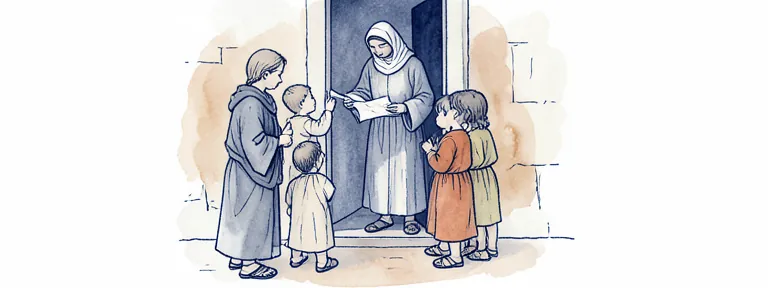
The address “to the chosen lady and her children” is most often read as a church and its members, with “your chosen sister” (1:13) as the church where the elder is. Some read it as a letter to an individual woman and her family. Either way, the setting is a network of house churches that depended on travelling teachers, and the elder is telling them whom to welcome.
Genre, and how to read it
Read it alongside 1 John, whose themes it compresses: truth, love, the command from the beginning and the confession that Jesus came in the flesh. The word truth appears five times in the first four verses.
The instruction not to receive a false teacher (1:10–11) concerned hospitality. In the early church, taking in a travelling teacher meant supporting and endorsing his work. Some readers take the verses as a call to shun anyone who disagrees. Many interpreters limit them to hosting and funding teachers who deny that Jesus came in the flesh.
The shortest books
3 John is the shortest book in the Bible: 219 Greek words, about a hundredth of Jeremiah’s 21,976. 2 John has fewer verses (13 to 14) but more words. Both are personal notes from a writer who calls himself the elder, each short enough for one sheet of papyrus. Obadiah is the shortest book of the Old Testament, and Philemon the shortest of Paul’s letters.
- 3 John 219 words 14 verses
- 2 John 245 words 13 verses
- Obadiah 292 words 21 verses
- Philemon 335 words 25 verses
- Jude 457 words 25 verses
- Nahum 562 words 47 verses
- Haggai 601 words 38 verses
- Titus 658 words 46 verses
- Habakkuk 672 words 56 verses
- Jonah 688 words 48 verses
- Zephaniah 769 words 53 verses
- 2 Thessalonians 822 words 47 verses
Words in the site’s Hebrew and Greek. A Hebrew word often carries a prefix or a suffix that English writes as a separate word, so the Old Testament books count a little short against the New. Verses are as the WEB numbers them; some Bibles give 3 John fifteen.
Outline
- 1:1–1:3 Greeting — The elder to the chosen lady
- 1:4–1:6 Walk in love — The command from the beginning
- 1:7–1:11 Beware of deceivers — Do not welcome those who deny Jesus came in the flesh
- 1:12–1:13 Closing — Hoping to speak face to face
Key themes
- Truth
- The elder loves the church “in truth” (1:1) and rejoices to find its children “walking in truth” (1:4).
- Love
- “This is love, that we should walk according to his commandments” (1:6).
- The teaching of Christ
- “He who remains in the teaching has both the Father and the Son” (1:9).
At a glance
Most mentioned: Jesus Christ