Philemon
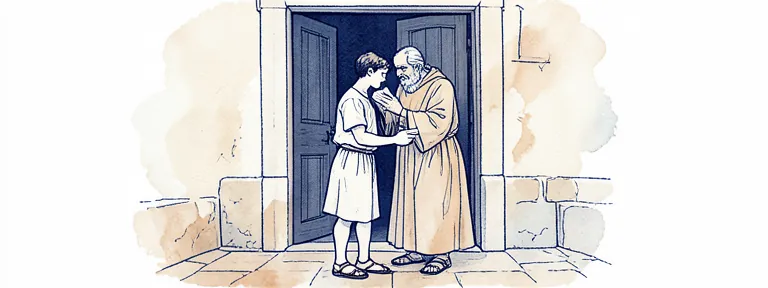
Paul sends Onesimus back to Philemon and asks him to receive him “no longer as a slave, but more than a slave, a beloved brother.”
Overview
Philemon is the shortest of Paul’s letters, a single page written from prison to a Christian householder in whose home a church met (1:2). It concerns Onesimus, Philemon’s slave, who has come to Paul and become a believer through him: “my child Onesimus, whom I have become the father of in my chains” (1:10). Paul is sending him back.
The letter is a careful and tactful appeal. Paul says he could command but would “rather appeal to you” for love’s sake (1:9). He plays on Onesimus’ name, which means “useful”: he “once was useless to you, but now is useful to you and to me” (1:11). He offers to cover any debt “with my own hand” (1:19). He suggests the separation may have happened “that you would have him forever” (1:15), and trusts that Philemon “will do even beyond what I say” (1:21).
Author and date
The letter is from Paul, “a prisoner of Christ Jesus,” and Timothy (1:1). It is among the letters almost all scholars accept as Paul’s.
Scholarly consensus
Philemon names most of the same companions as Colossians (1:23–24), and the two are traditionally placed in the same imprisonment. Rome, around AD 60–62, is the traditional setting. Many scholars prefer Ephesus, around AD 54–55. It is much nearer Colossae, which would suit Paul’s request for a guest room (1:22). Caesarea has also been proposed.
The letter does not say why Onesimus left. The traditional reading is that he ran away, perhaps after stealing (1:18). Others suggest that after a quarrel he went to Paul, a friend of his master, to ask Paul to plead for him, or that Philemon had sent him to help Paul. Readers also differ on what Paul asks: a welcome and forgiveness, Onesimus’ freedom, or his return to serve Paul (1:13–14).
Audience and setting
Philemon lived in Colossae, as Colossians 4:9 implies when it calls Onesimus “one of you.” He was wealthy enough to own slaves and host a church, and owed his own faith to Paul (1:19). The letter is also addressed to Apphia, perhaps his wife, to Archippus and to the church in his house (1:2).
Genre, and how to read it
Read Philemon aloud; it was meant to be heard by the whole house church. Paul builds the appeal with care. He opens with praise for Philemon’s love (1:7), waits until 1:10 to name Onesimus, and calls him “my own heart” (1:12).
Philemon has a long and troubled place in debates about slavery. The letter does not condemn slavery as an institution, and defenders of slavery in the 19th century cited Paul’s return of a slave to his master. Abolitionists pointed to the call to receive Onesimus as “a beloved brother” (1:16) as undermining slavery from within. Early in the second century, the church leader Ignatius of Antioch mentions a bishop of Ephesus named Onesimus. Whether he is the same man is unknown.
Paul’s letters, longest first
The New Testament does not put Paul’s letters in the order he wrote them. It puts them in two runs, letters to churches and then letters to individuals, and within each run the longest comes first. Measured in the site’s Greek text, only one letter breaks the pattern.
- To churches Romans to 2 Thessalonians
- Romans 7,100 Greek words
- 1 Corinthians 6,820 Greek words
- 2 Corinthians 4,469 Greek words
- Galatians 2,228 Greek words
- Ephesians 2,419 Greek words
- Philippians 1,630 Greek words
- Colossians 1,575 Greek words
- 1 Thessalonians 1,473 Greek words
- 2 Thessalonians 822 Greek words
- To individuals 1 Timothy to Philemon
- 1 Timothy 1,588 Greek words
- 2 Timothy 1,237 Greek words
- Titus 658 Greek words
- Philemon 335 Greek words
- After the thirteen names no author
- Hebrews 4,955 Greek words
Galatians (2,228 Greek words) stands before the longer Ephesians (2,419), and it is shorter by letters too (11,082 against 11,989), so it is not a matter of how words are counted. In the WEB’s English, Galatians comes out a little longer, so the exception only shows in Greek. Nothing in the letters explains the order; it belongs to the collection, not to the letters themselves.
Greek words counted in the Nestle 1904 text the site uses. Hebrews, which does not name its author, comes after the thirteen that name Paul, though it is longer than all but two of them.
Outline
- 1:1–1:3 Greeting — To Philemon, Apphia, Archippus and the church in the house
- 1:4–1:7 Thanksgiving — Philemon’s love and faith
- 1:8–1:22 The appeal for Onesimus — Useless and useful, a brother, “put that to my account”
- 1:23–1:25 Greetings — From Epaphras, Mark, Aristarchus, Demas and Luke
Key themes
- Brothers in Christ
- Onesimus returns “no longer as a slave, but more than a slave, a beloved brother” (1:16).
- Appeal over command
- Paul has “all boldness in Christ to command” (1:8), yet chooses to ask, so that Philemon’s goodness would be “of free will” (1:14).
- Reconciliation
- Paul stands between the two men and takes on any debt himself, telling Philemon to “put that to my account” (1:18).
- Partnership
- “If then you count me a partner, receive him as you would receive me” (1:17).
At a glance
Most mentioned: Jesus Christ, Paul, Apphia, Archippus, Aristarchus